
Chapter 13 · 1945–1955
What Came Back
June 1945 and after
The aircraft is dismantled before he can take souvenirs. Sam reopens the field, then dies. Frank goes back to a butcher’s apron, and a commercial ticket he still renews.
A synthetic reading of this chapter is in the bar at the top. It will keep playing while you move through the book. The text below is the transcript. The voice’s place on the page is marked as it reads.
13.1
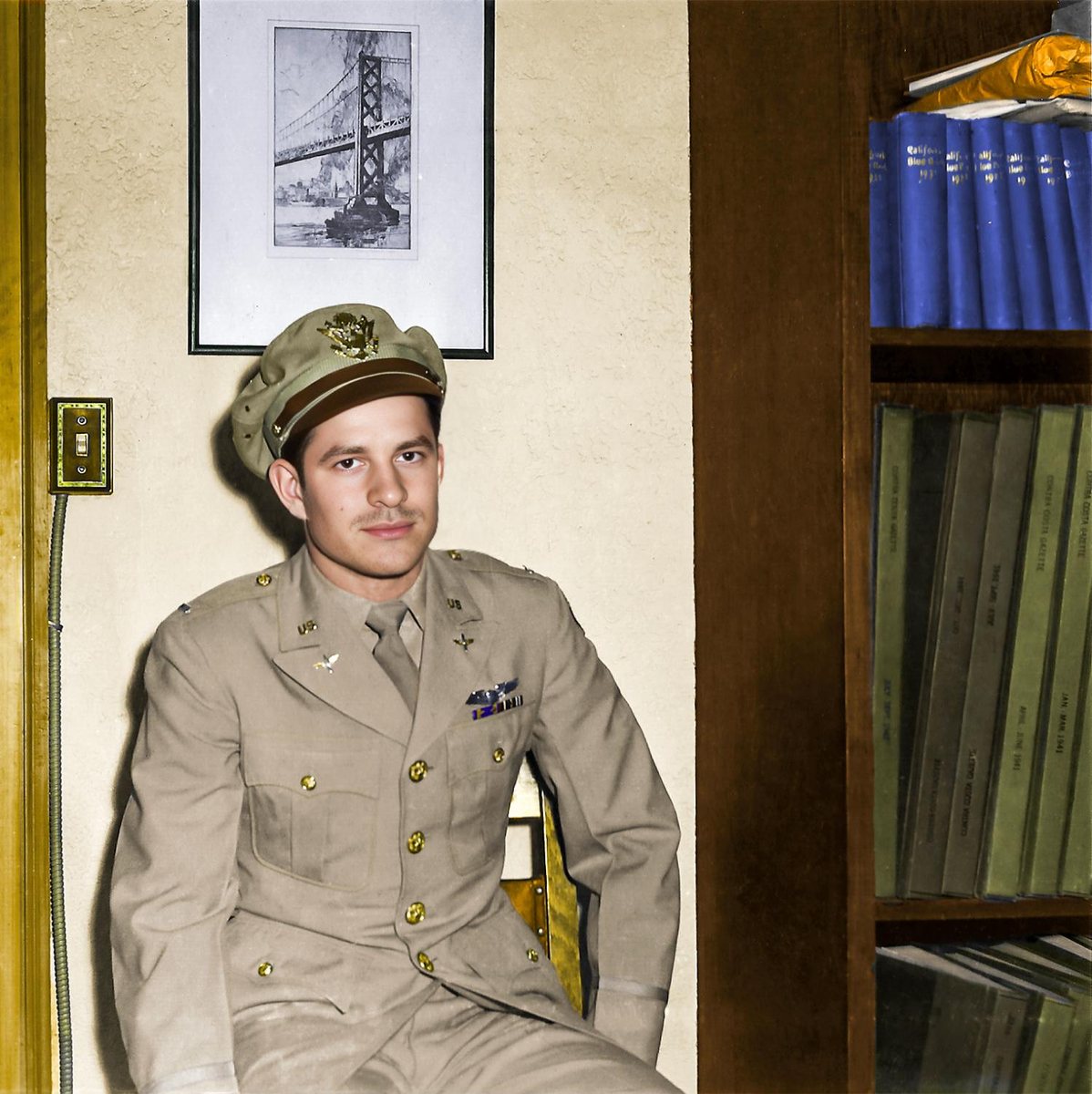
The Spirit of Martinez left England for the last time on June 21, 1945, landing at Bradley Field, Connecticut, with the crew that had flown her through the final months of the war in Europe. Frank Calicura came home a first lieutenant with a War Department tally-out receipt for his sidearm and ammunition, a pay and allowance voucher, and a Certificate of Service that reduced two and a half years to a handful of dates and a rank.
That certificate survives in the collection, and it says considerably more than the summary above allows. It gives his rank at separation as First Lieutenant, Air Corps, Army of the United States, serial number 0-828662; his civilian occupation as butcher and meatcutter; and his military occupational specialty as Pilot (1091). It credits him with three battle stars — Central Europe, Ardennes, and Western Europe — the first two by official Army certificate and the third by his own official claim, a distinction the form itself preserves without explaining further. None of the three appears elsewhere in this book. It records his departure from the continental United States on December 18, 1944, and his arrival in England on January 6, 1945 — the date already corrected in Chapters 7 and 8, where this book had previously given, without a document behind it, the first of the month.
The certificate also documents a stretch of Frank Calicura's service this book had not, until now, been able to account for at all. His organization at the time of separation was not the 95th Bomb Group but the 207th AAF Base Unit, Deming Army Air Field, New Mexico — a stateside posting that placed him roughly two thousand miles from Martinez for some part of the five months between his return to the United States on June 21, 1945, and his relief from active duty on November 12, 1945.
A transfer order fills in one piece of that gap. Special Orders Number 75, Headquarters Sioux Falls Army Air Field, Sioux Falls, South Dakota, dated 14 August 1945, releases First Lieutenant Frank J. Calicura, serial 0828662, from assignment to the 335th Bomb Squadron, 95th Bomb Group — his own combat squadron, still carried as his organization of record more than seven weeks after he had left England — and transfers him in grade to Deming Army Air Field, New Mexico, with property, on or about August 16, 1945, to report there for duty (family collection). The order places him at Sioux Falls sometime before mid-August, a stop this book has not otherwise documented, and it is the first direct evidence of how he actually got from the East Coast to New Mexico: not directly, but by way of South Dakota. What he did at either stop, and how long he had been at Sioux Falls before the transfer, go unrecorded. Separation itself was processed closer to home, at March Field, California, but still not in Martinez. Frank's own signature closes the separation form; John M. Guthrie, Second Lieutenant, Air Corps, signed as the officer supervising his separation.
One further document closes out the paper trail nearly two years later. On April 17, 1947, the War Department's Adjutant General's Office sent Frank — along with, by the letter's own address line, every other officer who had served in the war — a form letter over the signature of Major General Edward F. Witsell, forwarding a commission in the highest rank he had attained. The letter is explicit that this did not constitute a new appointment, only formal evidence of a rank already earned, "forwarded to you with the grateful thanks and deep appreciation of the War Department for your services." It is the last document from the Army anywhere in this collection.
What happened to the aircraft on landing is recorded only in Joyce’s own account, given decades later. Ray Taylor and other Martinez men had tried to reach Eighth Air Force commander Jimmy Doolittle through his peacetime employer, Shell Oil, hoping the ship could be brought somewhere townspeople could see her. The War Department had other plans. “The saddest part Frank said, was when he had to fly it back,” Joyce told the News-Gazette. “When he landed, before he got his stuff off, they had dismantled it and towed it away. He said if he had known, he would have gotten souvenirs.” By the time the Chamber of Commerce and the town’s service clubs held a luncheon at Armando’s to honor Frank and the other returning servicemen — a dollar twenty-five a plate, with a fountain pen presented to him in appreciation of the city’s obligation for naming his ship after it — the airplane the luncheon was partly about had already been broken up.
The aircraft did not come home with him for long. She went on to South Plains, Texas, that same summer, and was sold for scrap at Kingman, Arizona, on December 19, 1945 — six months after carrying Frank Calicura across the Atlantic for the last time, and not quite eleven months after she had first been assigned to his squadron. The 95th Bomb Group itself, which had flown from Horham for the whole of Frank’s combat tour and most of two years before it, is credited with something on the order of three hundred and twenty combat missions from that airfield — the exact figure varies by a few missions depending on which record is consulted, which is itself consistent with everything else the record shows about how bomb groups counted their own history.
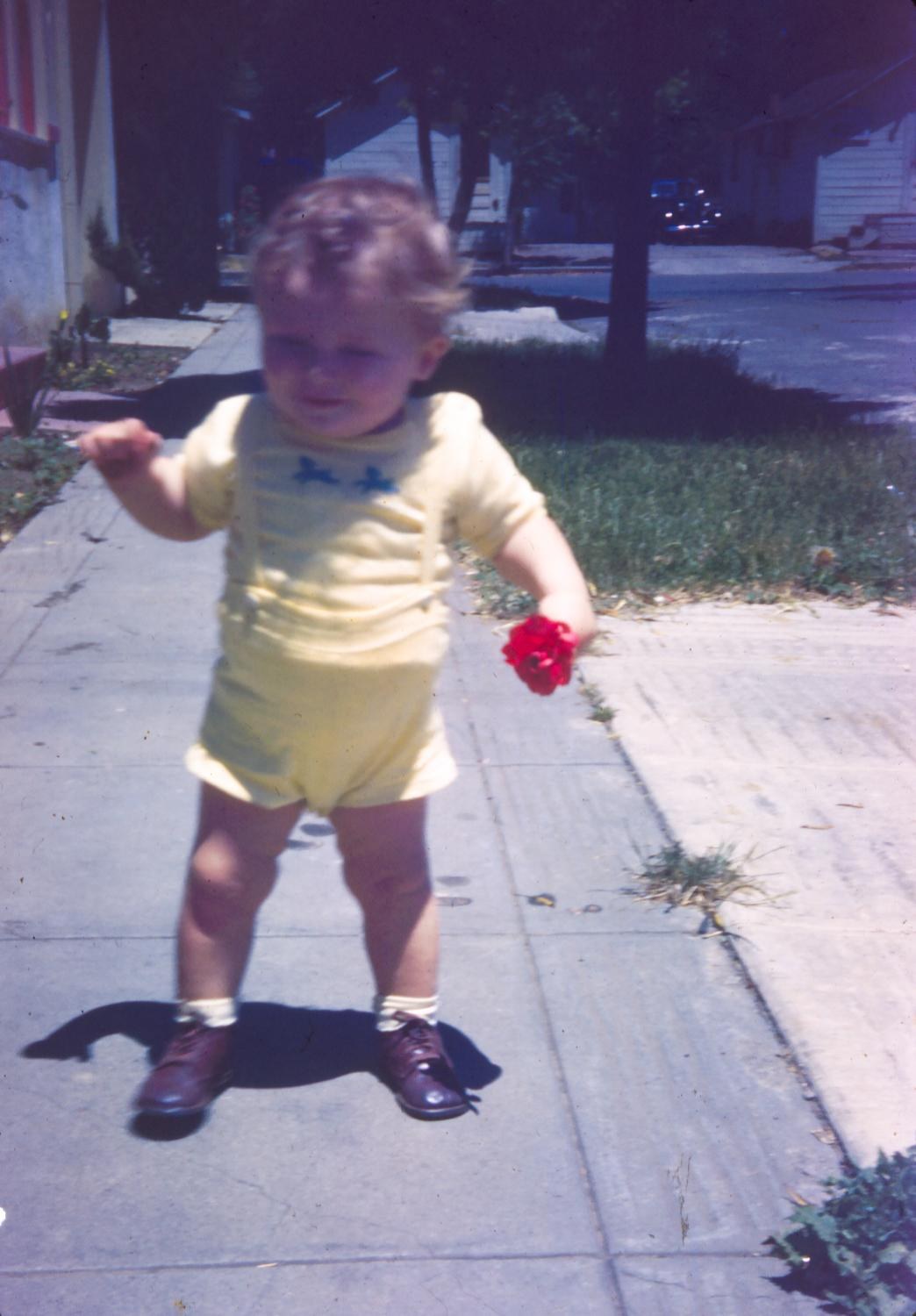
Frank returned to Martinez, to Joyce, to a son he had a photograph of before he had held him, and eventually to a butcher’s apron and a shop on Main Street with his brother Bill. He also returned with a commercial pilot’s rating and an instructor’s endorsement, recommended in writing by the last man to command the group he had flown with. The field where he had first been taught to fly was still shut, requisitioned out of civilian use since 1941. His brother was already working to get it back.
See the platePlate 104See the platePlate 49See the platePlate 51See the platePlate 56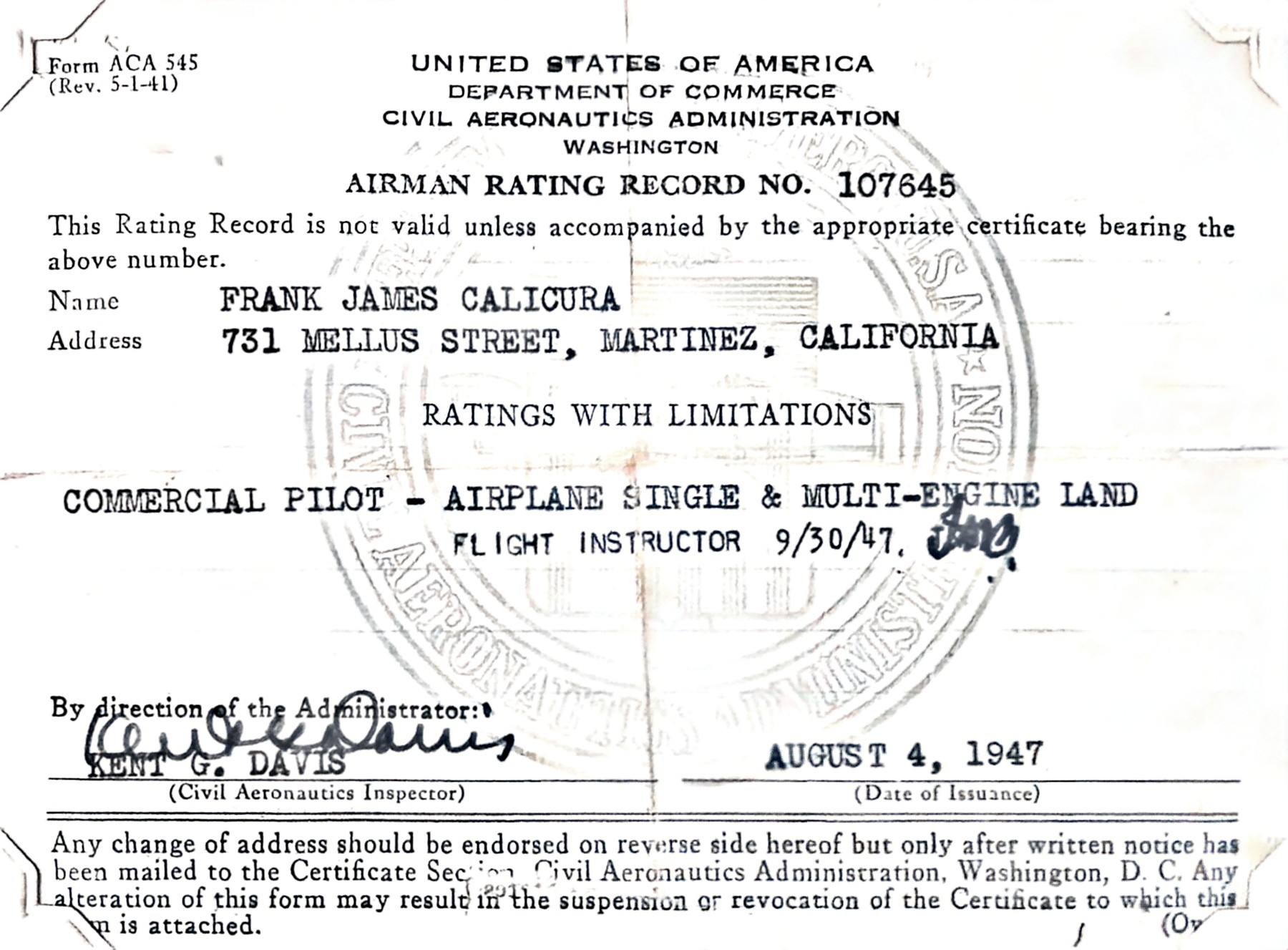
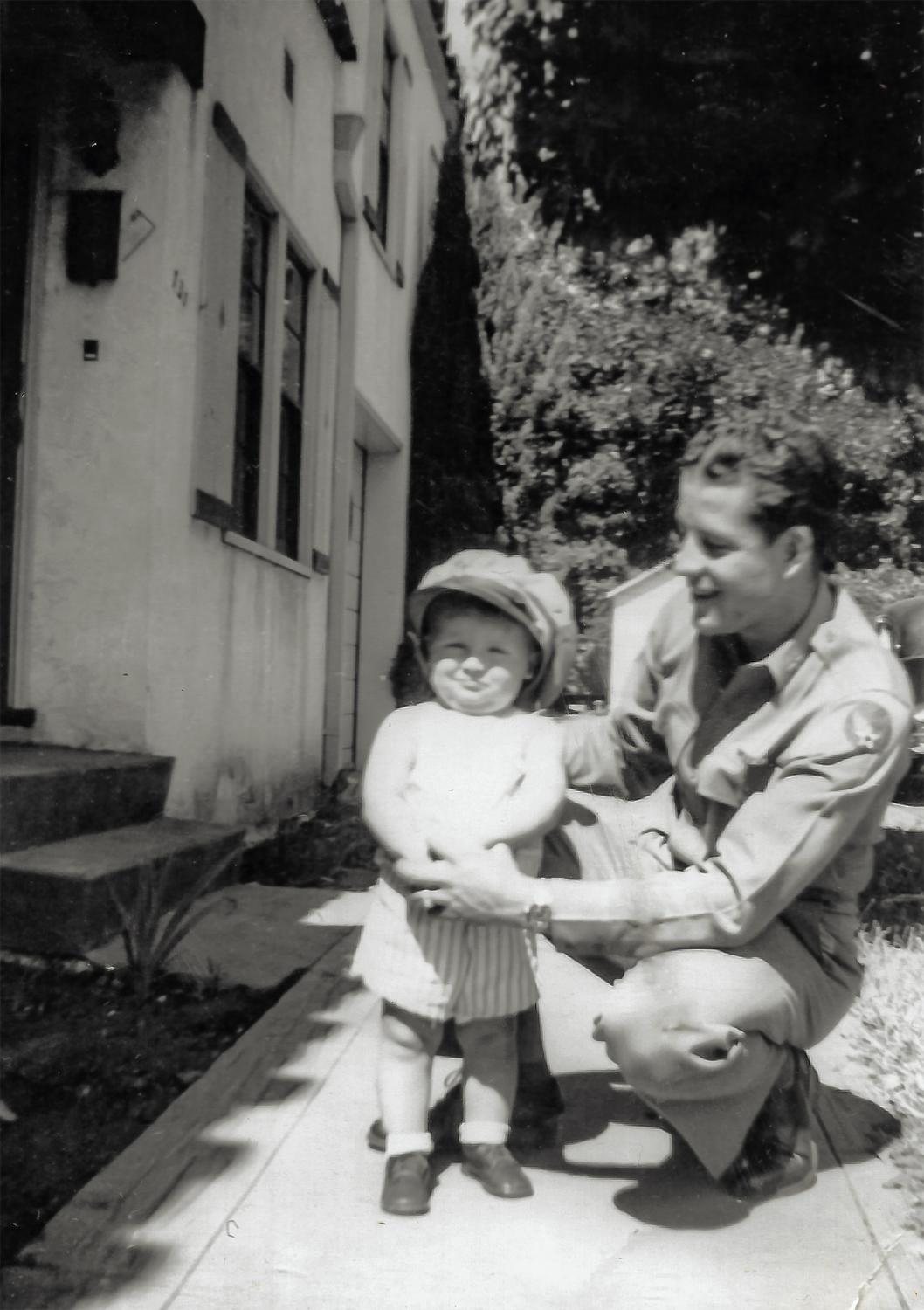

The pay and allowance voucher survives as an actual card, dated June 15, 1945 — six days before the Spirit left England for the last time — and it reduces the return itself to the same arithmetic that had governed everything before it. Base pay and longevity, $183.33. Flying pay, $91.67. Rental allowance, $75.00. Subsistence, $42.00. A total of $392.00 a month, a $200 allotment, $6.60 in insurance, a deduction for field rations. Joyce B. Calicura is listed as a dependent at 731 Mellus Street; beneath her, a second line notes that evidence of dependency for his mother had been filed under a separate voucher, a second claim on the same pay working through the system on its own schedule. It is not a different kind of document from the shipping ticket that itemized his flying gear by part number, or the memorandum that itemized his missions by general order. It is the same clerical habit turned toward the same man at the other end of the war: everything about Frank Calicura the Army thought worth recording, it recorded as a number.
13.2
Sam Calicura Jr. died on March 2, 1946, at thirty-nine or forty, not quite a year after Frank came home.
This is a correction to an earlier stage of the research. The family’s collection dates his death to December 7, 1945 — the fourth anniversary of Pearl Harbor — and an earlier draft of this chapter built directly on that date, reading a meaning into it that the actual record does not support. Cemetery burial records, sourced independently of the family’s own compilation, give the correct date as March 2, 1946, and a photograph of the Martinez News-Gazette’s edition from that same day is preserved alongside the record. The collection’s December date appears to be simply mistaken — the kind of error found in that same compilation before, corrected before, and corrected again here.
There is no anniversary to make of March 2, 1946. It was, as far as the surviving record shows, an ordinary late-winter day.
This is a second correction, and it goes the other direction from the first one. An earlier stage of the research assumed Sam Calicura Jr. died without seeing his brothers fly again. He did not. A Gazette article from early 1946 records the Martinez Airport reopening under lease to Sam Calicura and Charlie Beatie, its landing-area designation obtained from the CAA the week before, with Ralph Donohue of Martinez — recently released from the Navy — as a third partner. The field was limited to private fliers, with storage, repair, and a sales agency for a civilian airplane firm; no instruction this time, only operation. Sam Calicura’s three brothers, the paper noted, would run it with him: Frank, a first lieutenant discharged from the Army Air Corps, doing what flying the field required; Nick, out of the Navy Air Corps, in charge of repair; Bill, who had served in the Navy air corps’ ground forces, assisting both. That last description is the 1946 paper’s, and it does not match the wartime record set out in Chapter 4: an April 1944 Gazette item places Bill at Nashville, Tennessee, in the Army’s antiaircraft artillery, and his mother’s obituary that July calls him Corporal, a rank the Navy does not use. Two documents written during the war disagree with one written after it. The later paper is reproduced here as it stands, and the conflict is left open.
Sam Calicura Jr. died a few weeks into that arrangement, not at the end of a long wait to see it, but in the middle of actually running it. He had built the field in 1939, watched the war take it away in 1941, and lived to reopen it in 1946 with three of his own brothers standing beside him — the same brothers he had taught to fly there in the first place. He is the reason any of them ever flew at all, and for a handful of weeks at the start of 1946, he got to watch it work exactly the way he must have once imagined it would.
An independent source, found after this chapter was first drafted, confirms the date from outside the family’s own record entirely. A genealogical registry citing the California Death Index and the 1940 federal census gives Sam Calicura Jr.’s death as March 2, 1946, at Sunset View Cemetery in El Cerrito — the same date already established here through cemetery records and the Gazette’s own front page. The same source also supplies something the family’s collection had not: exact birth and death years for several of Sam’s siblings, most of them corroborating what this book already had — Nick (1908–2006), Dominic (1919–2008), Frank (1921–1962), William (1922–1986) — and one correction worth stating rather than absorbing silently. Antoinette, listed elsewhere in this book only as the Placerville aunt who took Jimmy Calicura in to work her family’s laundry business in 1963, appears here as Antoinette Florence Calicura Douvres, 1913–1996 — a daughter of Saverio and Angelina in her own right, not simply an in-law by marriage. She was already established in Placerville by the time of Sam’s death in 1946, seventeen years before her nephew arrived there. Jimmy’s move in 1963, in other words, was not a young man drifting to wherever work could be found. It was a family placement, an aunt taking in a brother’s son, in a town the family had already been living in for most of two decades.
Two smaller discrepancies surfaced by the same source are noted rather than resolved. It gives Angelina’s birth year as 1884, four years earlier than the approximately 1888 this book has used, derived from a 1928 Gazette article that put her age at forty at her sixteenth child’s birth. It gives Virginia’s birth year as 1925 against this book’s existing 1926. Neither conflict is large enough to argue past a single source in either direction, and neither is resolved here.
The field outlived him. A Contra Costa Gazette front page from April 1, 1947 — thirteen months after Sam’s death, its own headline given over to a missing Stinson and three men aboard — lists Charles Beatie as Martinez Airport’s manager and Ralph Donohue as his assistant, the same two men Sam had brought in as partners the year before, still running the place he had leased back into operation. A third name appears alongside them, new to the record: Lloyd Davis, a mechanic with his own garage business in Pleasant Hill. None of Sam’s brothers are mentioned. Whatever role Frank, Nick, and Bill had played in that first reopened season, by 1947 the field’s day-to-day operation belonged to Beatie and Donohue alone. That is not evidence the family had stepped away. A newspaper covering an aircraft in trouble near Quincy had no reason to name every man who worked the field, and did not.
13.3
The record is silent on exactly what happened to the family’s meat business in the years immediately after Sam Calicura Jr.’s death. What can be established is the shape on either side of that gap, not the gap itself.
By 1954, Frank and his brother Bill were running Calicura Bros. Meats out of space inside Martellacci’s grocery at Main and Castro, advertising rock cod, sliced bacon, hams, and steaks alongside Martellacci’s own produce and staples — a shared storefront, one family’s meat counter operating inside another’s store. The arrangement is dateable with some precision: a surviving flyer for a “Cupboard Sale” places Friday-Saturday specials on July 2–3 and a closure for July 4–5, a calendar pattern that matches 1954. Nothing in the collection documents when the Martellacci’s arrangement began, only that it was already running by then — leaving an undocumented stretch of roughly five years between Sam’s death in 1946 and the earliest date this book can independently confirm.
On July 22, 1955, the Gazette covered what came next: Frank, thirty-five, and Bill, thirty-four, preparing to leave Martellacci’s for their own renovated quarters at 700 Main Street, opening shortly after August 1. The article states that the two brothers had operated out of Martellacci’s “for the past four years” — placing the start of that arrangement at approximately 1951, five years after Sam’s death, not immediately following it. It traces the business back further still: the family, it states, had been in the meat trade thirty years by 1955, dating to roughly 1925, consistent with what this book has already established about the Star Meat Market where Frank himself had worked as a young man. It also states that Frank and Bill had taken over the shop from their brother Sam “following his death in 1947.” That date conflicts with the one already established in this book — March 2, 1946, confirmed independently through cemetery records, contemporary Gazette coverage, and a genealogical registry — and the conflict is noted rather than resolved. A reporter working nine years after the fact, from memory or an uncertain source, is a plausible explanation; it is not a documented one.
What the two dates agree on, regardless of which year is correct, is the sequence: Sam built the trade, died young, and his younger brothers carried it forward rather than letting it end with him. The “Thanks a million” notice that ran alongside the move, addressed to the shop’s customers and signed simply “Frank and Bill Calicura,” confirms the same expansion the article describes — a butcher’s counter growing into a store with a delicatessen, staples, and frozen foods, roughly a decade after Frank had come home from a war that had nothing to do with any of it.
See the platePlate 68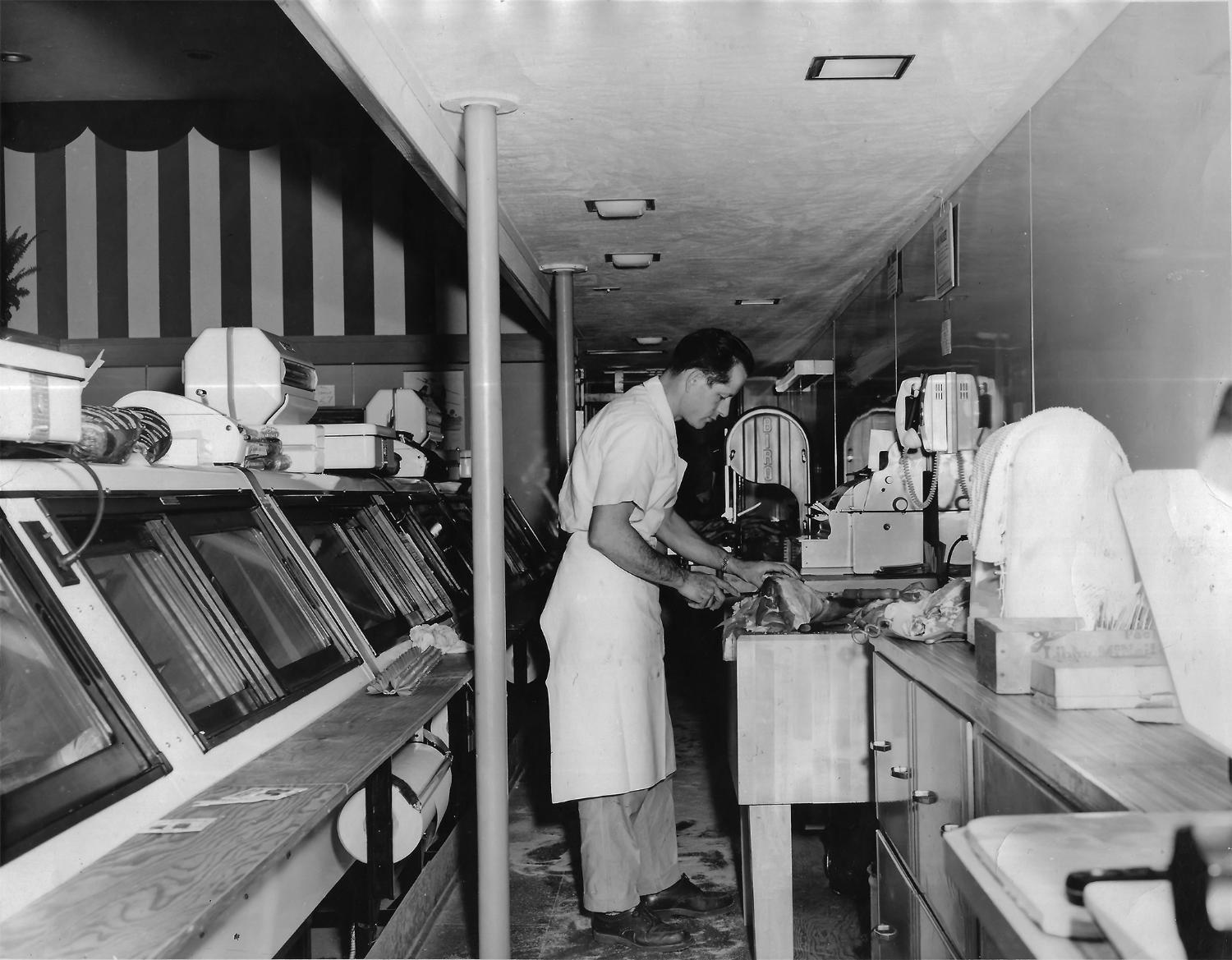
13.4
Billy Calicura played saxophone before he ever wore a butcher’s apron, and he did not stop when he put one on. A newspaper advertisement from the State Theater in Martinez, undated but placed by its own bill — a screening of “Meet Danny Wilson,” released in 1951 — to approximately that year, promotes a Friday-midnight “Jive Jam Session” on the theater’s stage: Russ Arno singing, Frank Meyers on bass, Benny Marcella at the piano, C. C. Pinkston on drums, and, billed with his own box on the page, “Billy Calicura and His Hot Sax.”
Nothing else in the collection documents this side of Billy’s life in any detail — how often he played, how long the arrangement with the State Theater ran, or whether it continued once Calicura Bros. Meats took on its later shape. What the clipping confirms is narrower: the family’s musical thread, elsewhere carried by Frank’s trombone, ran through Billy as well, in public, on a marquee, in the same years he was learning the trade at his brothers’ side.
13.5
The nine men who signed the same shipping ticket in December 1944 and flew the Spirit of Martinez through the final months of the war did not stay together afterward. What the record preserves of their later lives arrives mostly from outside the family’s own collection.
John R. Barnes earned a doctorate at Penn State and spent much of his career as Director of Pathology at DuPont’s Haskell Laboratory, retiring in 1982. He died in Wellsboro, Pennsylvania, on June 2, 2011, at eighty-nine. A later compilation in the Imperial War Museums’ American Archive identifies him as navigator of the Spirit of Martinez; the biography on that page was supplied in part by his son. It is not a paper issued at Horham. Victor G. Probst returned to England to study architecture at the University of London, then co-founded a Texas firm that designed hospitals — Houston’s St. Luke’s and Texas Children’s among them. The same man who had spent 1945 in the nose of a B-17 spent the next three decades designing places built to keep people alive.
Marvin L. Markus went home to Kingfisher, Oklahoma, married Dorothy Ellen O’Niel in July 1945 — a marriage that lasted sixty-nine years; she died December 16, 2014 — and built an automotive-electric business that expanded across several towns before he retired in 2003. He died March 30, 2015, at eighty-nine, and was buried at Kingfisher County Memorial Cemetery with full military rites. The Bartlesville Examiner-Enterprise obituary is the source of a number the family has carried: twenty-eight full bombing runs.
Earle F. Bogacki stayed in uniform for thirty-one years, rising to Chief Master Sergeant and serving through Korea and Vietnam. He married Emily “Lu” McGrath on May 3, 1952, later delivered rural mail in Greenville, Pennsylvania, and died on February 14, 2011, at ninety, buried with full military honors. Her 2020 obituary names him and confirms the rank. Dale S. Ernest went to West Virginia University, then to the Naval Ordnance Laboratory in Silver Spring, Maryland, where by January 1959 he held a patent for an automatic depth-correcting device for moored mines. That same year he appears in the family’s own slide index — a visit, a supper, an evening on the back step — before eventually returning to Silver Spring for good. He died in 2007. Robert J. Brown married in Manhattan in December 1947; the license is the last documented trace of him found. James A. Titus’s later record remains thin beyond the wartime clippings already cited. Robert E. Collins’s later life is otherwise thin in the record beyond the draft card and the shipping ticket already cited — a name, a seat, three mornings he was not in it, and nothing after that the family has been able to follow.
None of those later careers explains what the nine of them shared in a B-17 in 1945. The family kept what it kept — a visit, a name in a hospital firm, a patent clipped from a West Virginia paper — because it mattered enough to record.
13.6
Martinez, California — 1948
Three years after Frank came home, two sets of documents survive from the same year, and together they show a household still actively building rather than simply settled.
Frank's own Second Class Airmen medical certificate, issued by the Civil Aeronautics Administration and examined July 7, 1948, at 731 Mellus Street, lists no limitations. It is a routine renewal, not a milestone, but it confirms directly what §13.1 had only inferred from the commercial pilot's rating and instructor's endorsement he brought home in 1945: three years on, Frank was still an active, medically certified civil airman, not simply a veteran carrying a wartime credential he no longer used.
See the platePlate 105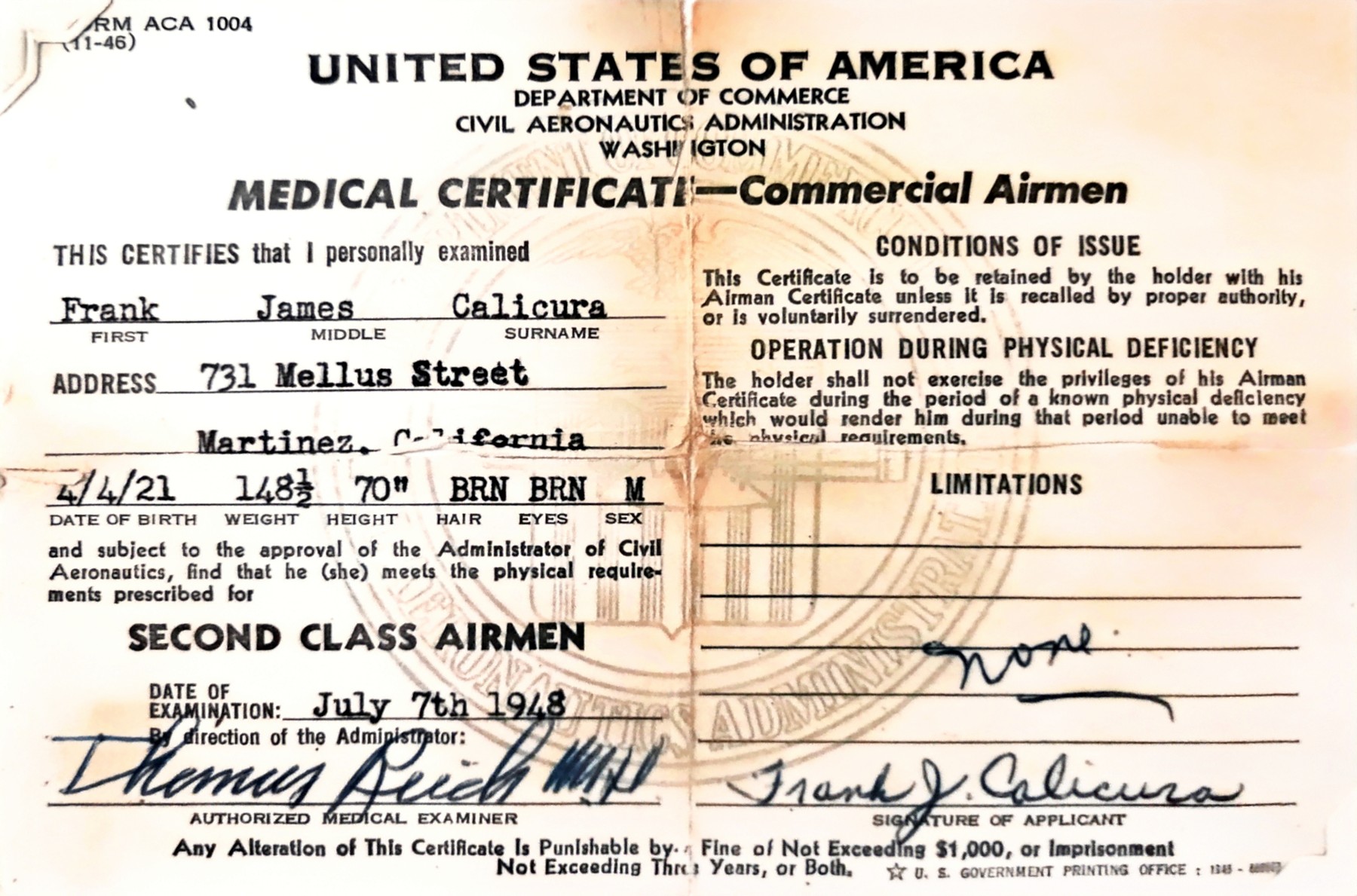

Joyce Calicura's own record from the same year documents something this book has not previously had occasion to record. On March 1, 1948, she was appointed Deputy Sheriff of Contra Costa County, badge number 72, under Sheriff James N. Long — a working appointment, not an honorary one, with her own signature and a right-index fingerprint on the reverse of the card. It expired January 2, 1951. Seven and a half months after that appointment, on October 15, 1948, the Federal Communications Commission issued her a Restricted Radiotelephone Operator Permit at San Francisco, authorizing her to operate licensed radiotelephone stations under FCC rules and regulations.
The collection does not state outright that the two credentials were connected — that the radio permit was obtained specifically for the deputy sheriff work, rather than for the family's continuing aviation activity, in which operating a station under FCC rule was an ordinary requirement of the era. Either explanation fits the timing equally well, and the collection does not choose between them.
What is not in question is a role for Joyce Calicura this book has otherwise had no occasion to document. In 1948, while raising a young son, she held a county badge, a federal radio operator's license, and a fingerprint on file with the Contra Costa Sheriff's Office — three credentials that, together, describe a working woman rather than simply the dependent named on Frank's own wartime paperwork.
Cite this
The Spirit of Martinez. What Came Back, Chapter 13. What a Family Kept.
https://www.spiritofmartinez.com/chapters/what-came-back
A note on sources