
Chapter 11 · March–April 1945
Borrowed Aircraft
March–April 1945
Martinez names a bomber. For two mornings the crew flies ships that are not theirs, while the Spirit sits at Horham with her cowlings off.
A synthetic reading of this chapter is in the bar at the top. It will keep playing while you move through the book. The text below is the transcript. The voice’s place on the page is marked as it reads.
These mornings also sit on the mission board.
11.1
The chapter that follows is about the break in that pattern, and about the airplane that carried their town’s name.
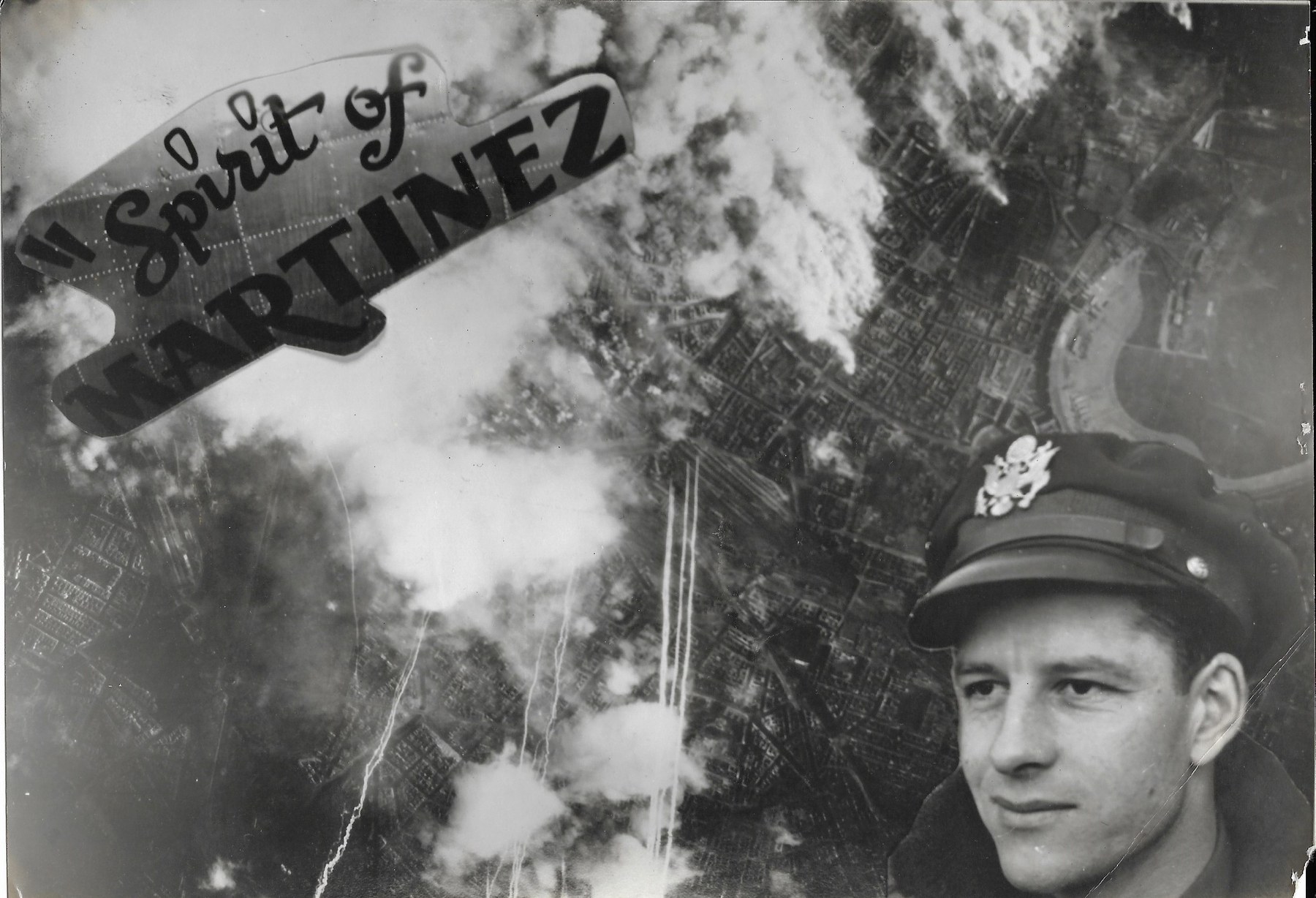
Mission sixteen was Hamburg, and the target was the Blohm+Voss shipyards — U-boat construction, still a priority target this late in the war because the submarine threat, though diminished, had not been eliminated. The family’s clipping, “Heavies Hit U-Boat Works,” matches the target. An aerial photograph in the collection shows smoke rising over the yards, the kind of image the Eighth Air Force produced by the thousands that spring to document what a mission had or had not accomplished.
See the platePlate 60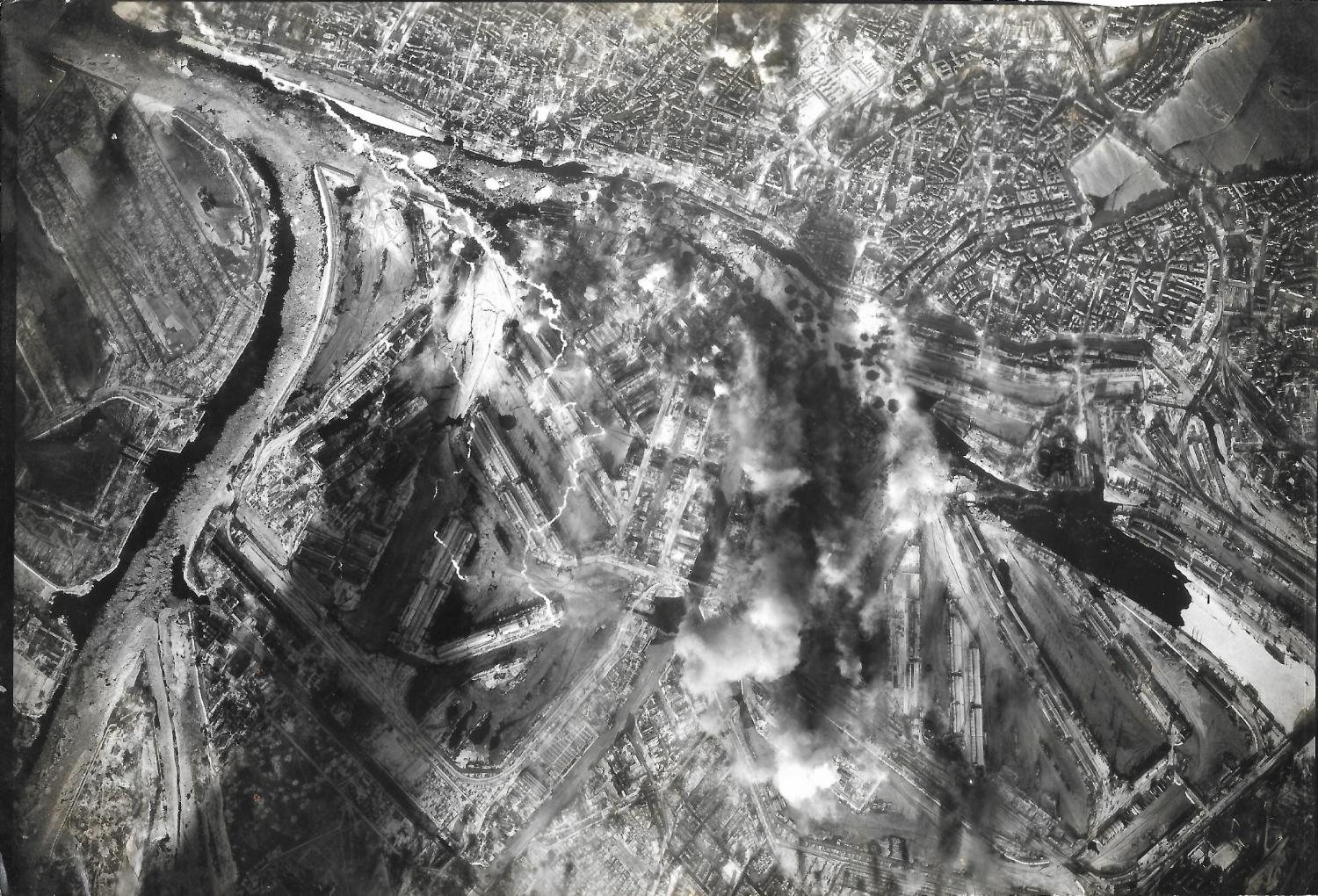

11.2
Two days later, mission seventeen struck the Luftwaffe airfield at Ahlhorn. That is where the crew record puts him. The family’s clipping kept against that page — “Few Enemy Planes Up, 22 KO’d” — names Ingolstadt, Fürth and Grafenwöhr, not Ahlhorn. The two records disagree. They are left in disagreement.
Fields like Ahlhorn had begun to host the first operational jet aircraft, the Me 262 and the Arado 234. Bomber crews at this stage mostly heard about jet encounters rather than fought them. The aircraft were too fast and too few to intercept a bomber stream in numbers that mattered.
11.2a
Between Ahlhorn and the week the Spirit went down for her engine change, the crew record shows six more missions.
March 23, Unna, the eighteenth. A dispatch on the Ruhr names the Unna-Dortmund yards among a dozen other targets.
March 24, Ziegenhain. The scrapbook page has not been found. A number in the sequence, and nothing else.
March 28, Hannover. The clipping is “1,250 Heavies Strike Tank, Gun Factories Near Hanover,” describing two tank plants and a factory making half-tracks hit in the city and at Hildesheim, with oil refineries at Misburg and Nienhagen and E-boat pens at Ijmuiden on the Dutch coast.
March 31, Zeitz. The scrapbook page has not been found. A wire report recovered from a newspaper archive rather than from the family records the raid on the synthetic oil plant alongside Brandenburg, Brunswick and the Halle freight yards.
April 3, Kiel, the first of two consecutive days.
April 4, Kiel again. The clipping is “Heavies Rock Kiel for 2nd Day, Pound Hamburg and Airfields,” which reports nine bombers and four fighters lost across the Eighth Air Force that day, and fifteen German aircraft claimed by escorting fighters, eleven of them jets.
No photograph, no letter, no mark of any kind setting any of the thinner mornings apart. They are dates in a run that, by early April, had gone on long enough that not every mission could be a story worth telling.
11.3
Martinez earned the right to name a bomber the way war bond drives usually earned such things: by exceeding a quota. The city put up eight hundred fifty-five thousand dollars toward its Sixth War Loan Drive target and doubled it, and the aircraft assigned in return was 44-6838, formally christened Spirit of Martinez in a ceremony that came well after the fact — by the time Frank stood under the nose for the photograph, with Col. Jack Shuck and Capt. David Olsson beside him, the crew had already flown the ship nine times under the name themselves. The Army caught up to what the men had already decided to call her. Olsson’s presence in that photograph was not simply official; the caption the family kept notes him as another Martinez man, standing in a field in Suffolk under a nose someone from his own town had painted.
See the platePlate 27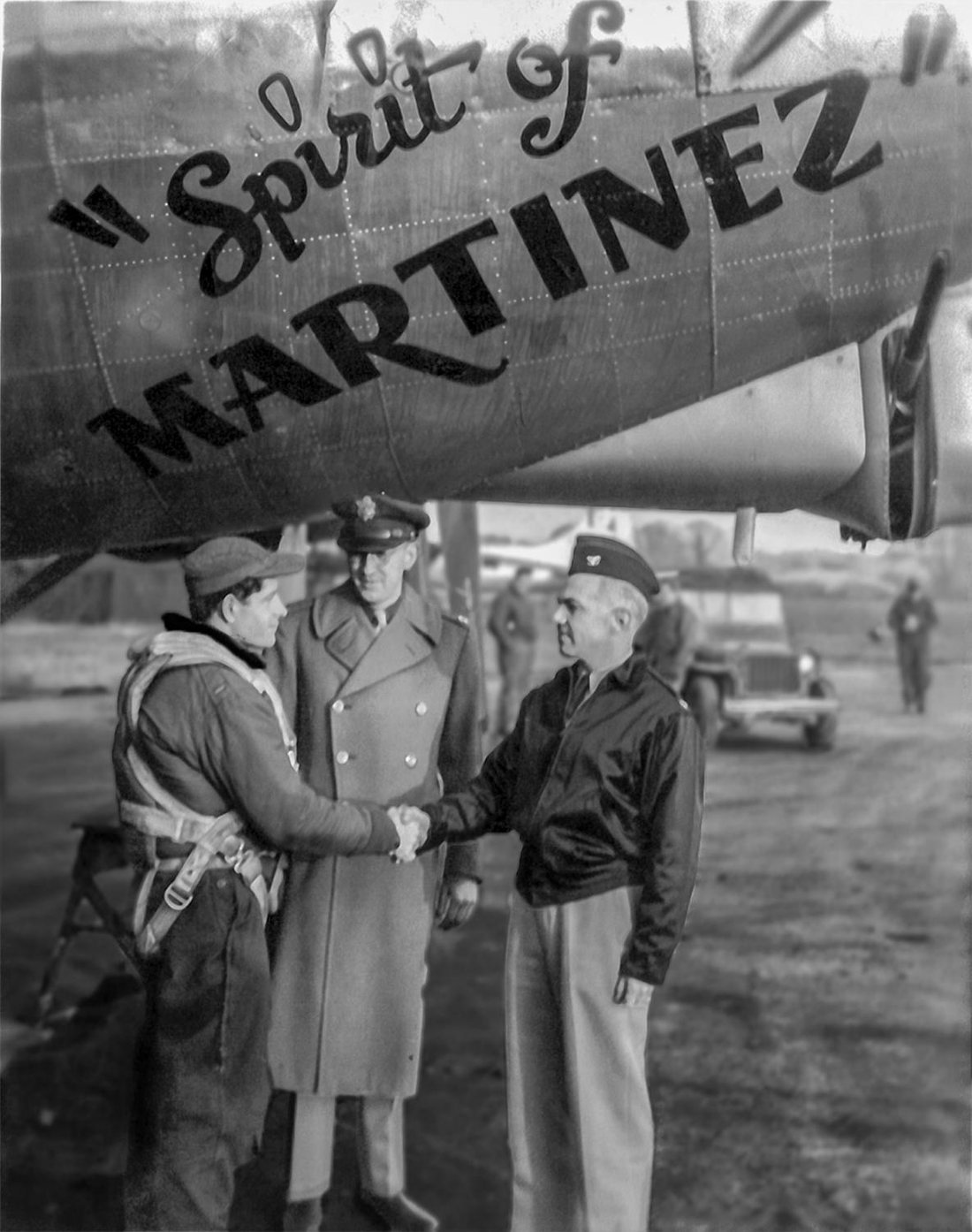

The Gazette put the name in type on February 22 — the same morning as Bamberg. Martinez Puts Name on Plane. War Finance Chairman Ray Taylor had received word from W. W. Crocker that a Superfortress had been provided through the last bond campaign. That is the B-29, not 44-6838. Several weeks earlier Taylor had addressed a public letter to Lieutenant Calicura. The paper still puts Sam at 515 Mellus. Training finished two months ago. The handshake under the nose came after nine missions. This is the hometown announcement of a name the crew had already decided to use.
See the platePlate 30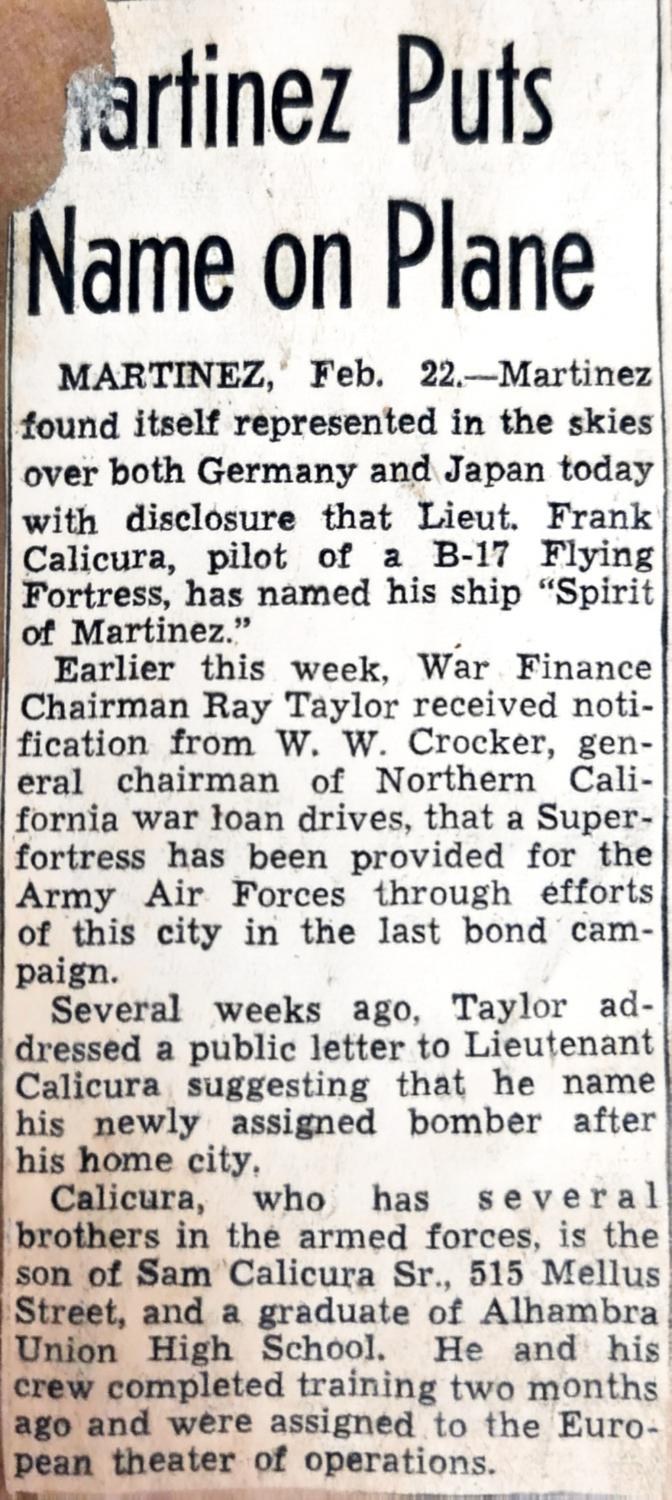

A retrospective feature published decades later in the News-Gazette, built on an interview with Joyce, fills in how the name reached Frank in the first place. That article is used carefully here and in Chapter 13. Its handling of the operational record is unreliable — it misstates where Frank formed his crew, inflates both his mission count and the aircraft’s, and describes him in 1944 as the father of two when his first son was two months old — and every such figure in this book comes from the orders and crew records instead. What the article carries that nothing else does is Joyce’s own memory of things she was present for, and the committee’s correspondence, which she kept. A widow’s account of what her husband told her about the day he landed is a different kind of evidence from a reporter’s grasp of how many missions he flew, and it is treated differently here. The surplus from the bond drive was meant to buy a B-29 to carry the city’s name; the War Finance Committee, chaired by Ray S. Taylor, learned instead that a newly commissioned local pilot was forming a crew, and wrote to him directly. The committee’s letter is quoted: “We learn from one of your brothers that you and your crew have completed all training and are awaiting assignment of a B-17.” Somebody, the letter went on, had suggested it would be wonderful if the city had one of its own boys piloting a ship bearing its name, “so it could watch the ship’s exploits with pride and hope and feel true community kinship with the pilot, ship and crew.” Frank agreed. When the aircraft was delivered, the article states, he and the crew chose the name themselves — which is consistent with the nine missions they flew under it before the Army held its ceremony.
The letter itself is in the collection. Addressed to Lieut. Frank Calicura, USA, somewhere in the Eastern U.S., awaiting assignment, and signed by the Martinez War Finance Committee and the Citizens of Martinez. The Sixth War Loan Drive had overrun an $815,000 quota; the Treasury said another $350,000 would buy a B-17 named City of Martinez. The paper asked him to put that name on his ship, and to let the town adopt “the whole ten or eleven of you.” This book has already carried $855,000 from a later account. The letter says $815,000. The paper asked for City of Martinez. The men painted Spirit. Eleven is the hometown paper’s crew, here as it was on the East Coast clipping.
See the platePlate 29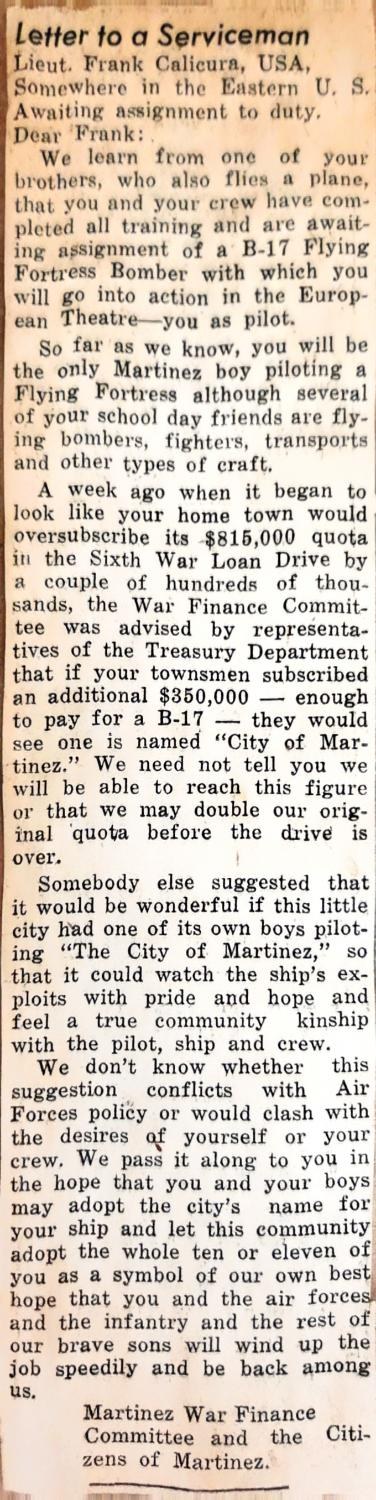

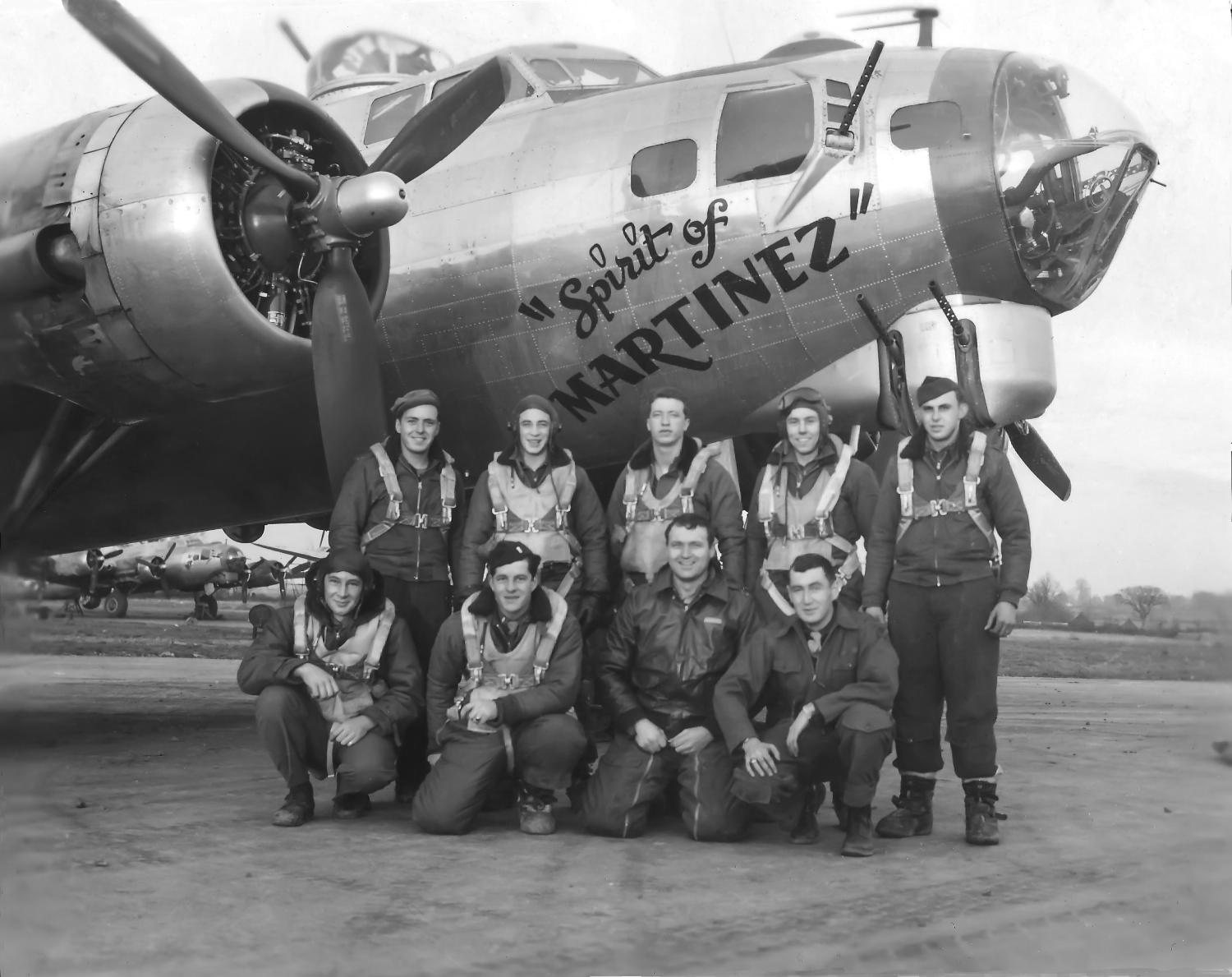
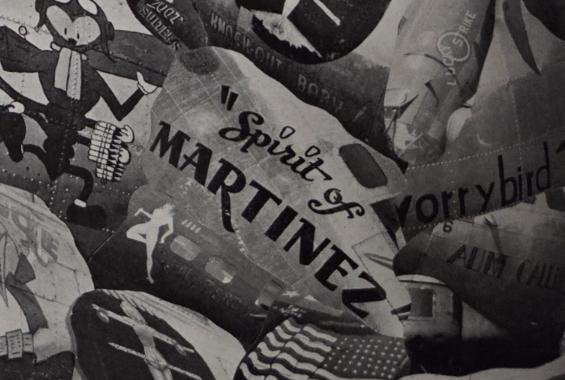
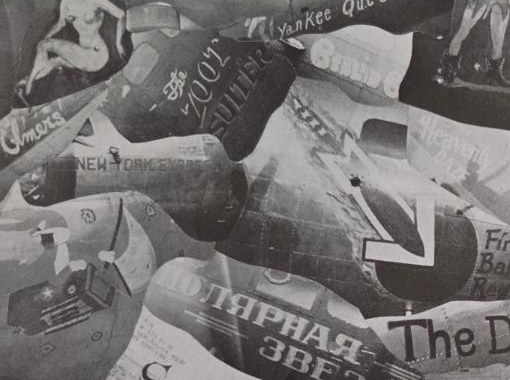
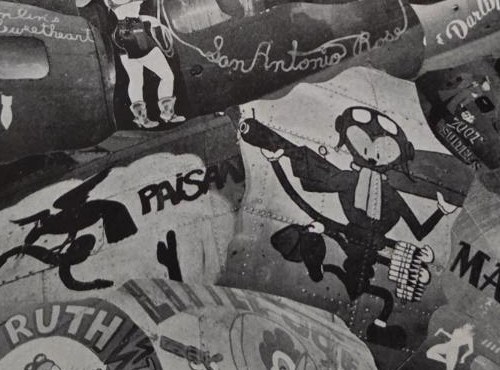
One detail in that account sits oddly against the photograph. The committee, the article reports, was disappointed to learn that the “name” consisted not of nose art “big enough for enemies to read without their glasses” but merely a small plaque mounted under the instrument panel. The surviving photograph of Frank beside the aircraft shows the name painted across the nose in script a good deal larger than a plaque. Both may be true in sequence — a plaque first, paint later, once the crew had adopted the name in earnest — but no document in the collection dates the painting, and the two accounts are not reconciled here.
See the platePlate 32See the platePlate 33See the platePlate 34See the platePlate 17See the platePlate 31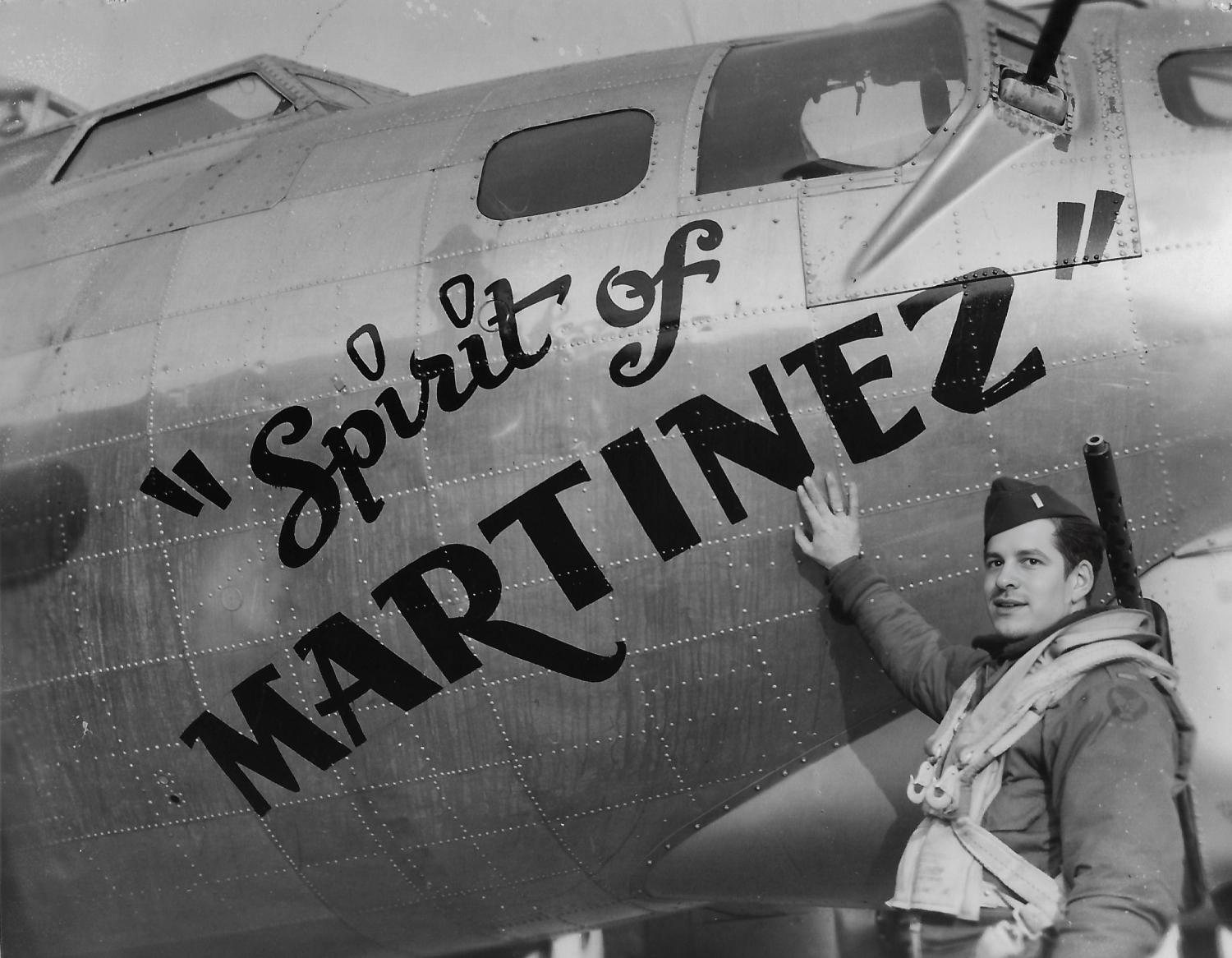
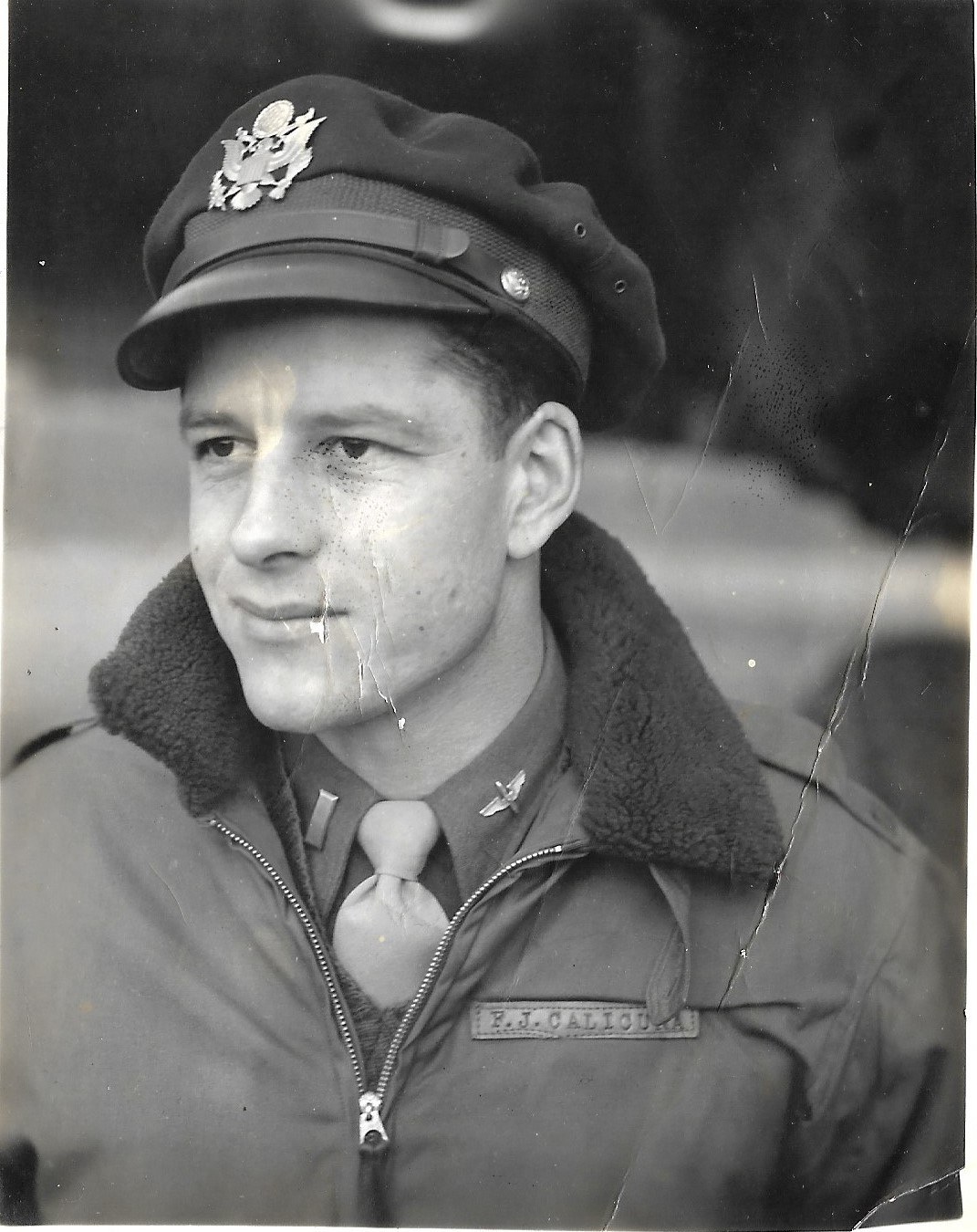
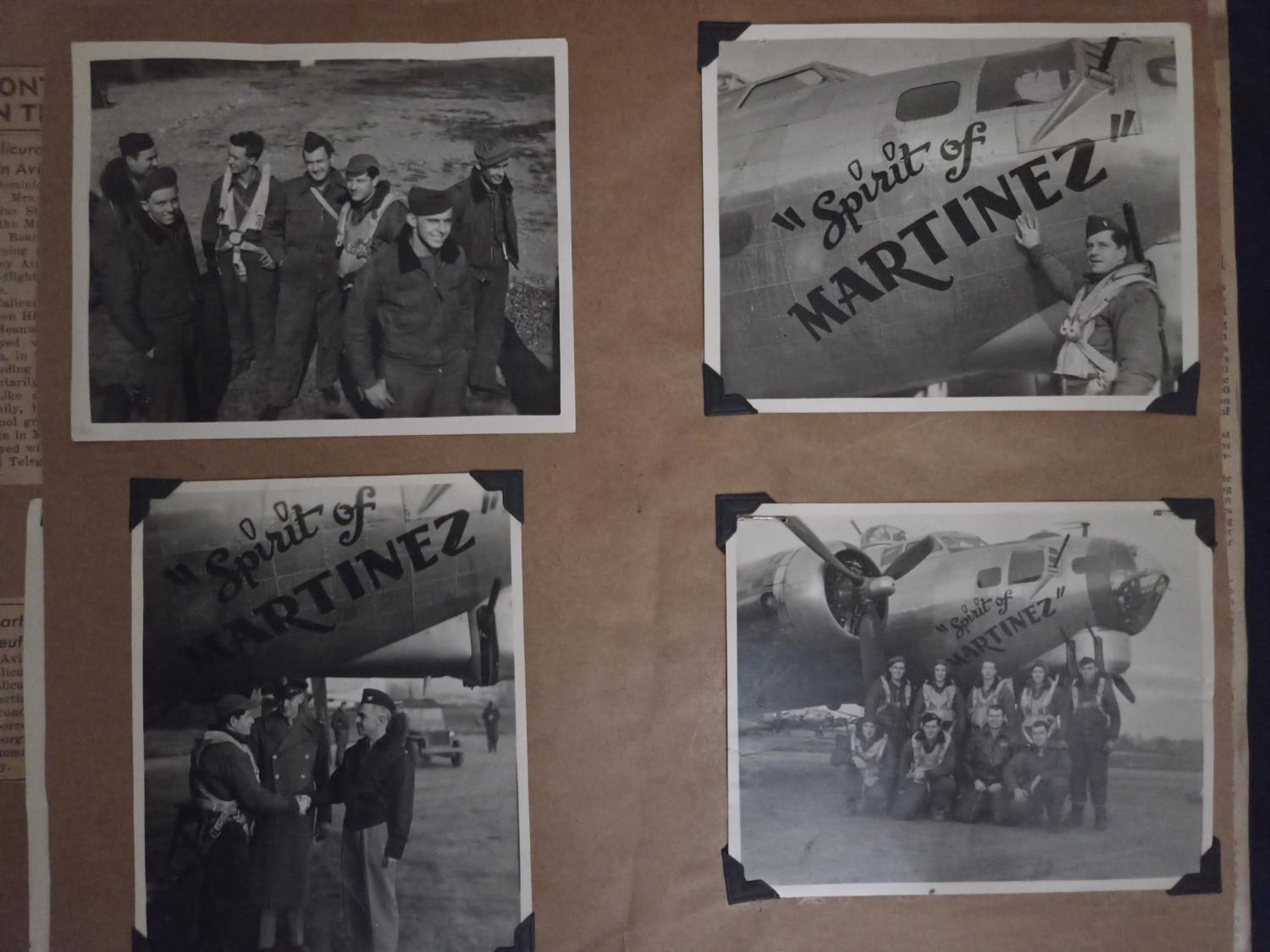

Joyce’s own description of her husband, given to the same reporter, is four words long and does not elaborate: “Frank was serious, steady.” She added what she took to be the consequence: “They take the serious, steady men for the bombers.”
Frank’s own account of the honor, written to Ray Taylor a week before the engine change grounded the ship, reverses the direction the ceremony photograph suggests. “We should be the honored ones,” he wrote, “in having the people at home asking us to name it after our town.”
He wrote to Taylor about the airplane itself in the same register, and the boast he allowed himself was a narrow one. “We can brag about her, Ray,” he wrote. “In all those missions; not once did we or those others who were fortunate to fly her have to turn back; abort as we call it.” Not that she was lucky, or that the crew was — that the ship had never once failed to reach a target she was sent to.
A published B-17 log, Dave Osborne’s Fortress Master Log, lists the same serial under another name: CAL'S RASCALS aka THE SPIRIT OF MARTINEZ. The Imperial War Museums’ American Archive repeats it. Neither is a wartime paper. The name on the nose, on the wallets, and in Frank’s letter to Ray Taylor is Spirit of Martinez. Cal’s Rascals is the log’s other name for the tail number, not a second christening.
There is a fact underneath the name that the ceremony had no way of marking. The town Frank Calicura was flying a bomber for had no airfield at all until 1939, when his own eldest brother helped drag one out of the waterfront fill, trucked in a hangar, and taught him to fly on it. Sam Calicura Jr. was thirty-six in 1942, a decade past the ceiling for aviation cadet training and born in Italy besides. He did not fly this war. The two brothers he had taught did.
11.3a
For twenty-three missions, Frank Calicura’s crew flew the same aircraft. On the twenty-fourth, they did not.
The traffic ran the other way as well, and more often than this book first reported. On March 17, 1945, on a mission to Ruhland, the Spirit of Martinez flew to Germany without any of the nine men who thought of her as theirs. The crew record puts John Bradley’s crew in her that day — the same crew that had lent Frank Calicura a co-pilot on his first morning — while Frank’s own crew did not fly at all. An aircraft in good order did not sit on the ground because the men usually in it were resting.
A second such day has since come to light, and it is not quite the same shape. On March 2, 1945, also to Ruhland, the Spirit flew under J.J. Getchius’s crew — but with Victor Probst, Frank’s own co-pilot, in the right-hand seat. The airplane went without her pilot and with one of her own men aboard. Frank did not fly that day at all.
Whether the group flew two Ruhland missions that month, or whether one of these two dates is an error in a database compiled decades afterward, this book cannot establish. Both entries exist in the same record. Both are reported here.
There is a third day, and it is the mirror of the first morning. On March 10, 1945, to Dortmunderfeld, Victor Probst flew with C.D. Crawford’s crew in 43-38255, Poof Proof, while the Spirit went out with Claude C. Greear in the right-hand seat — Crawford’s regular co-pilot, on the first mission of his life. In February a veteran had been placed beside a new pilot and Probst sent away to make room. In March the arrangement ran backwards: Probst was now the experienced man, and it was Frank’s airplane that took the stranger. The two co-pilots changed seats for one morning and changed back. Why is not recorded anywhere this writer has found, and nothing is gained by supposing.
These three mornings account for a number that does not otherwise fit. The 95th Bomb Group’s database credits Probst with thirty-two sorties. The crew flew thirty-one. Twenty-nine of Probst’s were with Frank Calicura; three were not — Chemnitz with Bradley, Ruhland with Getchius, Dortmunderfeld with Crawford. Two men sat side by side for almost an entire tour and do not agree on how many times they flew, and neither of them is wrong. Thirty-two is the database’s figure, and appears in no wartime document held by this family.
Joyce Calicura remembered him talking about this. Frank said the crew worried every time the back-up crew took her out, she told a reporter decades later, until she came back. The crew record supplies the date he was worrying about.
The 95th Bomb Group’s crew record shows a break in the pattern on April 5, a mission to Nuremberg: the aircraft listed is not 44-6838, Spirit of Martinez, but 44-8269, a B-17 named The Red Fox.
Two days later, on April 7, a mission to Kaltenkirchen shows a third aircraft again — 43-38942, Belligerent Beauty. The group’s compilation puts Donald J. Wilcox in the ball turret that morning, not Robert E. Collins, and Floyd L. Mathis aboard as observer.
By April 9, on the mission to München-Riem, the crew was back in the Spirit. Wilcox again in the ball; Mathis still observing. Collins is not on that roster either. That mission has its own clipping in the collection — the companion to the Munich piece from February, and the one that actually belongs here: “1,250 Heavies Strike Munich,” describing more than 1,250 Fortresses and Liberators, protected by some 750 fighters, hammering ten airfields in the vicinity of the city, all of them believed to be bases for the jet-propelled fighters that had become the bomber force’s greatest source of trouble in recent weeks. It was the third straight day the Eighth had put more than a thousand bombers in the air, and the third day of a run that had by then hit twenty-seven airfields. Frank Calicura’s crew, flying the Spirit again for the first time since the engine change, took part in the kind of mission the closing weeks of the air war had become: not cities anymore, but the airfields the Luftwaffe’s last serious aircraft flew from.
See the platePlate 35See the platePlate 36See the platePlate 37See the platePlate 38See the platePlate 39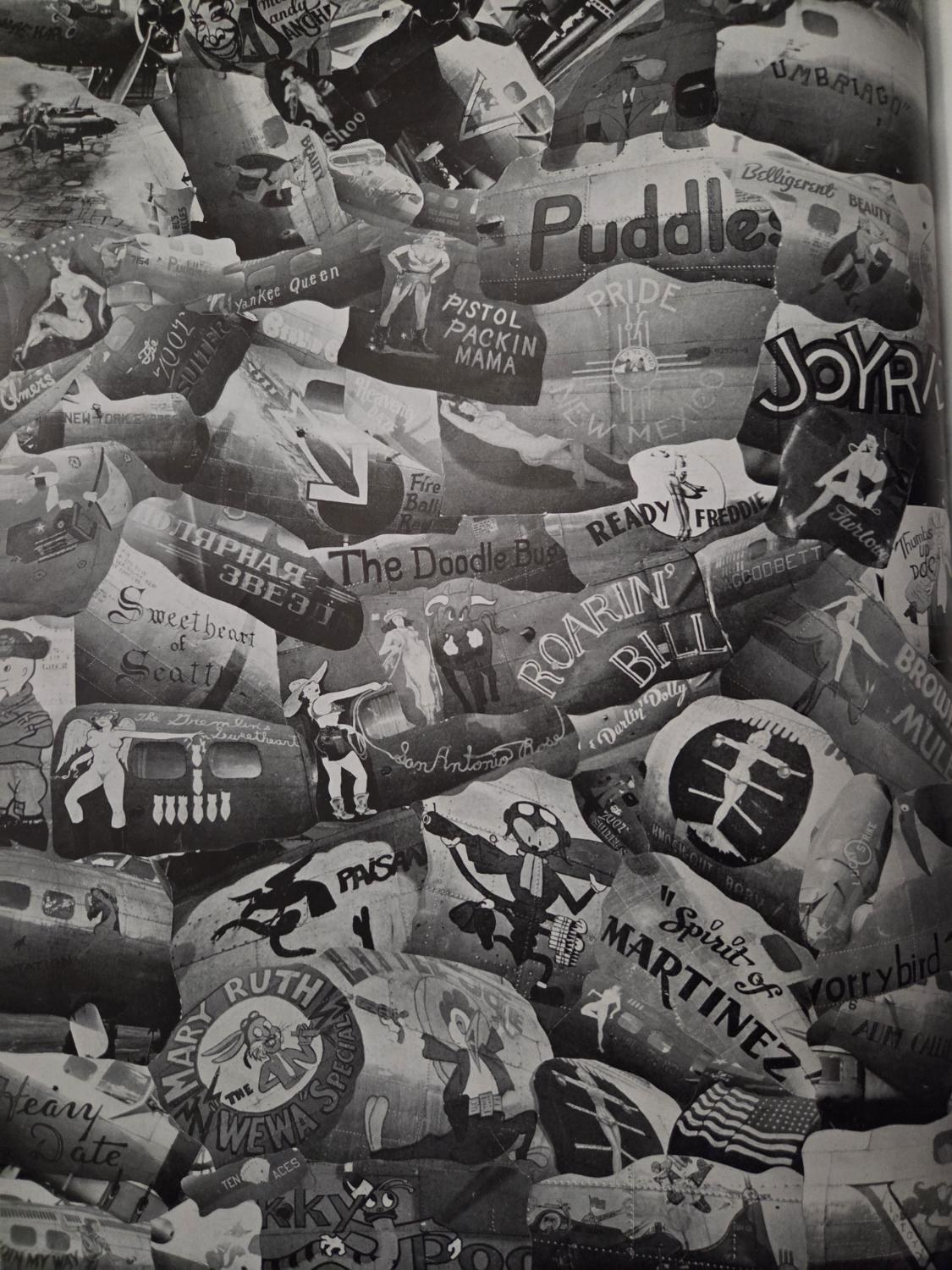

Frank’s own account, in a letter written from England on April 21, 1945, to a friend named Ray Taylor and later published under the title “If the People at Home Only Knew,” explains the gap without meaning to. He wrote that the Spirit had been stood down for an engine change — her third — after nearly fifty combat missions and more than four hundred combat hours. The dates align exactly: an aircraft flown that hard, pulled for maintenance in the first week of April, would put a crew into whatever airplane was available for a mission or two before their own ship came back on the line. Frank Calicura flew two combat missions in airplanes that were not his, in a week when the machine he trusted was somewhere on the ground at Horham with her cowlings off, and then he went back to her.
See the platePlate 101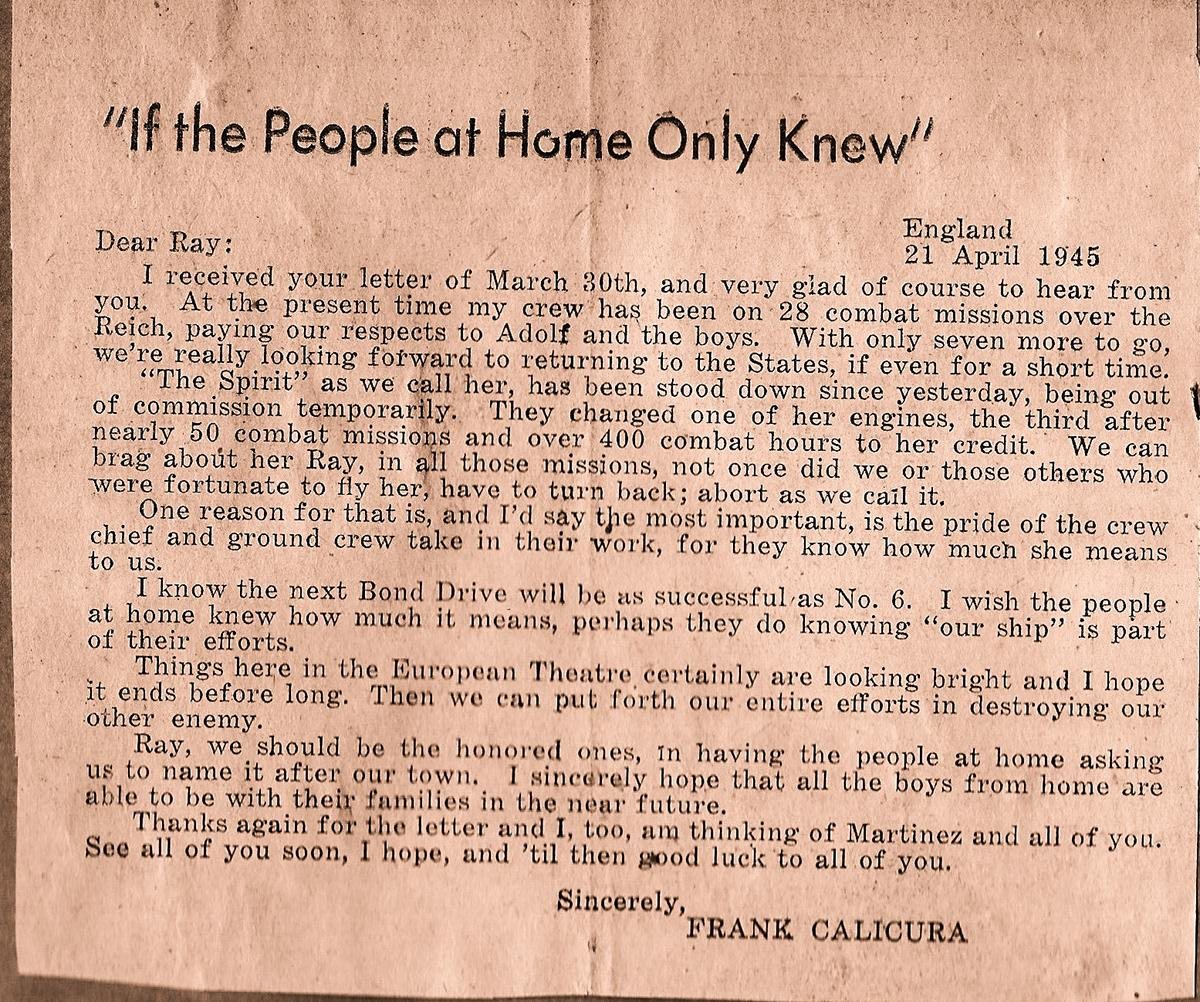

This is very likely the origin of a number the family has carried without fully being able to explain: thirty bomb symbols painted on the B-15 flight jacket in the collection, against a total logged count of twenty-eight combat missions and three humanitarian ones, thirty-one in all. Subtract the two missions flown in borrowed aircraft — April 5 in The Red Fox, April 7 in Belligerent Beauty — and the 95th Bomb Group’s own crew record puts the number flown specifically in the Spirit of Martinez at twenty-nine, not thirty. The jacket and the database disagree by exactly one symbol. It may be an extra mission the crew record simply doesn’t carry under 44-6838’s tail number, a training or ferry flight painted on alongside the combat count, or a man who miscounted his own jacket by one bomb in a hangar in England. What the arithmetic confirms is the shape of the count itself: a tally kept of an airplane rather than a man, accurate to within a single bomb.
See the platePlate 96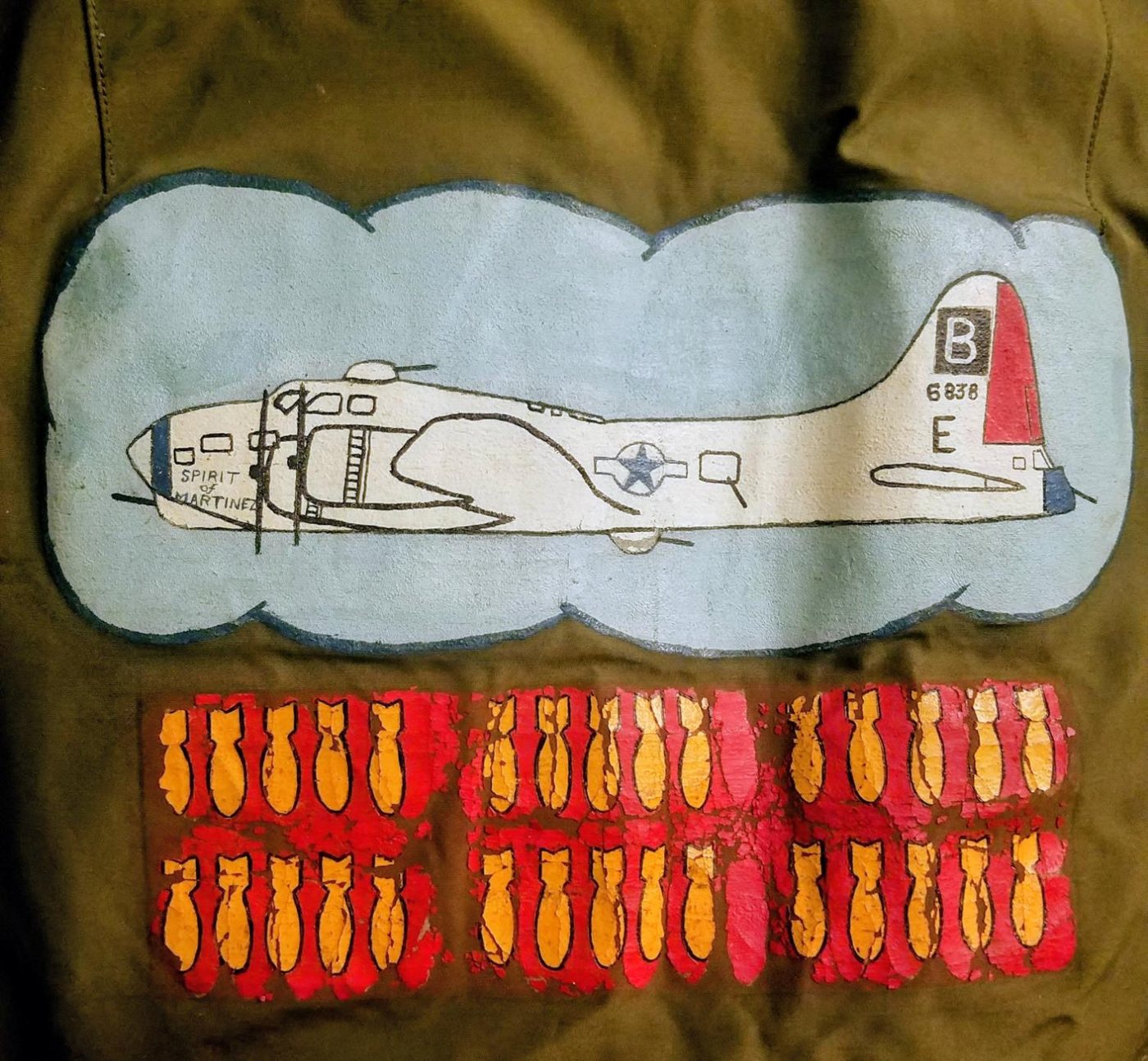

11.3b
Mission twenty-seven was the next morning. The crew was back in the Spirit. The target was Burg — one of seven jet airfields in the arc around Berlin named in the clipping Joyce kept. The crew record puts him there on April 10. The scrapbook writes the same name in the margin. Wilcox still in the ball; George F. Gearn observing. Collins is not on this roster either.
Nothing else in the collection marks the morning. No letter. No photograph. A number, a field, and a clipping that names it among others. The compilation names the seats. It does not say why Collins was missing those three days, or why he is back on the roster for Oranienburg ten days later.
11.3c
Mission twenty-eight, April 20, 1945. Rail yards ringing Berlin. The crew record’s last combat entry for this crew names Oranienburg. The scrapbook stops on the same date, the same target.
Ten days after Burg. Joyce numbered it Mission #28 in pencil. The three mornings over Utrecht that followed carry no number at all.
11.4
Sometime in this stretch — the collection dates it only broadly to the spring — Frank Calicura’s crew was sent to one of the Eighth Air Force’s rest homes for a week.
The system was real and specific: roughly twenty houses and hotels requisitioned across England, jointly run by Air Service Command and the American Red Cross, offering aircrew a week away from the base with no return home possible. Rank did not apply there. Men were issued civilian clothes for the stay, with uniforms required again only for dinner. It was, by design, as unmilitary an experience as the Army Air Forces could construct for men who had spent months being nothing else.
The family’s clipping records it plainly: “Spirit of Martinez Crew Takes Rest.” It is one of the only points in this entire chronology where the record shows the war stopping, briefly, rather than continuing.
Cite this
The Spirit of Martinez. Borrowed Aircraft, Chapter 11. What a Family Kept.
https://www.spiritofmartinez.com/chapters/borrowed-aircraft
A note on sources