
Chapter 9 · February 14, 1945
Mission One
Chemnitz, Germany — February 14, 1945
Chemnitz, not Dresden. The first entry. Twenty-eight to go, though he does not know the number will change twice more before the war lets him stop counting.
A synthetic reading of this chapter is in the bar at the top. It will keep playing while you move through the book. The text below is the transcript. The voice’s place on the page is marked as it reads.
These mornings also sit on the mission board.
9.1
The name Frank Calicura had been waiting to see went up before dawn on February 14.
A mission day at Horham followed the same sequence regardless of the target: wake in the dark, a hurried breakfast, briefing in a room that filled with cigarette smoke before the curtain came off the map. Only then did a crew learn where they were going. For Frank Calicura’s crew, on this particular morning, the answer was Chemnitz — a marshalling yard in Saxony, part of the rail network still moving German men and material toward a collapsing eastern front.
It was, by the standards of the war by that point, an enormous operation. The Eighth Air Force dispatched 1,377 bombers and 962 fighters that day, aimed at oil and rail targets across Germany — one of the largest single-day efforts the Eighth would mount. The force split roughly in two. Four hundred sixty-one B-17s were sent to hit the marshalling yard at Dresden. A separate force of four hundred fifty-seven B-17s — Frank’s among them — was sent to hit the marshalling yard at Chemnitz, roughly forty miles away. Of that second force, 294 aircraft found and bombed the primary target; the rest, turned back by weather or unable to identify it, dropped instead on airfields and rail yards at Eger, Bamberg, Sonneberg, Tachau, and Hof. Losses on the Chemnitz mission were, in the arithmetic of that war, light: one B-17 lost, a handful of casualties. Frank’s crew came home.
A map in the scrapbook circles Chemnitz among that week’s raids. A number in the margin may be 7 or 8. This book numbers Chemnitz first. The circle and the number are both in the collection.
See the platePlate 67See the platePlate 32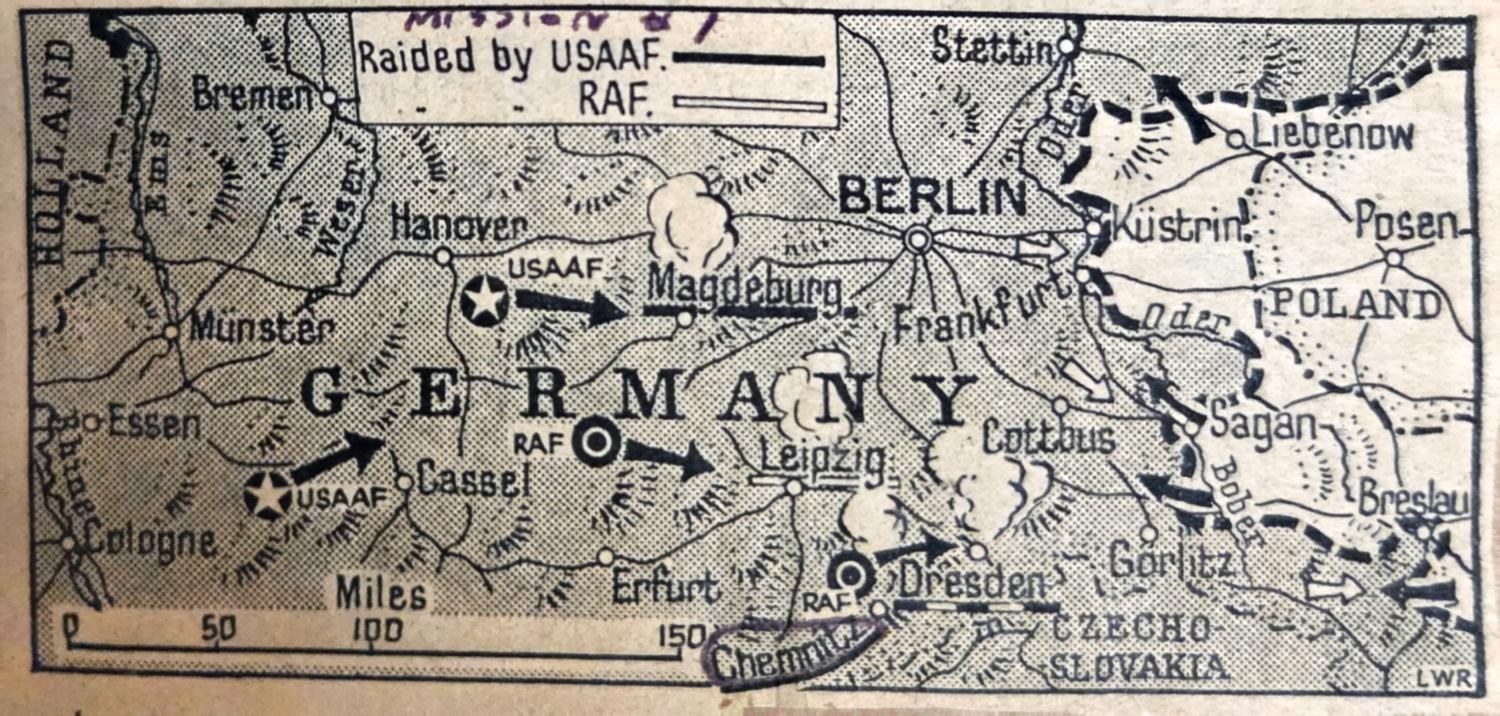


9.2
Chemnitz was not Dresden. The distinction matters, and the record keeps it.
But the two missions launched within the same operation, on the same morning, from bases scattered across the same corner of England, and any account of February 14, 1945 has to hold both facts without letting one blur into the other. The night before, RAF Bomber Command had struck Dresden with roughly eight hundred aircraft, followed at midday by the separate American force of 461 B-17s that bombed through smoke still rising fifteen thousand feet from the fires of the night before. That was not Frank Calicura’s mission. His squadron never approached Dresden’s airspace that day. What can be said is only this: on the single morning of his first combat mission, in the same hour, from airfields not far from his own, roughly seven hundred American aircrew were flying toward a city that would become one of the most argued-over targets of the entire war, while Frank Calicura and four hundred fifty-six other B-17s were flying toward a rail yard forty miles away that, by comparison, history has mostly forgotten.
Neither the collection nor the manuscript records what, if anything, Frank knew or thought about Dresden that day. The clipping the family kept — “Key Rail City Near Capital Is Pounded” — describes his own mission, not the other one. The timing is a coincidence, and nothing more should be put in his mouth about a raid he did not fly.
9.3
What Chemnitz meant to Frank Calicura personally was smaller and more exact than what it meant to the war. It was the first entry.
His own accounting, recorded later in his own hand, would eventually run to twenty-eight combat missions and three humanitarian ones — thirty-one in total, against an original tour requirement of thirty-five. Chemnitz was where that count began. Every subsequent number attached to Frank Calicura’s war — the twenty-six on the Lucky Bastard Club card, the thirty bomb symbols painted on his jacket, the twenty-eight his commanding officer would certify, the thirty-one that only appears when two documents are read together, the forty-eight a hometown newspaper would eventually print, the fifty-three missions the aircraft itself would fly before the war ended — all of it starts counting from this one morning, this one rail yard, this one mission that was not the famous one happening forty miles away at the same hour.
He flew home, was debriefed in a hut that smelled of cigarettes and wet sheepskin and coffee that had been on the stove since before the first ship came back, and went to sleep with twenty-seven missions still ahead of him, not knowing yet that the number would change twice more before the war let him stop counting.
The 95th Bomb Group’s own crew record settles a detail the family’s clipping had left ambiguous. The headline read “Chemnitz/Cottbus,” as though the two were one target. They were not. Chemnitz was mission one, on the fourteenth. Cottbus was mission two, flown the very next day, February 15. Frank Calicura’s war did not begin with a single mission. It began with two, back to back, before he had been in combat forty-eight hours.
The second of them cost the group two aircraft. One was Big Casino, C. D. Schaad’s B-17 of the 335th Squadron — Frank’s own squadron, on Frank’s second day of the war. Her Missing Air Crew Report, number 12378, is a record of an aircraft simply falling out of the sky over a period of half an hour: at 1142, with her number two engine feathered, she lagged behind the formation; at 1212 she was last seen heading northwest; she crashed at Tillowitz. The report gives two map coordinates, two timestamps, and a direction. It does not say what happened in between, because nobody watching was in a position to see. The other was Easy Going, F. W. Volz of the 336th. A different squadron. The compilation records both.
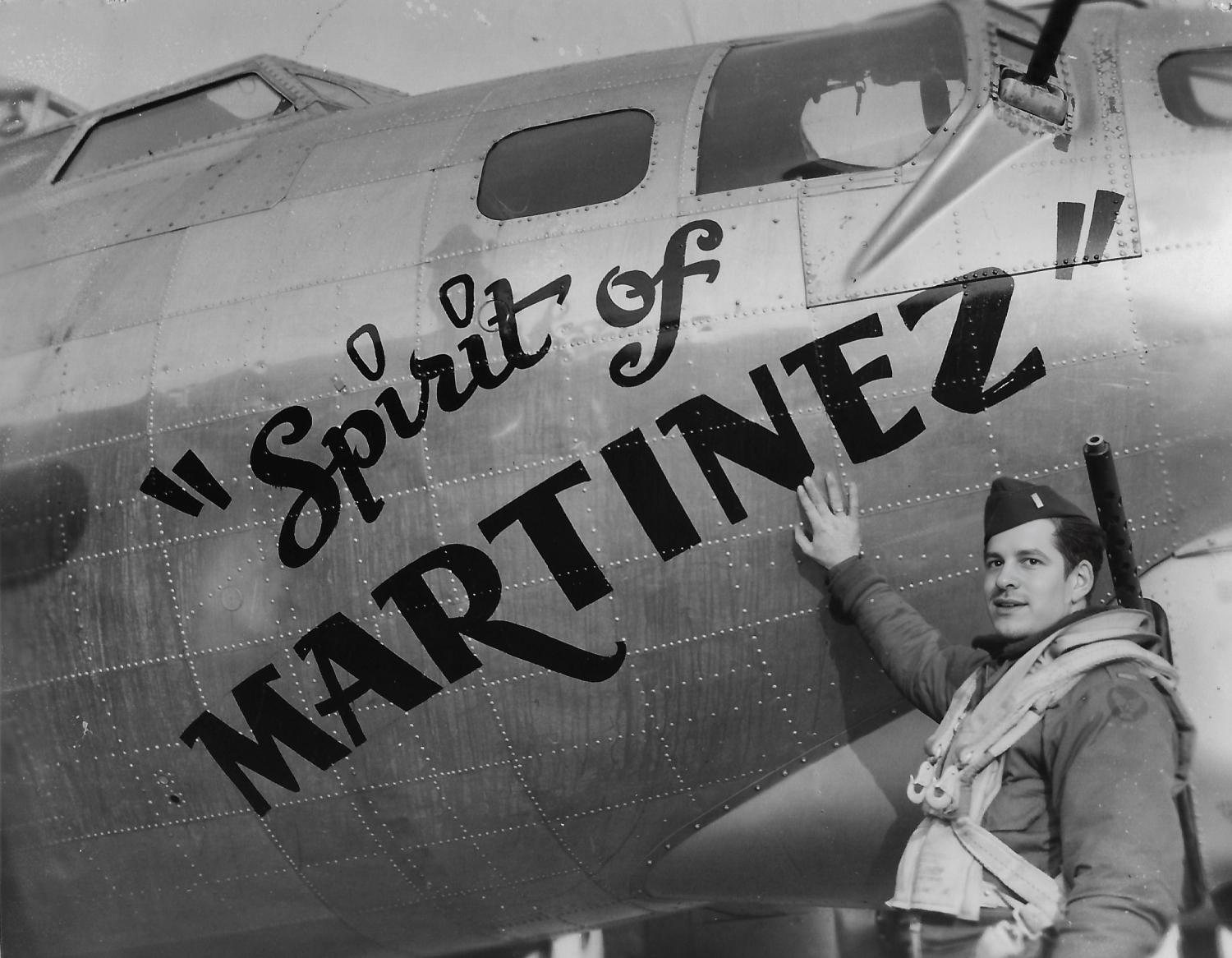
The same crew record settles something else about that first morning, and it runs against the way this book has described the crew up to now. On February 14, 1945, Frank Calicura flew the Spirit of Martinez with Barnes navigating, Markus in the nose, Brown on the radio, Bogacki in the top turret, Collins in the ball, Ernest at a waist gun and Titus in the tail — seven of the eight men he had trained with at Avon Park. The eighth was not aboard. In the right-hand seat that day was Richard J. Austin, a name that appears nowhere else in the family’s collection.
Victor Probst flew that morning too, in a different airplane. The crew record puts him in the right-hand seat of The Red Fox, co-piloting for John V. Bradley, with eight men whose names do not otherwise touch this account. The two aircraft went to the same target, in the same formation, and came back to the same field.
Nothing in the family’s collection explains the arrangement, but the crew record itself does. Richard J. Austin was not a name pulled from a pool. He was John Bradley’s own co-pilot, and appears in the right-hand seat of Bradley’s crew on its other missions that spring. Bradley’s crew had been flying combat since January, through Mannheim and Neuss and Duisburg and Weimar, well before Frank Calicura reached Horham.
What happened on February 14 was therefore not an assignment but a trade, between two particular crews. Bradley gave up his co-pilot to the new crew for the day and took the new crew’s co-pilot with him. Frank Calicura flew his first mission with a man who had already done a dozen; Victor Probst flew his sitting beside a pilot who had. It was the Eighth Air Force’s standard way of putting a new crew over Germany the first time, and here the crew record shows the two halves of it in the same formation, on the same morning, going to the same rail yard. One mission.
What the record does show is that the crew this book has called nine strangers, and then simply the crew, did not all fly their first mission together — and that when they did assemble in the Spirit of Martinez, it was already, for seven of them, the second day of the war. Neither man appears in the other’s aircraft again.
Cite this
The Spirit of Martinez. Mission One, Chapter 9. What a Family Kept.
https://www.spiritofmartinez.com/chapters/mission-one
A note on sources