
Chapter 6 · 1944
Nine Strangers
Tampa & Avon Park, Florida — August–November 1944
The Army puts nine names on the same piece of paper. They learn to work against something that will shoot back. A dollar bill goes around a room.
A synthetic reading of this chapter is in the bar at the top. It will keep playing while you move through the book. The text below is the transcript. The voice’s place on the page is marked as it reads.
6.1
Before Frank Calicura ever met the men he would fly with, the Army had already begun putting their names on paper — twice, three months apart, at two different fields.
A Special Order issued August 30, 1944, from Headquarters, Third Air Force Replacement Depot, Tampa, Florida, formally constituted the crew — numbered 1479 in the surviving copy, though the number is partly obscured by a typewritten correction in the original — with Frank Calicura as pilot, Victor Probst as copilot, and six enlisted men beneath them: Earle Bogacki, Robert Brown, Marvin Markus, Robert Collins, Dale Ernest, and James Titus. No navigator appears on this order.
See the platePlate 92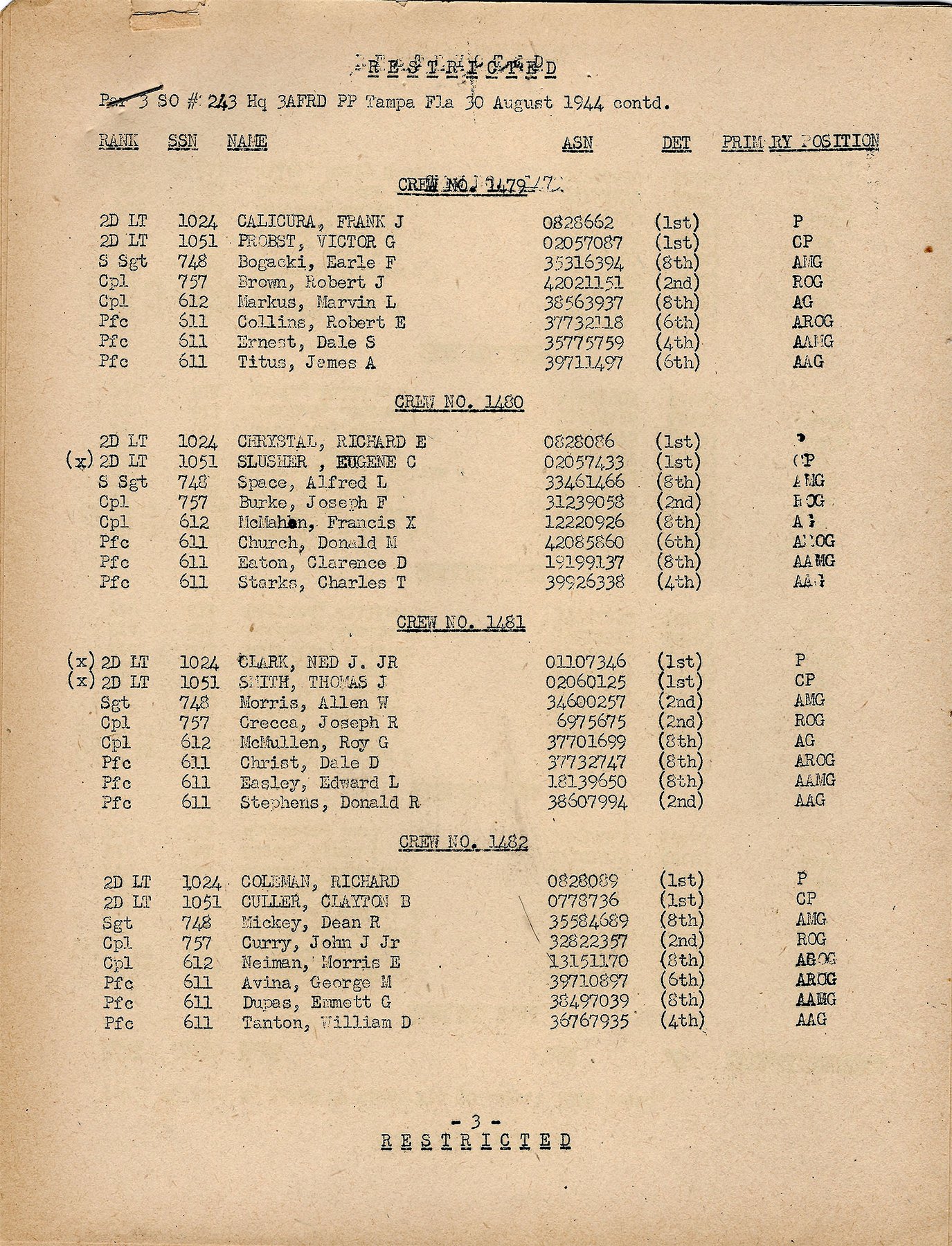

A certificate from the same headquarters fixes the dates of that stretch precisely. Headquarters Third Air Force Replacement Depot, Plant Park, Tampa, Florida, certified on September 2, 1944, that Second Lieutenant Frank J. Calicura had not been assigned or occupied public quarters at his permanent station — Plant Park itself — from August 17 to September 2, 1944, both dates inclusive, because the quarters available there were inadequate for an officer with dependents, signed William H. Askey, Captain, AC, Adjutant (family collection). The dates close a gap this book had left open without noticing it: Frank's qualification record puts the end of his Hendricks Field training at August 17, 1944, and this certificate places him at Tampa starting that same day, continuously, until the Avon Park training record picks him up on September 2. There is no gap between Hendricks and Avon Park. There is Tampa, in between, for exactly sixteen days — and Joyce, already carried as his dependent, kept off the base the entire time by quarters the Army itself judged inadequate.
The navigator's absence from the Tampa order closes in the next document. Special Orders No. 341, Headquarters Avon Park Army Air Field, dated November 6, 1944, lists the same eight men, now designated 3AF-NV-23 Crew No. 8, with a ninth name added: John R. Barnes, second lieutenant, navigator. The same order transferred the crew to Hunter Field, Georgia, to arrive November 20, 1944, and report to the Combat Crew Center of the Third Air Force Staging Wing — the same Hunter Field that appears again a month later in the shipping ticket already documented in this book, where all nine men signed for their flying gear before the last leg overseas.
A third document fills the gap between that transfer order and the gear issue at Hunter Field. Special Orders Number 337, Headquarters Third Air Force Staging Wing, Hunter Field, Georgia, 2 December 1944, dispatches the crew overseas by air under Shipment FQ-555-CA, listing them as Crew FQ-555-CA-93, Project 92923R: Frank J. Calicura, pilot; Victor G. Probst, copilot; John R. Barnes, navigator; Earle F. Bogacki, engineer; Robert J. Brown, radio operator; Marvin L. Markus, Robert E. Collins, Dale S. Ernest, and James A. Titus, gunners — all nine names and serial numbers matching the crew already established here (family collection). The order routes them from Hunter Field to Dow Field, Bangor, Maine, via Grenier Field, New Hampshire, reporting to the Commanding General, Air Transport Command, for further dispatch to an overseas destination.
The order also assigns them an aircraft for the movement: Ap. No. 44-6830, a B-17G — not 44-6838, the Spirit of Martinez. The two serials sit eight apart, and the reason is that they were built eight apart: both came out of Douglas production block B-17G-65-DL, serials 44-6751 through 44-6875. They were never the same airplane.
44-6830’s own record follows the order exactly. She was delivered to Hunter Field on November 23, 1944, and reached Grenier Field, New Hampshire, on December 13 — Hunter to Grenier, the route Special Orders Number 337 lays out, in the fortnight after the order was cut. She was the ferry ship. On the far side of the Atlantic the crew gave her up, as ferry crews generally did, and she went to a different group altogether: the 407th Bomb Squadron of the 92nd Bomb Group, at Podington, on March 4, 1945.
She lasted fourteen days there. Battle damaged over Berlin on March 18, 1945, she force-landed in Poland and was written off on the twenty-sixth. By then Frank Calicura’s crew was most of the way through a tour in an aircraft built in the same shed, in the same block, the same month.
6.2
Frank Calicura met the men he would fly with in Florida, in September 1944, at a base built to manufacture that meeting.
Avon Park had not started out for this purpose. It opened in 1942 as a bombing and gunnery range, then trained medium-bomber crews for the 336th and 397th Bombardment Groups. In November 1943 the 88th Bombardment Group arrived from Walla Walla, Washington, to run B-17 operational training instead, and on 1 May 1944 the field was reorganized again and renamed for what it had by then become: the Avon Park Replacement Training Unit, Heavy Bombardment. Its whole function was to take pilots who had finished four-engine transition somewhere else — Hendricks Field, in Frank’s case — and put them together with the eight other men the Army had decided, on paper, belonged in the same airplane.
No one at Avon Park asked whether the nine of them would get along. The unit’s job was to teach them to work, not to like each other, though most crews managed both before it was over.
6.3
What Avon Park actually taught a crew was not flying. Every man aboard already knew how to do his own job, or was expected to by the time he arrived. What the base taught was working together against something that would shoot back.
The range itself was built to simulate it. Engineers had laid out a mock town of some five hundred fifty-five acres on the shore of Lake Arbuckle, purpose-built for a crew to practice finding and hitting a target that looked like the ones waiting in Germany. A floating target sat out on Lake Kissimmee for the bombardier and the pilot to coordinate a run against water instead of ground. An eight-mile stretch of dummy railroad gave them something long and thin to walk their bombs down, the way railyards actually behaved as targets. Later in the war, instructors from the Army Air Forces School of Applied Tactics in Orlando built a specialized incendiary target as well, as the target list overseas shifted toward that kind of raid.
None of it was Germany. All of it was built to feel, procedurally, like Germany would.
6.4
The crew that trained together at Avon Park, and would fly together over Europe six months later, had nine names on it.
Frank Calicura, pilot. Victor G. Probst, copilot. John R. Barnes, navigator. Marvin L. Markus, togglier. Earle F. Bogacki, flight engineer and top turret gunner. Robert J. Brown, radio operator. Robert E. Collins, Dale S. Ernest, and James A. Titus, gunners.
See the platePlate 23See the platePlate 18See the platePlate 95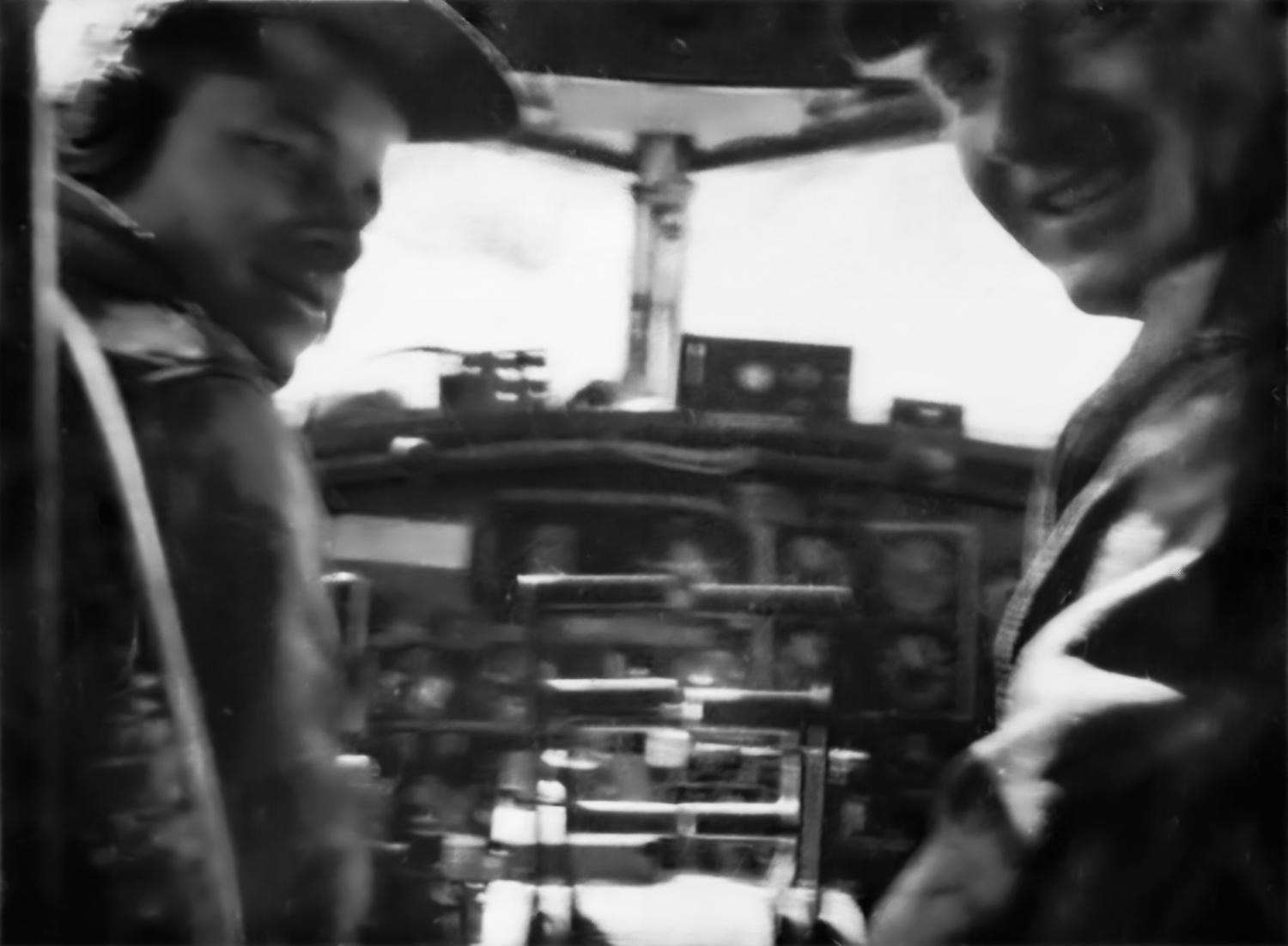
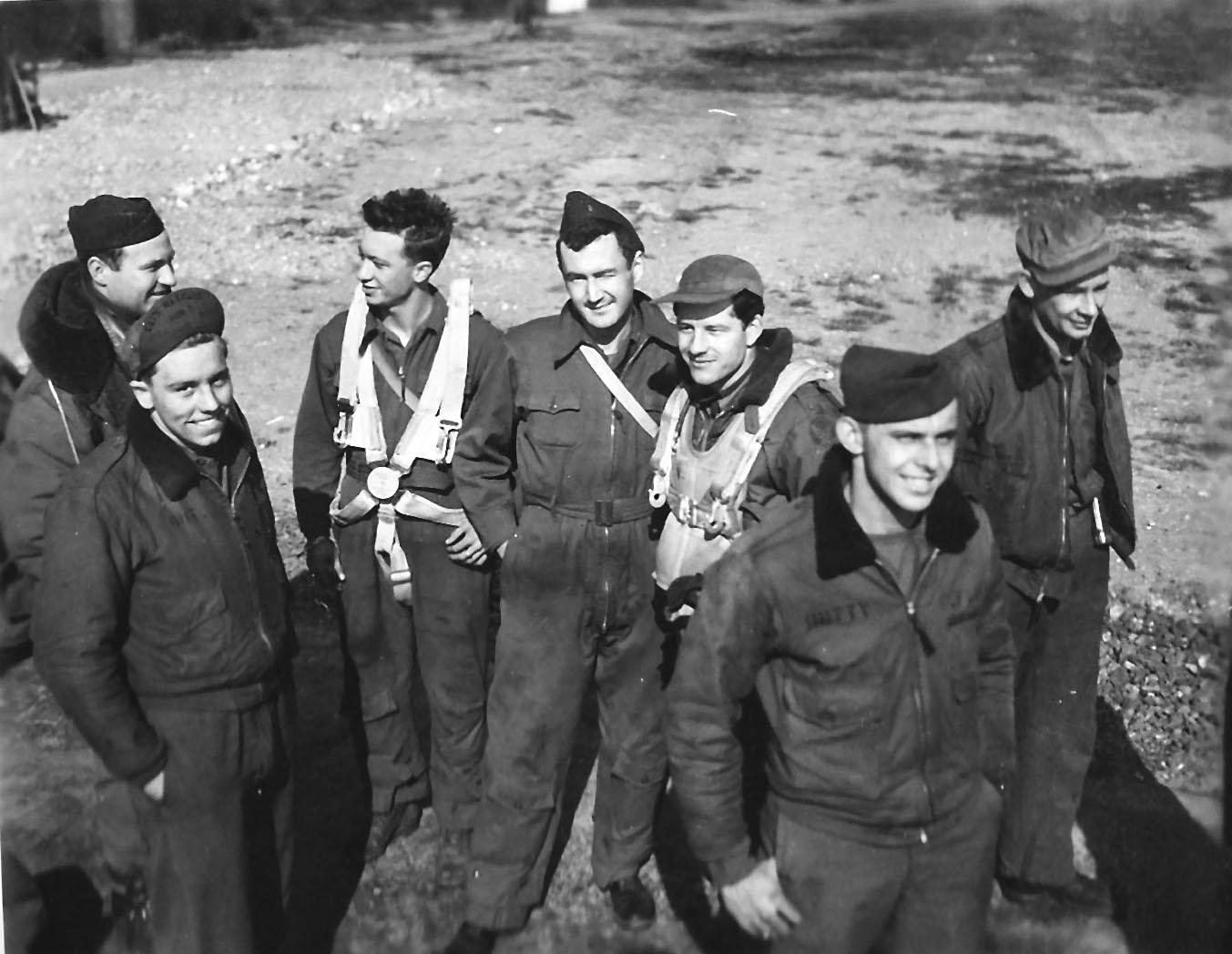
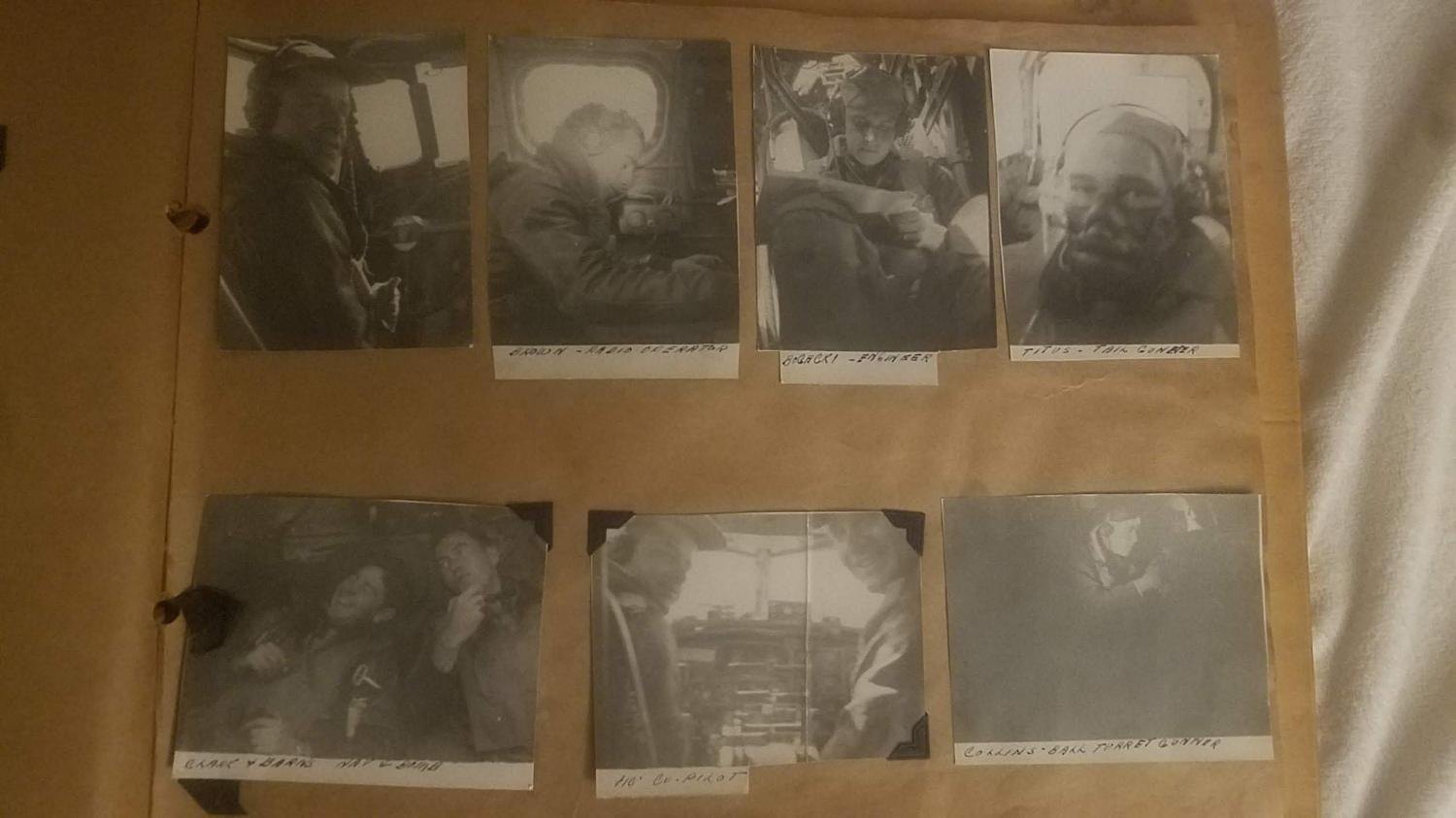


Barnes was born in Philadelphia on January 31, 1922, the son of Leonard and Gertrude Barnes of Emporium, Pennsylvania. Probst would later study architecture; at the time he was simply the copilot. Markus came from Kingfisher, Oklahoma — the town already named on the wallet that would later be stamped for the crew. Bogacki had been born in Cleveland in 1920 to Frank and Stella Bojack, a surname the family later changed to Bogacki (which is very likely why a contemporary wallet clipping misprinted a Cleveland man’s name as “Nogacki” and still got the city right). Brown was born May 1, 1924, in Corning, New York, to a Polish immigrant father. Ernest came from West Virginia. Titus’s own record comes into focus through two wartime clippings from what internal evidence points to as a Lincoln, Nebraska paper. The first places him, as a corporal, having landed in England after graduating gunnery school at Las Vegas in June 1944. The second records his later discharge as a sergeant from L.A.A.F. — almost certainly Lincoln Army Air Field — and names his parents as Mr. and Mrs. Joe B. Titus of 3343 LaSalle Street. Both state plainly that he served in England as tail gunner on a B-17: a fourth independent source for a fact the record had already secured three times over.
See the platePlate 43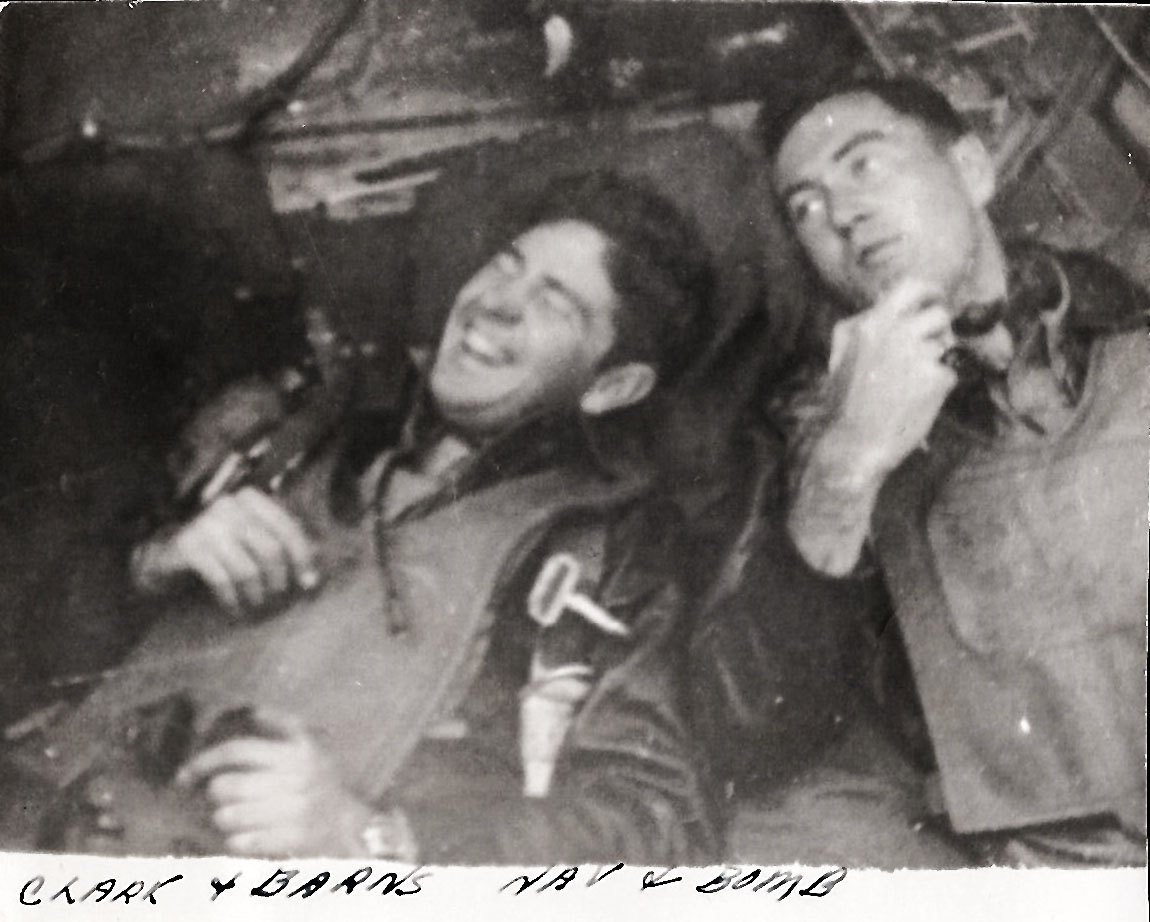

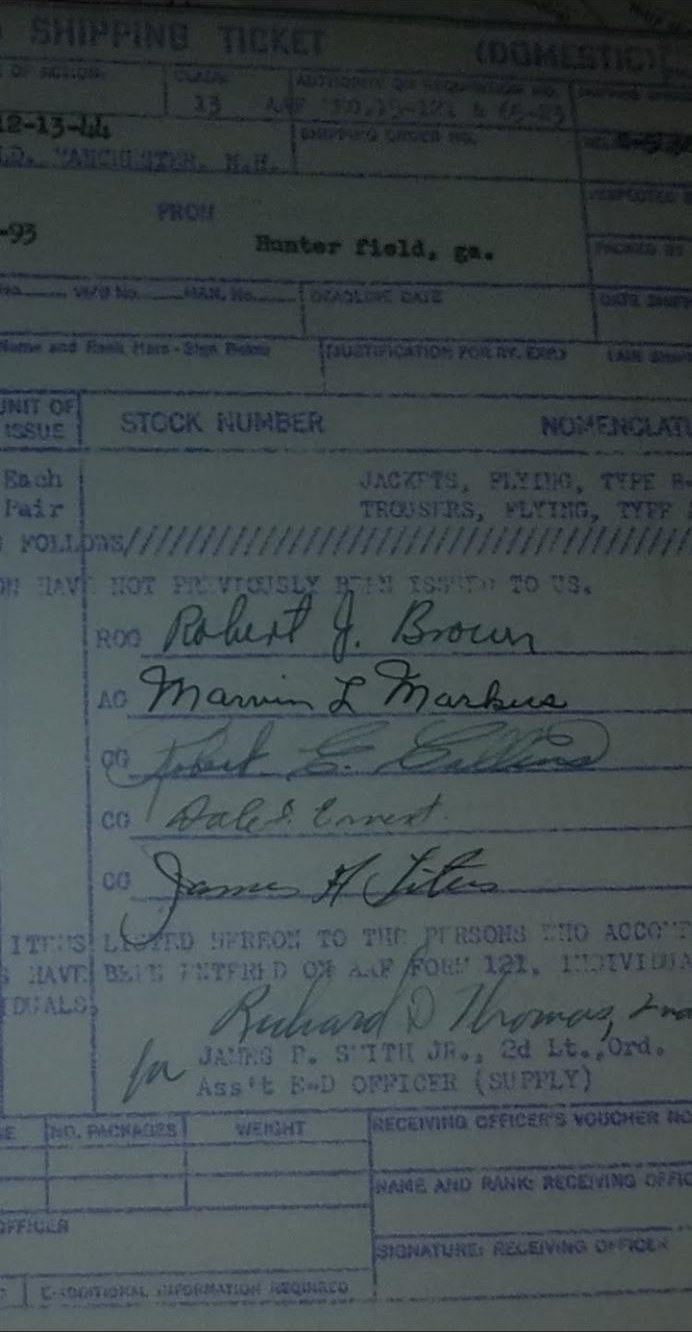
Robert E. Collins’s identity is anchored across two independent wartime records. His WWII draft registration gives the Hutchinson, Kansas residence and employment at the Coca-Cola Bottling Company; a shipping ticket from December 1944 carries an actual wartime signature reading “Robert E. Collins,” consistent with the one on the draft card. He was not yet twenty when he registered, working under a boss named Lewis Scruggs, with a next-of-contact listed as Margaret Dappen at 221 East First Street. Born October 5, 1923, he had grown up and gone to work in one small Kansas city before the ball turret of a B-17 became his job instead.
See the platePlate 46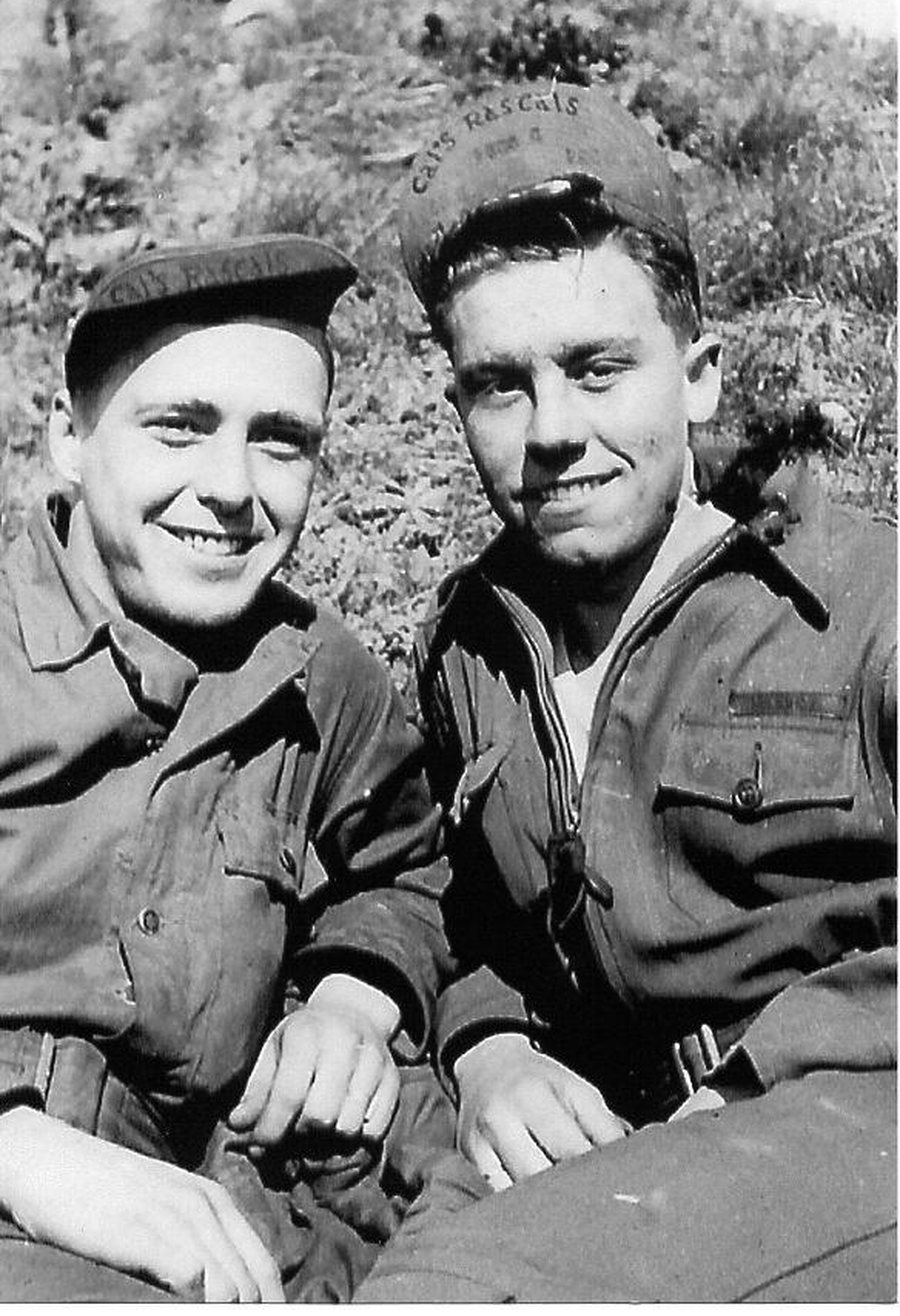

That shipping ticket turns out to carry more than Collins’s signature. The full document — a complete copy of a page previously seen only in part — shows the entire crew signing together on December 13, 1944, the ticket issued out of Hunter Field, Georgia and drawn at the 177th AAF Base Unit, Grenier Field, Manchester, New Hampshire, for flying jackets and trousers before the last leg overseas: Calicura as pilot, Probst as copilot, Barnes as navigator, Bogacki as engineer, and Brown, Markus, Collins, Ernest, and Titus in their turret and gunner positions, nine signatures in two columns on a single government form. A tenth name appears beside them — Eugene P. Allamano, listed as “RAD” — who was not part of the combat crew at all, but a passenger carried on that same overseas ferry flight in late December 1944, gone from the record as quickly as he appears in it.
See the platePlate 93See the platePlate 94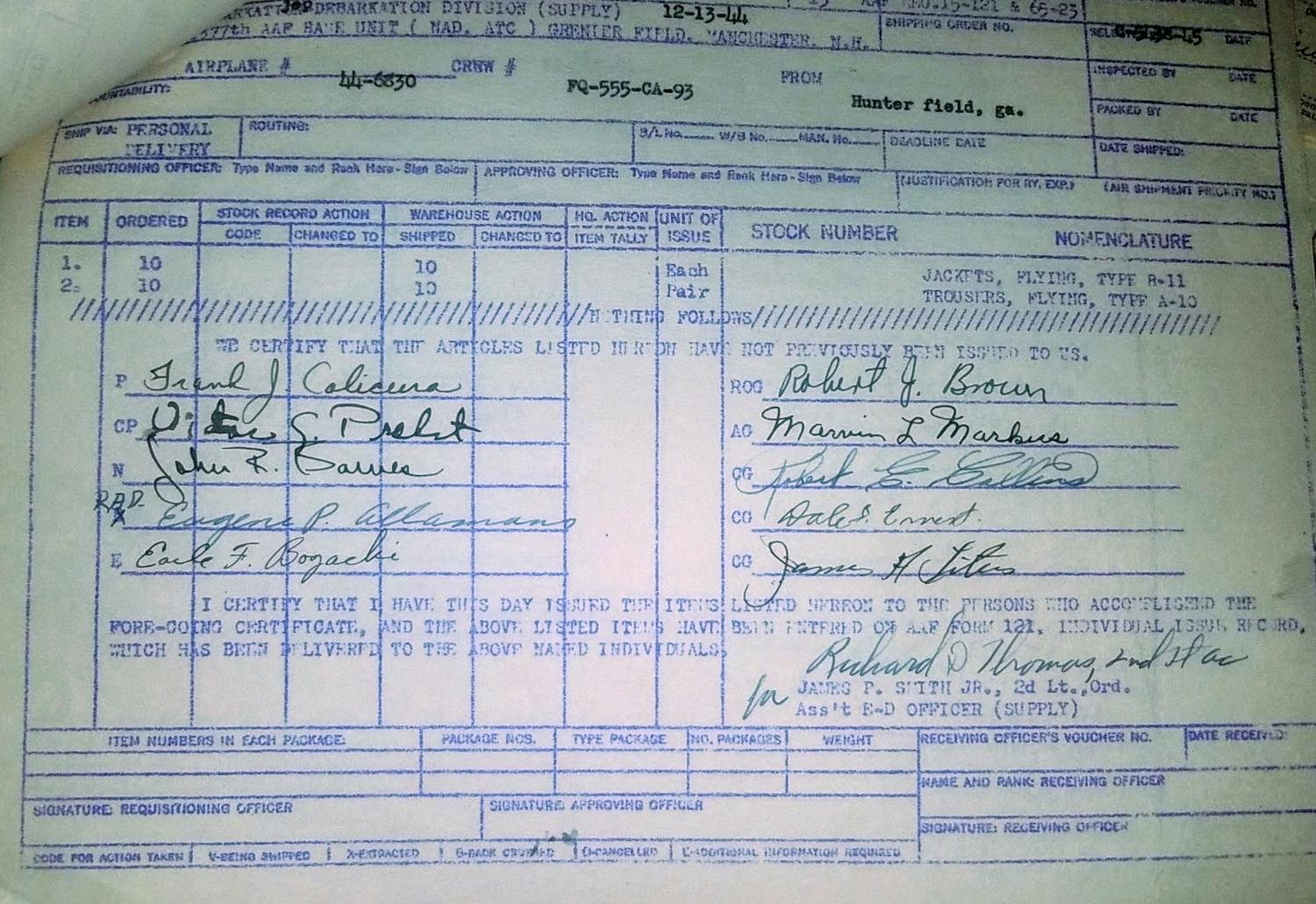


In September 1944, none of that had happened yet. They were nine men who had been assigned to the same airplane and told to learn to trust it, and each other, before anyone put a target under them.
6.5
Somewhere in this stretch of training — the collection does not fix an exact date — a dollar bill went around a room and came back covered in signatures.
Frank signed it. Dominic signed it. Other names on it belong to local airmen the family can no longer fully place, and possibly to a tradition Sam Calicura Jr. had a hand in starting, back at the field on the Martinez waterfront where all of this had, in one sense, begun. A short snorter carried no military significance whatsoever. The Army did not require it, did not track it, and would not have cared if it were lost. It survived only because someone decided it was worth keeping, which is a different kind of significance than the Army’s.
See the platePlate 91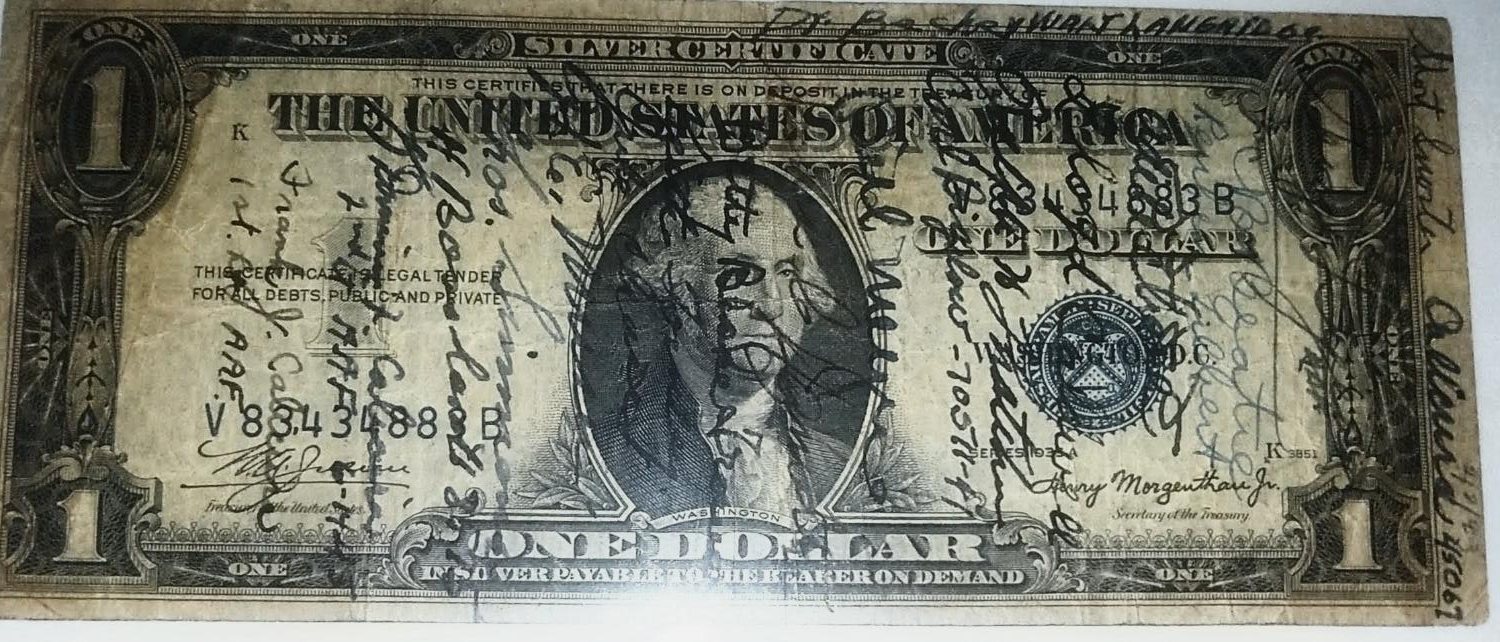

It is the only surviving record of a night none of the nine of them wrote an account of. No letter describes it. No clipping mentions it. What happened in that room exists now only as a list of names on a piece of currency. That is how most of what happens between men in wartime survives: not in the official record, but on whatever scrap was in a pocket when it seemed worth writing something down.
6.6
Between Avon Park and the ocean, Frank Calicura and his brother Dominic saw each other one more time.
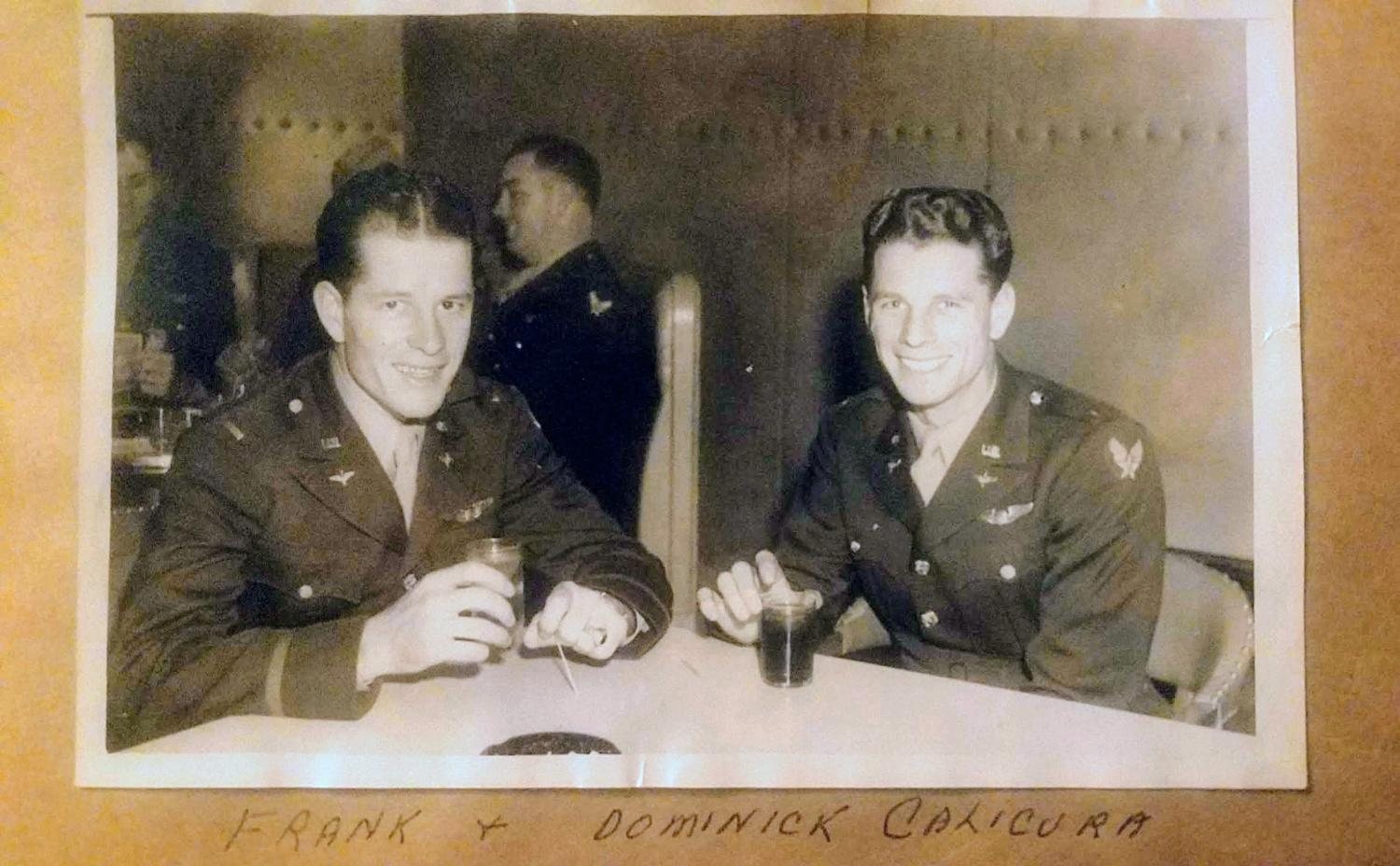
A Gazette clipping, undated in the collection but internally dated by its own content, places Frank on the East Coast in December 1944, “awaiting assignment to duty, presumably in the European Theatre of action” — his crew having, in the paper’s words, “recently completed all training assignments at a southern flying field,” a description that matches Avon Park exactly. The same clipping states that Dominic, “pilot of a fighter plane and now instructing at a Georgia field,” had “recently got together with Frank in New York during a brief leave.” A photograph in the family’s collection, captioned in period handwriting “Frank & Dominick Calicura,” shows the two of them at a table in uniform, pilot wings visible on both men — very likely the same meeting the clipping describes, though nothing in either source fixes the two together beyond the coincidence of timing.
See the platePlate 48See the platePlate 47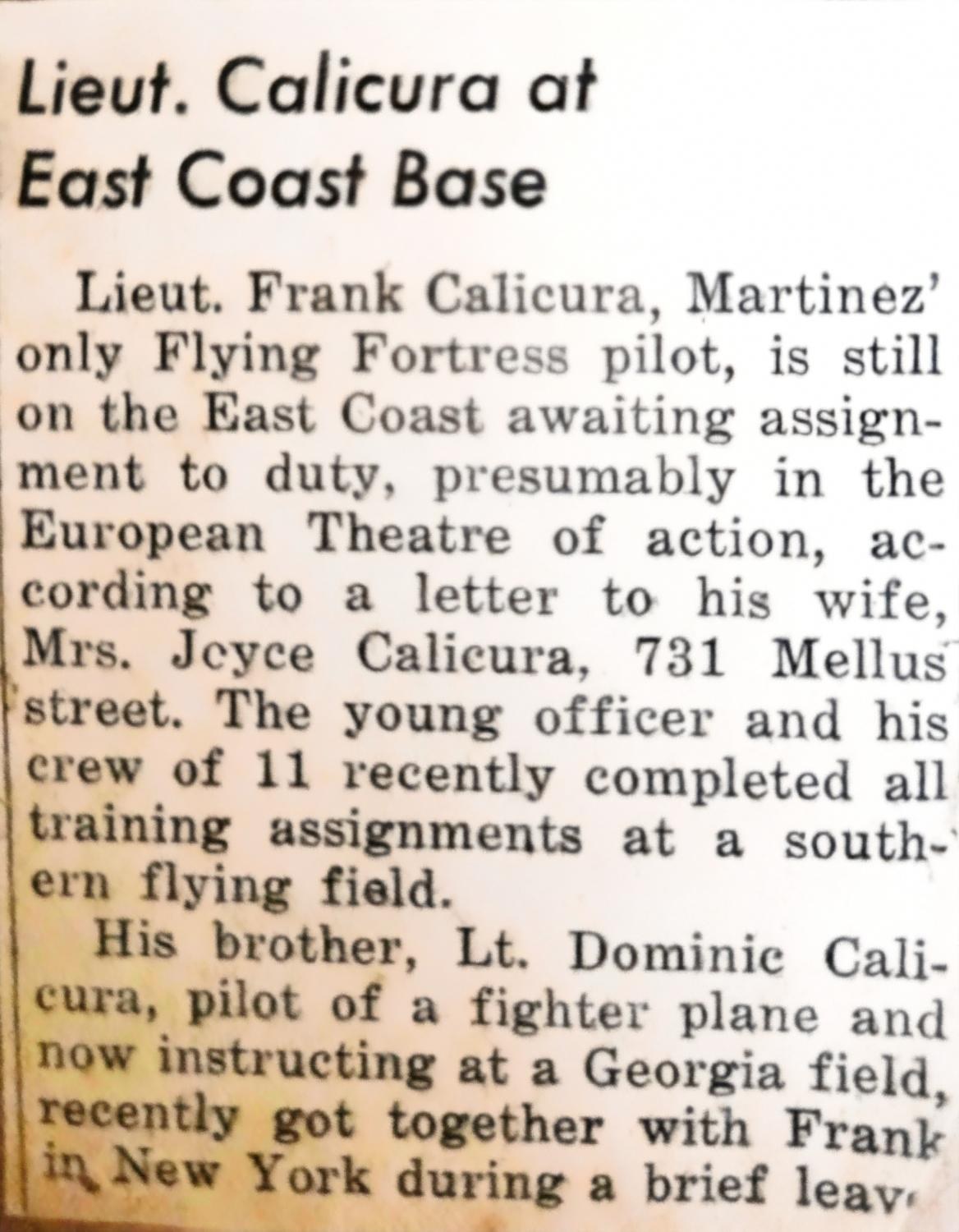


One detail in the clipping does not match anything else in this book. It gives Frank’s crew as eleven men. Every other source — the nine names established in §6.4, the shipping ticket bearing nine crew signatures and one additional passenger — accounts for at most ten people ever associated with the aircraft, combat crew and passenger together. “Eleven” is not derived from anything else in the record, and it is treated here the same way this book has treated every other hometown-paper figure that doesn’t square with the operational documents: stated, not corrected.
Cite this
The Spirit of Martinez. Nine Strangers, Chapter 6. What a Family Kept.
https://www.spiritofmartinez.com/chapters/nine-strangers
A note on sources