
A note on sources
Who supplied a piece of evidence, and how close to it they stood
Four kinds of material sit behind every page of this book. They do not agree with one another, and where they disagree the disagreement is stated rather than settled.
Provenance
This account was assembled from four kinds of material, and the difference between them matters more than any individual fact drawn from any of them.
It was assembled by a descendant. Frank Calicura was this writer’s grandfather, Joyce Calicura his grandmother, and Samuel Calicura — cited as a family witness, and the boy standing beside his father in the photograph that closes the book — is this writer’s father. The relationship is stated here because the same standard is applied to every other source in these pages: the reader is told who supplied a piece of evidence, and how close to it they stood.
The reading
The voice that follows each chapter is synthetic. It is a reading of the text as written, not a recording.
Start here
Two doors into chapters already written. The method is the same in both: what the papers say, and what they cannot settle.
Chapter 14
The NumberWhy the records disagree. Seven counts attached to one man. Nine attached to nine, on the crew page. None of them is a lie.
Chapter 12
UtrechtFour hundred feet. Flour and chocolate. The war from the ground’s view, as the bomb bay saw it.
The collection
The footlockerThe papers, the plates, and the seven counts. None of them agrees with all of the others.
The four classes of material
First
The family collection
Military records, certificates, photographs, correspondence, newspaper clippings, and physical artifacts held by the descendants of Saverio and Angelina Calicura of Martinez, California.
It is not catalogued, not complete, and not neutral. It preserves what a family chose to keep, which is a different thing from what happened. One of those objects is a copy of Contrails, the 95th Bomb Group yearbook of 1945, from which the nose-art montage in the archive is taken.
Second
The institutional record
Unit histories, crew records, mission logs, government correspondence, and the surviving federal paperwork of a man’s service. This material is more systematic and no more complete.
A great deal of it burned in St. Louis in 1973.
The 95th Bomb Group’s compiled crew record for this crew is published at 95thbgdb.com/crew/59. It is a modern database, not a paper issued at Horham. Each sortie on the mission board links to that compilation’s corresponding mission page. Each man on the roster links to its corresponding person page. The same compilation credits Victor G. Probst with thirty-two sorties — twenty-nine with this crew, three on loan. That figure appears on his person page and in no wartime document held by this family.
The Eighth Air Force daily mission record is compiled at americanarchive.iwm.org.uk. It is a modern finding aid, not a paper issued at Horham. Combat sorties on the mission board link to that compilation’s corresponding day page. The three food drops do not: Chowhound is not in the combat-mission series, and the archive’s Chowhound page is dated 2 May, not the days this crew flew.
The same archive holds a person page for John R. Barnes at americanarchive.iwm.org.uk/archive/person/john-r-barnes — the other copy is americanairmuseum.com/person/127516 — that identifies him as navigator of the Spirit of Martinez. It is a modern compilation, not a paper issued at Horham. The biography on that page was supplied in part by his son.
Dave Osborne’s B-17 Fortress Master Log, which that archive also draws on, lists 44-6838 as CAL'S RASCALS aka THE SPIRIT OF MARTINEZ. That is the log’s other name for the serial, not a second christening.
Third
The contemporary press
Wire reports and hometown papers, several of them clipped and annotated by hand at the time. A substantial share of the mission clippings cited here comes from a single object: the scrapbook Joyce Calicura kept through the war and for the rest of her life.
She clipped the dispatches as they appeared. After Frank came home the two of them sequenced and numbered them together, glued to black pages and bound in a wooden cover made for the purpose.
The war coverage reproduced here is not a neutral sample of what the papers printed. It is what one woman in Martinez chose to cut out and keep while her husband was flying, arranged afterward in the order the missions were flown. Newspaper content is referenced by headline, publication, and date, paraphrased rather than reproduced, and treated throughout as what it is: a first draft written under deadline by people who did not have access to the records now available.
Later obituaries are a different thing from the wartime clippings. Marvin L. Markus’s 2015 notice in the Bartlesville Examiner-Enterprise is kept at okcemeteries.net/kingfisher/kingfisher/m/markusmlobit.htm, with a shorter funeral-home listing at stumpff.org. Emily “Lu” Bogacki’s 2020 notice is at wkbn.com/my-valley-tributes/emily-lu-bogacki-greenville-pa/. They are what those families told a paper after the men were gone. They are cited as such.
Fourth
The mission charts
Fourteen printed aeronautical charts, Newcastle to Prague, heights in feet, each headed CAPTAINS OF AIRCRAFT MAP and each annotated by hand with a mission number, a date, control points and their times, an initial point, a rally point, and flak concentrations shaded in colored pencil. They cover missions one through fourteen without a gap.
Whose hand made the annotations is not established here.
What the charts record is a mission count kept while the tour was still being flown. Where that count can be checked against the group’s crew record — at missions three, four, five, six, eight, nine, ten, twelve, thirteen and fourteen — the two agree.
The flak shading is planned intelligence, not observation. The times are briefed times, not flown times.
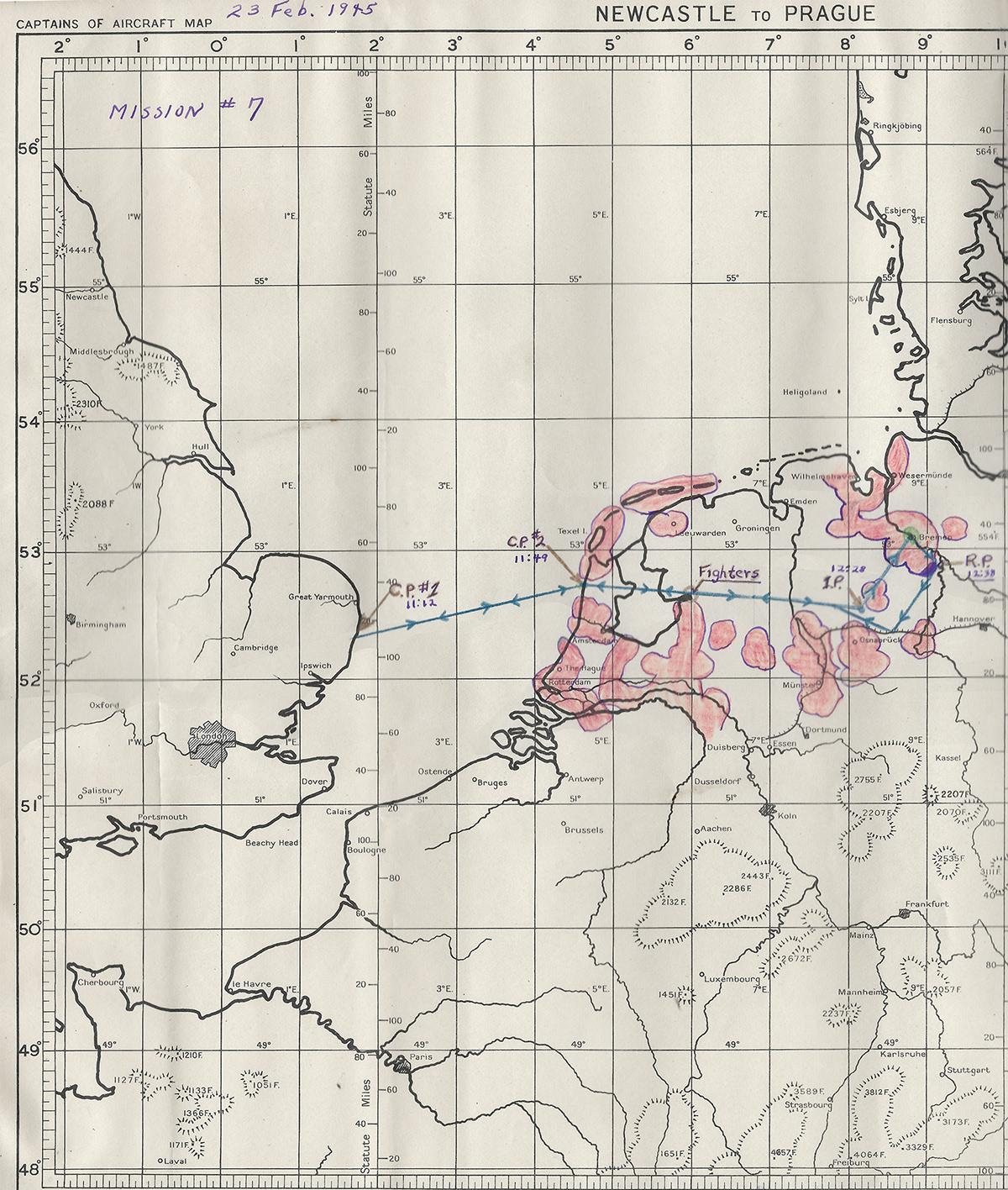
Captains of Aircraft Map, Newcastle to Prague. Hand-dated 23 Feb. 1945 and numbered Mission #7. Control points, an IP, an RP, fighters, flak in colored pencil. The crew record puts mission seven on the 24th, at Bremen. Whose hand made the annotations is not established here. The flak is planned intelligence; the times are briefed times.Family collection

How conflicts are handled
- Disagreements are stated, not resolved
- Where the three records conflict, the conflict is named on the page. Nothing is quietly reconciled to make a cleaner story.
- Inferences are labelled where they are made
- Where a claim rests on inference rather than a document, it is identified as an inference in the text itself rather than buried in a note at the back.
- Absence is reported
- Gaps in the record are stated as gaps. Nothing has been supplied to fill them.
- The clipping is not the event
- A newspaper is evidence of what a paper printed, on deadline, at a distance. It is not evidence of what happened.
None of these documents agrees with all the others about exactly what happened, or exactly how many times it happened. The book stopped trying to resolve that. A family kept everything anyway.