
Chapter 2 · 1927–1943
The Strip by the Tracks
Martinez waterfront — 1927 to February 1943
The ground had a history before they touched it. Two men rebuilt a half-working strip on city fill. One of them is Frank’s eldest brother. Both younger brothers enlist as Aviation Cadets from the field he taught them on.
A synthetic reading of this chapter is in the bar at the top. It will keep playing while you move through the book. The text below is the transcript. The voice’s place on the page is marked as it reads.
2.1
The ground had a history before Beatie and Calicura ever touched it. The Gazette had floated the idea of a municipal airport on the Martinez waterfront as early as August 1927, and by January 1928 the paper was proposing the same reclaimed ground east of the municipal wharf that the airfield would eventually occupy. A deputy sheriff built the first hangar there in 1933. The field opened, in some rough working form, in July 1935 — though by one account its condition was not the best. It was still too minor to appear on any aeronautical chart as late as 1936; the earliest surviving photograph of it dates to 1937, showing a single runway and a few small buildings on the west side.
So in 1939, when two men who owned airplanes and had nowhere in Martinez to keep them turned their attention to that ground, they were not starting from nothing. They were taking over a strip that had already sat there, half-working, for six years, and beginning to rebuild it into something a city would grant exclusive commercial rights to operate.
Charles Beatie lived in Pleasant Hill. Sam Calicura Jr. lived in Martinez and was Frank’s eldest brother. Both kept their aircraft at other people’s fields because Martinez had no hangar. The land they chose belonged to the city and had been made, not found — filled ground along the strait, level and worthless and adjacent to the Southern Pacific line that ran the length of the waterfront.
The Tribune of July 24 carried it: Martinez Aviators Begin Work Of Restoring City’s Flying Field. Charles Beattie and Sam Calicura, owners of planes housed elsewhere for lack of hangars, discing and dragging a runway on filled land belonging to the city. Moral support, no money. Waterfront Commissioner C. A. Ricks would not object to hangars and would not build them. The paper spells Beattie with two t’s.
See the platePlate 05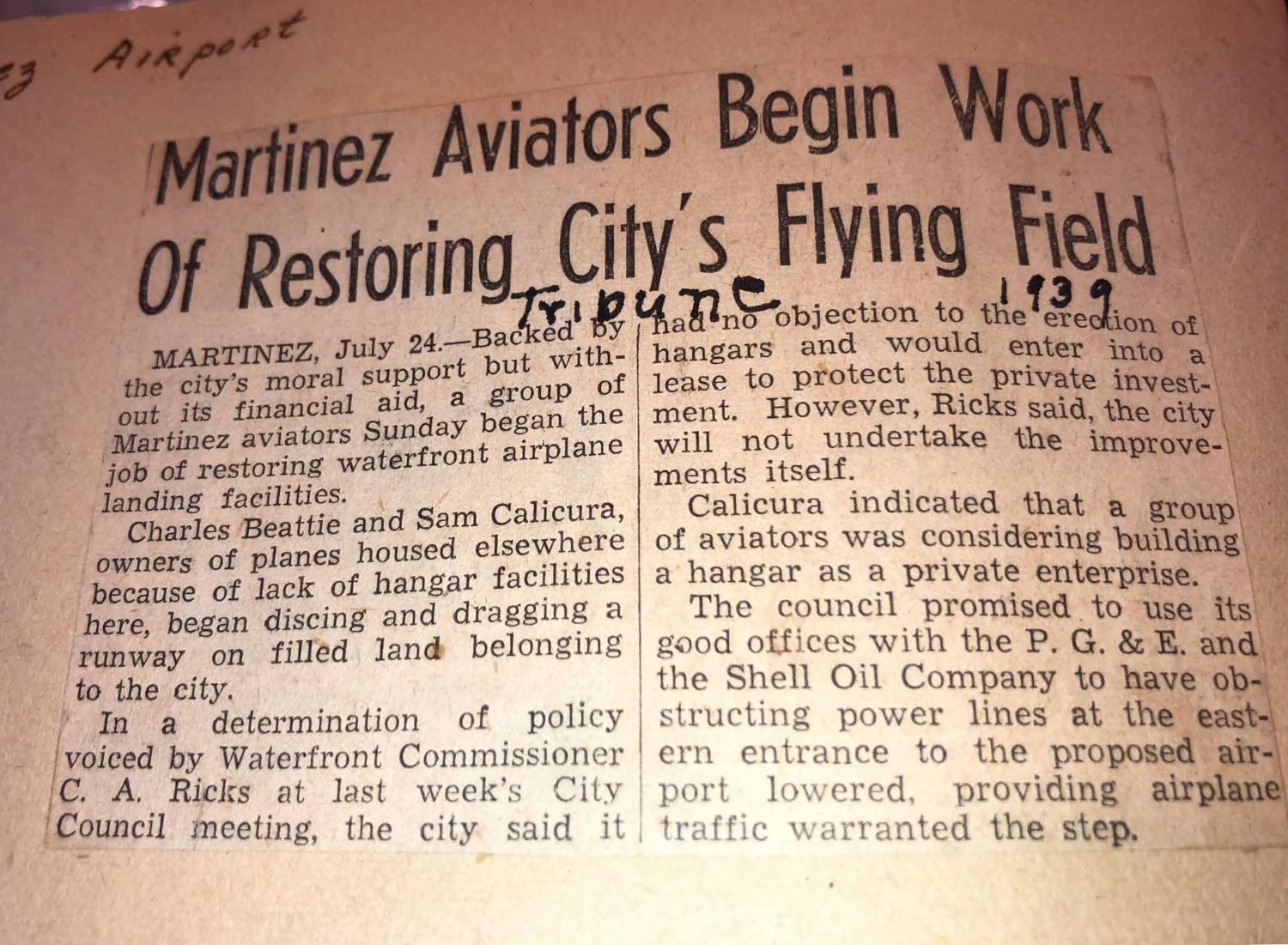

Sam Calicura Jr. appears in the family’s photographs the way he appears in its history — present, central, and rarely the subject. One portrait from the early 1940s shows him with his son Richard, born in 1934, both of them in suits and ties.
See the platePlate 06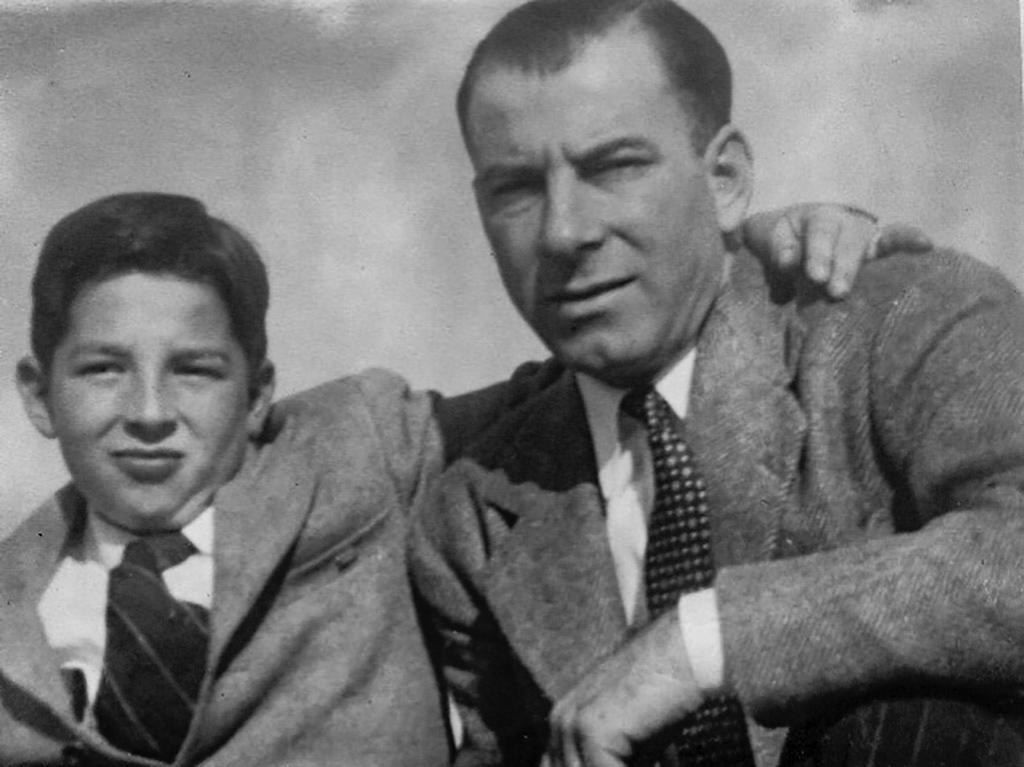

The city gave them what the record calls moral support and no money at all. What it did give was introductions. The waterfront commissioner, C. A. Ricks, and the council offered their good offices with Pacific Gas and Electric and with Shell Oil, whose refinery stood above the town, for whatever accommodations an airstrip on that ground was going to need.
This is how most small American airfields came into existence in the late 1930s. Not through appropriation or federal program, but through two or three men with airplanes, a piece of ground nobody wanted, and a municipality willing to be helpful in every way that did not involve a check.
By 1940 Ricks had been elected mayor, and Beatie and Calicura had come away from a meeting with him holding exclusive rights to operate a commercial airport on the Martinez waterfront.
The meeting was covered directly. On December 12, 1940, Sam Calicura and Beatie appeared before the city council to ask terms for leasing hangar space on the waterfront, telling councilmen they held a deposit on a building at the San Francisco World's Fair and needed to move it off Treasure Island as soon as possible. They asked for the exclusive right to operate a commercial hangar on the field. Mayor Ricks told the council that since the two men were “pioneering the situation,” he felt they were entitled to protection and should have “first crack at everything as long as they are doing right.” The council agreed, verbally, to grant the lease.
The Golden Gate International Exposition was closing, and that was the whole of their hurry. The Gazette says only this much about what they bought: a building, purchased at the exposition grounds, for airplane hangar purposes. It does not say which building, or what it had been used for during the fair, and nothing else in the collection does either. It came in pieces, by truck, across the bridge and down to the strait, and the work ran late through a wet winter. The power lines strung around the field were a problem the whole time; with a hangar added to the ground beneath them, the authorities judged the approach dangerous.
A contemporary clipping dates the start precisely. In the Gazette of December 16, 1940, contractor William E. Douglas “began Saturday” — the fourteenth — erecting the building on the airport grounds; the structure, the paper noted, would house several planes. Beatie had purchased a new 105, a three-place cabin Stinson, for the field.
So: the fair Frank Calicura had visited in 1939, on an island dredged out of the bay to be an airport that was never built, was dismantled — and one of its buildings was trucked to Martinez and stood up on filled land beside the railroad tracks, where it became the hangar of an airport that actually existed.
See the platePlate 01See the platePlate 02See the platePlate 03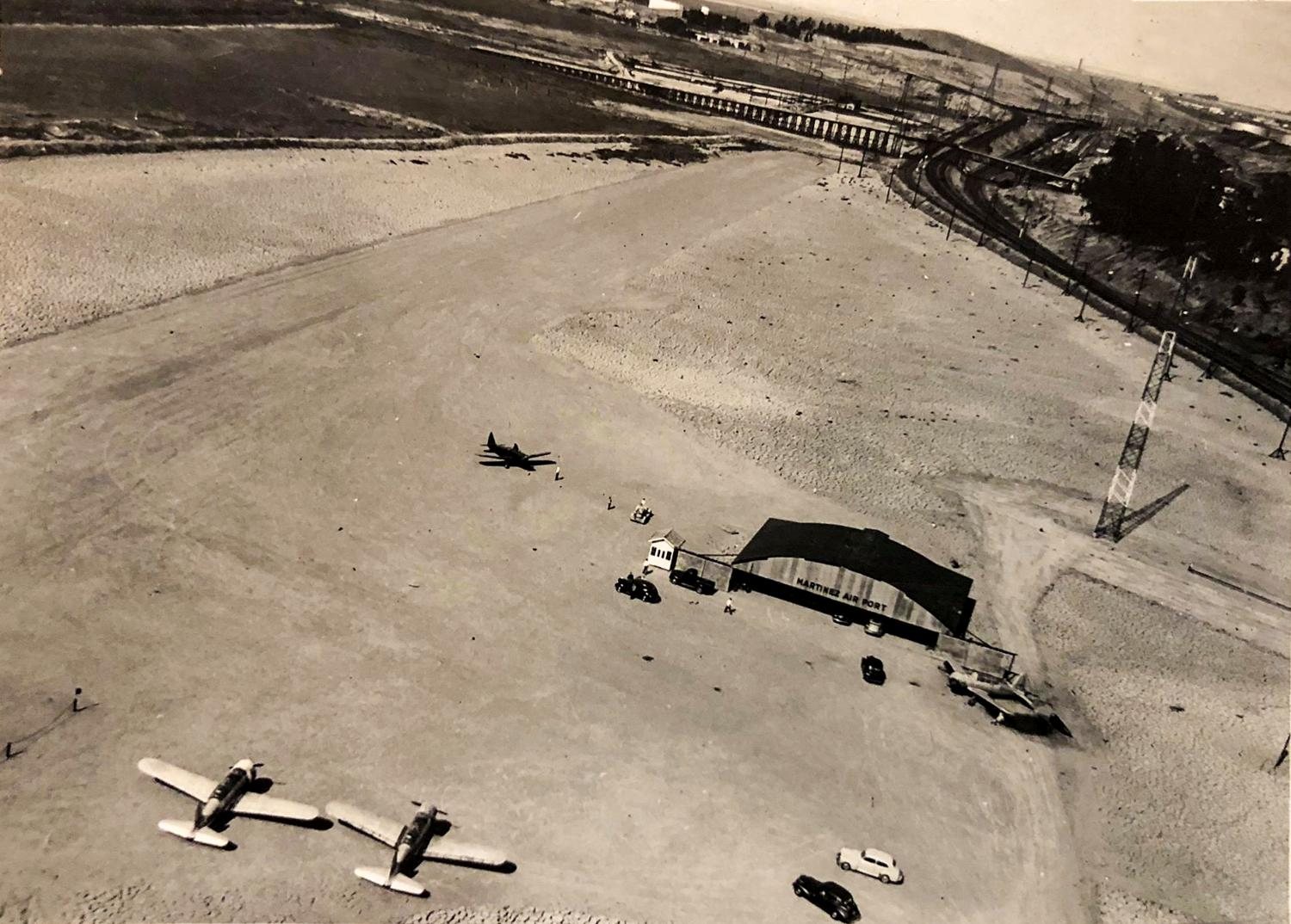
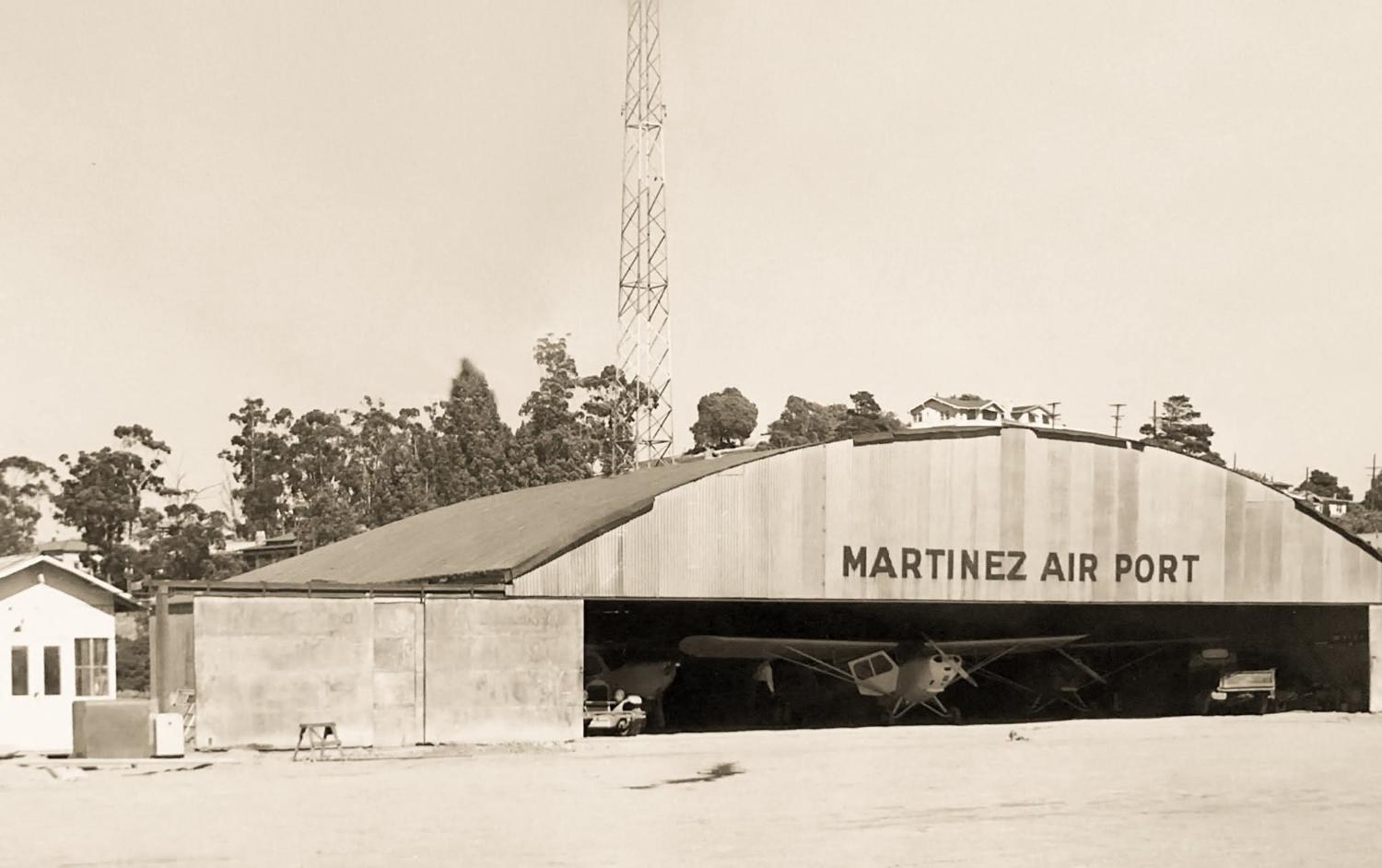


Which building it had been is worth wanting to know and not worth guessing at. Treasure Island had been laid out with a terminal and two hangars along its south shore, built for the municipal airport it was supposed to become; it also had the Gayway, and exhibition halls, and a great deal else. Any of it was for sale that winter. The Gazette reported a purchase, not a provenance.
The hangar's completion did not end the field's troubles. A Gazette clipping dated February 27, 1941 quotes Sam Calicura Jr. directly on the problem that had dogged the site from the start: hazardous wires on the airport's east side, he said, were the one factor keeping a shop operator from locating there, and their removal would let two developments follow — a representative of the Franklin Aircraft Corporation had already asked about installing a motor repair shop next to the hangar, and the Twin-Coach Company, which operated a fleet of delivery trucks and kept two planes for taxiing its own personnel, was prepared to base its aircraft at the field permanently once the wires came down. The hangar itself, once finished, would measure 65 by 75 feet — large enough for eight to ten medium-size ships — and most of that space, Calicura said, was already spoken for.
Some of that promised traffic arrived. An undated clipping in the collection reports that Warren Susan of the Alameda Air Service had reached an agreement with Sam Calicura and Beatie, by then established as lessees of the field, to move his servicing operation to Martinez — five employees relocating with it, and Susan himself erecting a shop at the airport hangar. Susan was, at the time, rebuilding an eight-place Travelair-6000 seaplane, which he intended to base and operate from Martinez once the move was complete, alongside service work he already performed for other operators in the area. The field that had opened as two men's private ambition was, within a year, drawing outside business to the waterfront on its own account.
A hand-drawn plan of the finished field survives in the collection, undated and unsigned, titled Martinez Airpark and drawn to a scale of one inch to two hundred feet. It gives the runway as 2,112 feet by 100, with a second strip of 1,800 by 50 running off it at an angle, a parking area, taxi strips, a road along the south edge, and a single building 60 by 70 feet.
Most of the sheet is not about dimensions. It is about oil. The entire runway was to be oiled lightly, to lay dust; the center fifty feet oiled heavy, to withstand water; the taxi strips oiled heavy and crowned eight inches; the parking area oiled for dust only; the road oiled heavy. Five specifications, all addressing the same fact — that the field was made ground on a strait, and what it mostly had to survive was weather.
The building on the plan is 60 by 70 feet. The Gazette, quoting Sam Calicura Jr. in February 1941, gave the hangar as 65 by 75. The plan is undated, and the difference may be nothing more than the gap between a figure quoted to a reporter and a figure measured afterward, but the two are not the same and this book does not reconcile them.
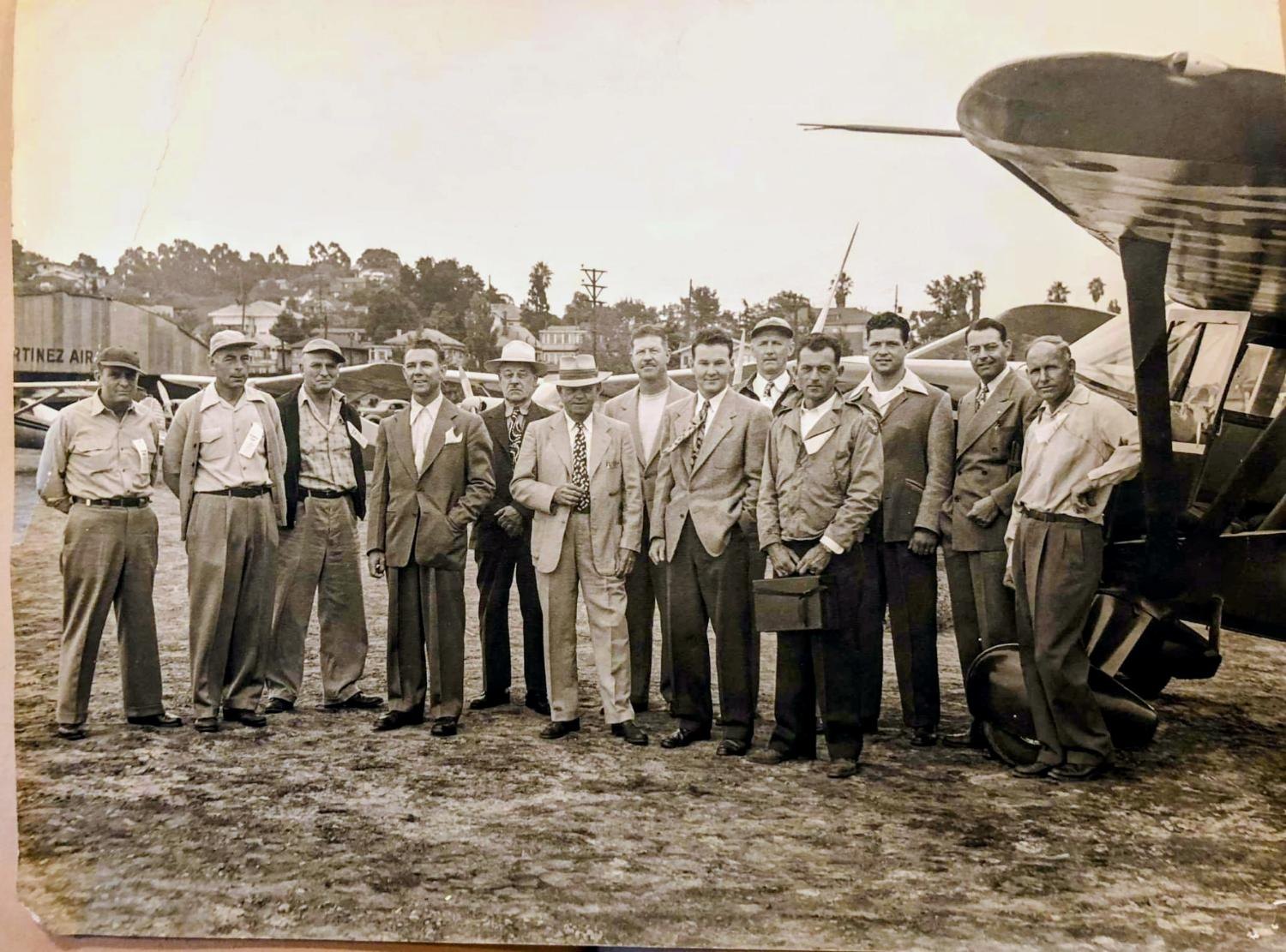
Sam Calicura Jr. was the field’s co-founder and its vice president. He taught his two younger brothers to fly there. A group plate from the strip shows him fourth from the left, in a suit, no cap. The other men are not named here.
That last sentence is the one to read slowly. Frank Calicura did not go looking for aviation, did not answer a recruiting poster, and did not have a moment of vocation that anyone recorded. His older brother rebuilt an airfield four blocks from the family’s front door and taught him, and taught Dominic, on that strip of fill between the refinery and the water.
See the platePlate 04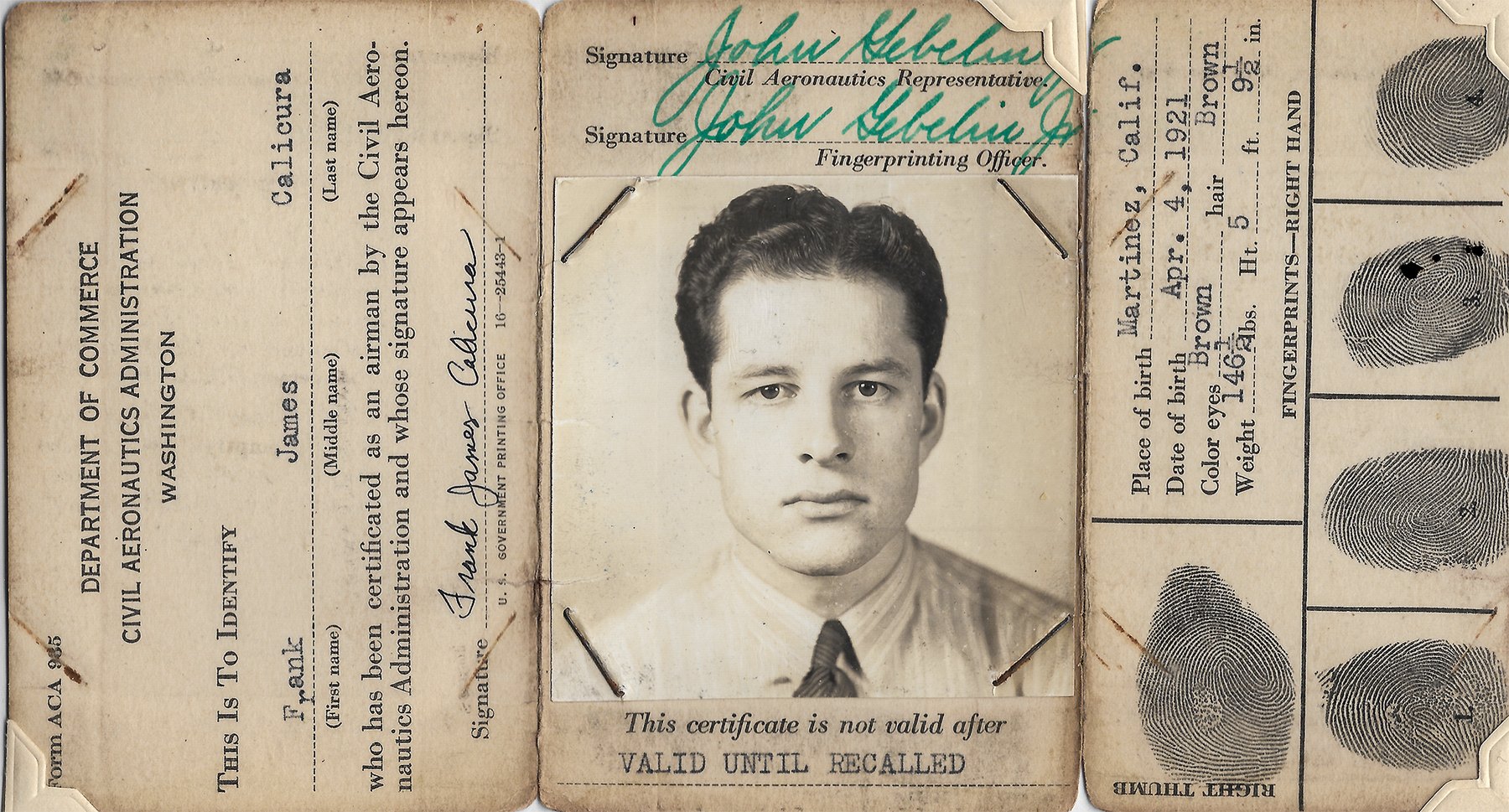

Both of them enlisted as Aviation Cadets in June 1942.
The short snorter dollar bill in the family’s collection carries the signatures of men and women connected to that airport. Charles Beatie’s name is on it.
See the platePlate 91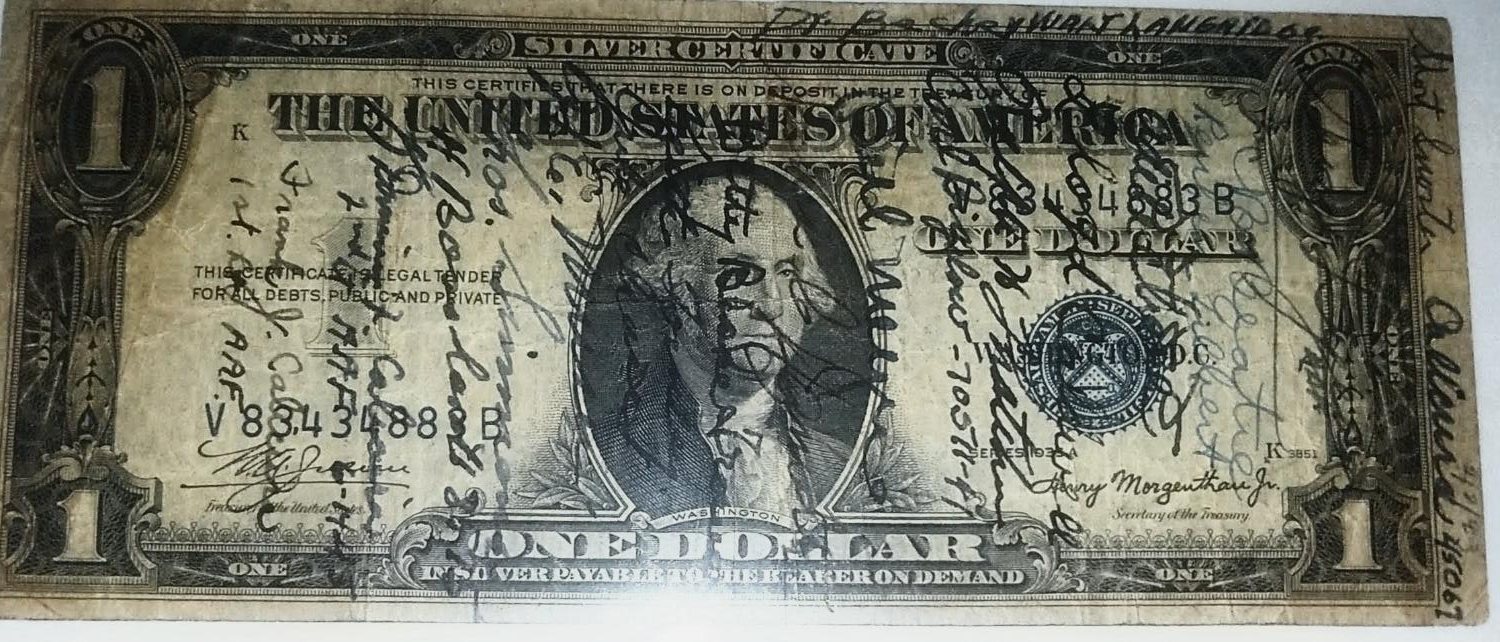

2.2
Oakland, California — July 1942
In July 1942 a national aviation magazine ran a section on the Metropolitan Oakland unit of the Aircraft Owners and Pilots Association. Two of the men in it were Charles Beatie and Sam Calicura Jr., photographed with a Curtiss Robin.
See the platePlate 08See the platePlate 07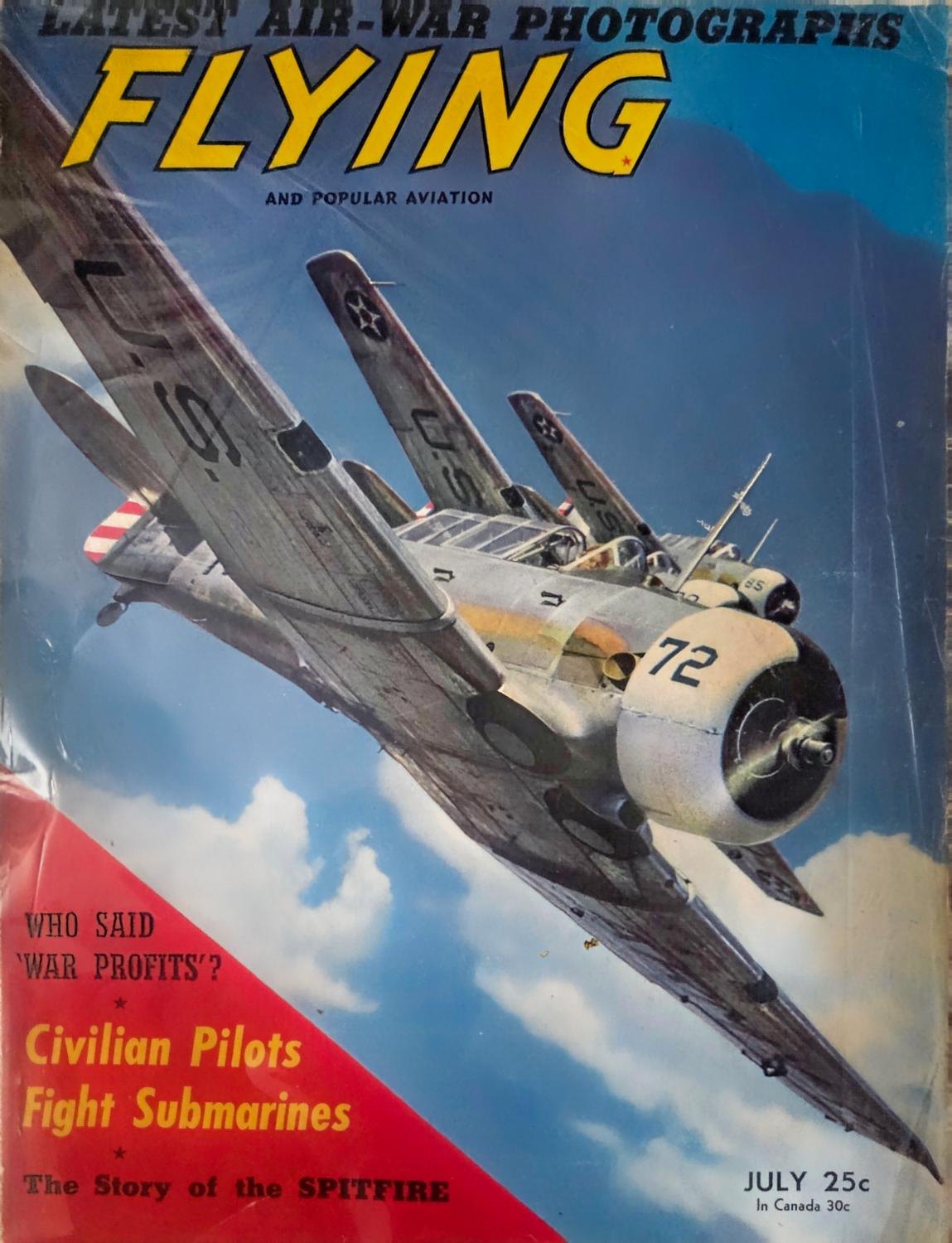
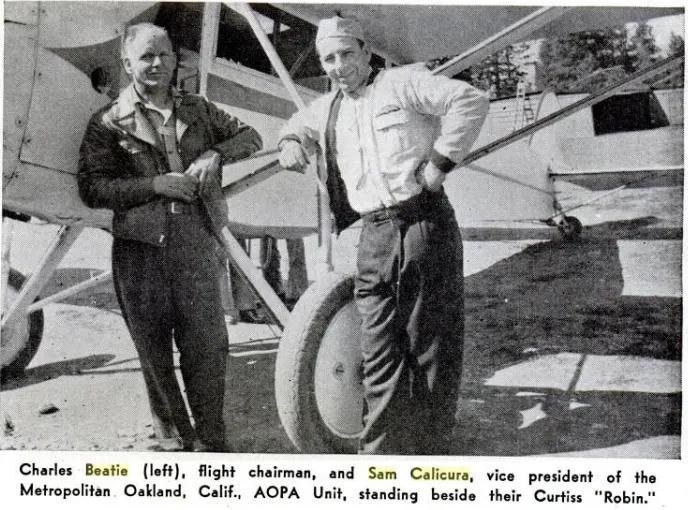


They were the same two men who had rebuilt a runway on the Martinez waterfront three years earlier. What had happened to that airport in the interval is the reason the photograph exists.
Late in that interval, and before the war closed it off, the same association ran a competition flight over Alameda County. Pilots were handed photographs of ground objectives, sent up to locate them and mark them on a flight map, and asked to predict their own flying time before takeoff; air raid warning lookouts tracked the aircraft from the ground and reported what they saw. The winner was Sam Calicura of Martinez. He spotted every objective on his route and judged his own flying time to within fifteen seconds. Charles Beatie, flying the same exercise, was thirty seconds off. The clipping carries no date, but a Junior Chamber of Commerce Aviation Day and an association meeting set for October 28 place it in the autumn of 1941 — a matter of weeks, as it turned out, before the thing being rehearsed for arrived and the rehearsing stopped.
On December 8, 1941, every civil aircraft in the United States except the airliners was grounded. The ban was lifted two days later for most of the country. It was not lifted for the West Coast. Restrictions on private flying along the coast continued after that, in a region the government had decided was the likeliest to be attacked next — and Martinez sits on a strait with a Shell refinery above it, twenty-five miles from the Golden Gate.
So the field that two private owners had rebuilt out of city fill, a bought fairground building, and their own labor was closed to the flying it existed for, within eleven months of receiving its operating rights.
Grounded did not mean idle. The Gazette reported it on December 12, 1941, five days after Pearl Harbor and four after the grounding: a Contra Costa County sheriff’s air posse, fully organized, M. V. Hanley of El Cerrito elected president, Ed McLaughlin of Albany secretary, with Sam Calicura and Charlie Beatie of Martinez named to its organizing committee alongside members drawn from across the county. The unit had, by its own account, no aircraft currently permitted to fly. It organized anyway, on the working assumption that the restrictions would eventually lift and that trained pilots would be worth having ready for defense work when they did. That is the same reasoning the Civil Air Patrol would formalize nationally within months. Here it shows up first as a county sheriff’s volunteer roster, assembled by men with nothing to fly, before Washington caught up to the idea.
The Metropolitan Oakland unit put that principle into practice directly. An AOPA national bulletin praised the group by name for keeping flying activity alive on a grounded coast, citing a successful overnight excursion to Quincy via the Western Pacific Railroad and a Memorial Day weekend trip to Reno, held over the last weekend of May. Beatie and Calicura, pictured beside their Curtiss Robin, were named as the unit's flight chairman and vice president. The bulletin invited any pilot in a grounded area of the western defense region to write the unit's secretary in Berkeley for details on running a similar program. What circulated nationally was the Oakland unit's answer to being grounded, not Martinez — but two of the men answering for it were the two who had rebuilt the Martinez runway out of the fill.
The organization that absorbed men in this position had been created six days before Pearl Harbor. On December 1, 1941, Fiorello LaGuardia, running the Office of Civilian Defense, signed the order establishing the Civil Air Patrol, with Maj. Gen. John F. Curry as its first national commander. Its founders had spent two years arguing that the country’s private pilots and their aircraft were a national asset that would otherwise be grounded and wasted. Within a month of its creation they were proved right in the most direct way available.
The Curtiss Robin in the photograph was a fourteen-year-old airplane. It first flew in 1928, a high-wing cabin monoplane from the era when a manufacturer still expected to sell aircraft to private citizens the way one sold automobiles. By 1942 it was thoroughly obsolete and thoroughly useful — an airframe that could carry a man aloft to look at something and bring him back.
Sam Calicura Jr. was thirty-six that summer. He was past the age ceiling for aviation cadet training by a decade, he had been born in Italy, and he had a business. He was not going to fly a bomber. What he did instead was teach — young flyers, through the Civil Air Patrol, which is what he had already been doing at Martinez without a war to justify it.
His name and his photograph were in a national magazine in July 1942.
His two younger brothers had enlisted as Aviation Cadets the month before.
2.3
Martinez, California — June 1942 to February 1943
The *Contra Costa Gazette* recorded it in June 1942: two of the Calicura brothers, Frank and Dominic, had enlisted as Aviation Cadets.
The clipping the family kept does not treat them as a pair. Under the heading CONTRA COSTA IN THE WAR, Dominic F. Calicura, of 515 Mellus Street, has been accepted by the Mather Field Cadet Examining Board and will be sent to Santa Ana for pre-flight. Frank, employed with his eldest brother Sam at the Star Meat Market, is standing by, expecting notice momentarily for similar duty. Both Alhambra High. Joyce remaining in Martinez, employed with the Pacific Telephone and Telegraph Company. The paper does not date the column. This book has both men enlisting in June 1942. The clipping is the hometown version of that month: one brother already accepted, the other still at the block.
See the platePlate 09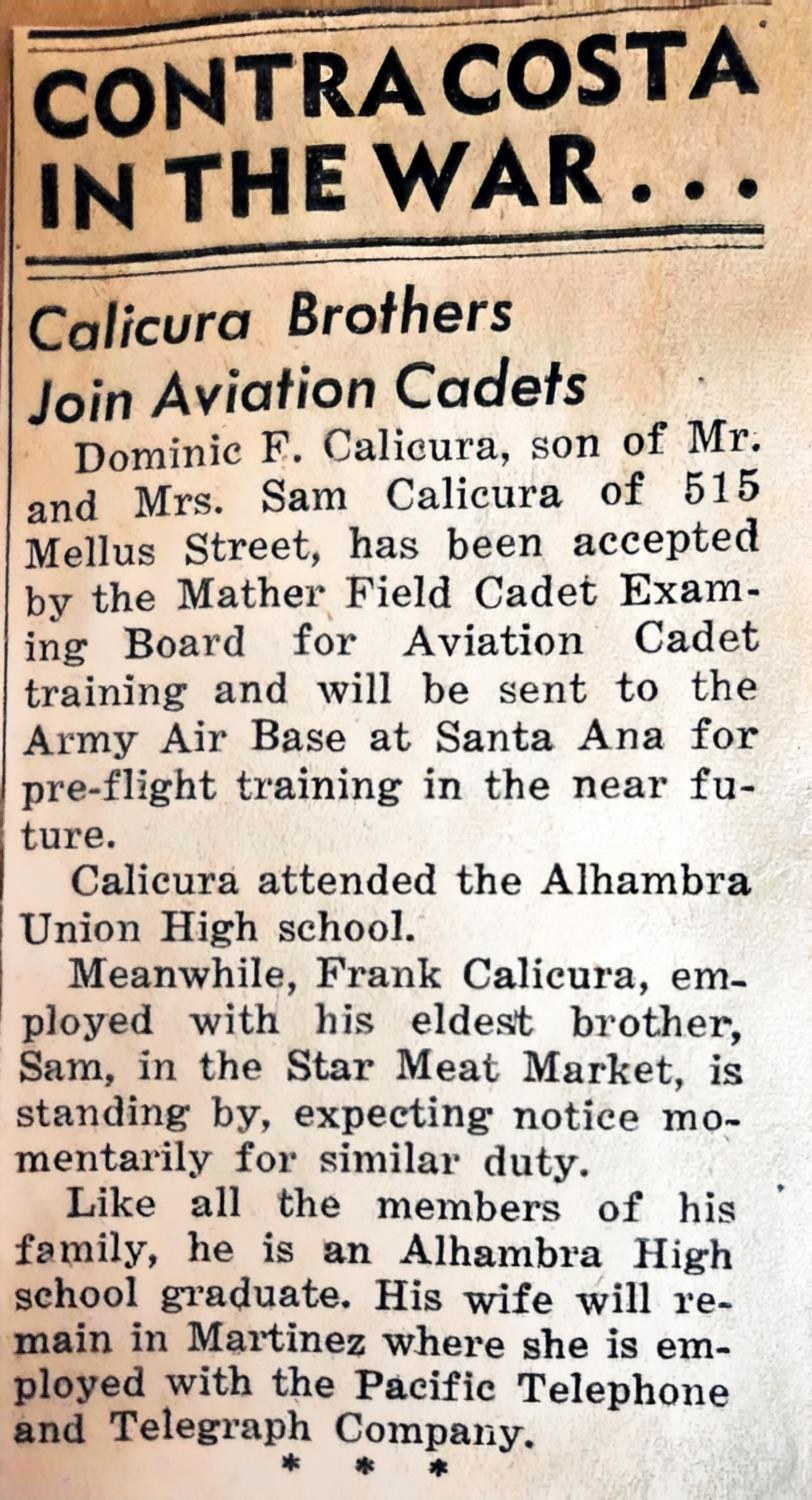

Six months earlier Frank would not have qualified. Until January 1942 the Army required two years of college of anyone entering aviation cadet training, and he had none — he had finished high school in 1938 and gone to work cutting meat. Then on January 15, 1942 the requirement was struck out and replaced with an examination. The Aviation Cadet Qualifying Examination measured what the college requirement had been standing in for, and measured it better; college men now sat the same test as everyone else. The doorway that opened for Frank Calicura opened because the Army had finally worked out that a transcript was a poor instrument.
What he enlisted into was not the Army, exactly. It was a waiting room.
The Air Corps Enlisted Reserve had been established in April 1942 for precisely this purpose. A qualified applicant could enlist for active duty as an unassigned private and go sit on a base — or he could enlist in the reserve, go home, keep his civilian job, and wait to be called when a training slot opened. The Air Corps wanted the men claimed and on its books. It did not yet have anywhere to put them.
So Frank Calicura, aviation cadet, spent the second half of 1942 cutting meat on Main Street for his brother.
He was not alone in it. By December 1942 roughly ninety-three thousand men were in the same condition — enlisted, classified as future aircrew, and waiting. Many had been waiting six or seven months. The pool was large enough and idle enough that the selective service boards and the War Manpower Commission began asking about it, and the Air Corps’ own reasoning for holding them was recorded without embarrassment: better to store the men and risk a morale problem than release them and let the public conclude that the Air Corps had more cadets than it could use.
The bottleneck was never volunteers. After Pearl Harbor there were more than the system could absorb. What the Army lacked was instructors, airfields, and aircraft, and the entire enormous training apparatus of 1943 was built to work through a backlog that already existed before it opened.
The solution arrived in January 1943, when the Secretary of War ordered the reserve called up and sent to college. About a hundred institutions were selected to begin with. The official history of the Army Air Forces is unusually blunt about why: the college program came into being not to meet an educational need but to hold a backlog of aircrew candidates. At its height in April 1943 more than sixty thousand men were in college training detachments at over a hundred and fifty schools.
Frank was called in February 1943 and sent to Houghton, Michigan, on the Keweenaw Peninsula, five hundred miles north of Chicago, to study physics and mathematics in a winter he had no preparation for.
What the record gives of those eight months is the work and the length of them. Nothing else.
Cite this
The Spirit of Martinez. The Strip by the Tracks, Chapter 2. What a Family Kept.
https://www.spiritofmartinez.com/chapters/the-strip-by-the-tracks
A note on sources