
Chapter 14 · 1945–1959
The Number
What the paperwork says, and what it cannot settle
Seven numbers, none of them a lie. A scrapbook numbered in pencil. A ribbon without a citation. A letter that could not quite decide about a man’s back.
A synthetic reading of this chapter is in the bar at the top. It will keep playing while you move through the book. The text below is the transcript. The voice’s place on the page is marked as it reads.
14.1
Ask how many missions Frank Calicura flew, and the honest answer depends on which document is doing the counting.
Twenty-six is the threshold of the Lucky Bastard Club, a squadron tradition rather than an official Army count, and the card in the family’s collection commemorates his membership in it. Twenty-eight is the number of combat missions the 95th Bomb Group’s own crew record shows him flying, from Chemnitz on February 14 to Oranienburg on April 20. Thirty is painted in bomb symbols on his flight jacket — not, as it turns out, his own mission total, and not quite the number of missions he flew specifically in 44-6838, the Spirit of Martinez herself, either. Subtracting the two missions flown in borrowed aircraft while she sat grounded for an engine change, the crew record accounts for twenty-nine of those thirty symbols and leaves the last one unexplained. Thirty-one is not a number any single document states, but it is the most complete count available once two of them are read together: Lieutenant Colonel Robert Stuart’s own memorandum, dated May 8, 1945, certifies twenty-eight operational missions and two hundred eight combat hours — the same crew-record figure already established here, put in writing by Frank’s own commanding officer at the very end of the group’s existence as a fighting unit — and the group’s separate mission log adds three humanitarian sorties over Utrecht that Stuart’s certification, concerned only with combat performance, does not count. Add them together and the total is thirty-one. Stuart’s memorandum alone still says twenty-eight. The group’s modern compiled crew record titles the listing F.J. Calicura, 31 — independently the same figure, and not a paper issued at Horham. Forty-eight appeared in a Public Forum letter to the Martinez Gazette, a hometown’s rounding-up of a hometown son’s service, generous rather than accurate. Nearly fifty was the figure Frank used himself, in April 1945, describing not his own tally but the Spirit’s — the number of combat missions she had flown, under whichever crew was assigned her, without a single abort. Fifty-three is where that number finally stopped, the aircraft’s full lifetime total from her first assignment through the end of the war, under every pilot who ever sat in her left seat.
None of these seven numbers is a lie. Each answers a different question — a club’s rule, a squadron’s log, a jacket a man painted himself, a colonel’s judgment, a town’s affection, an airplane’s own life.
See the platePlate 103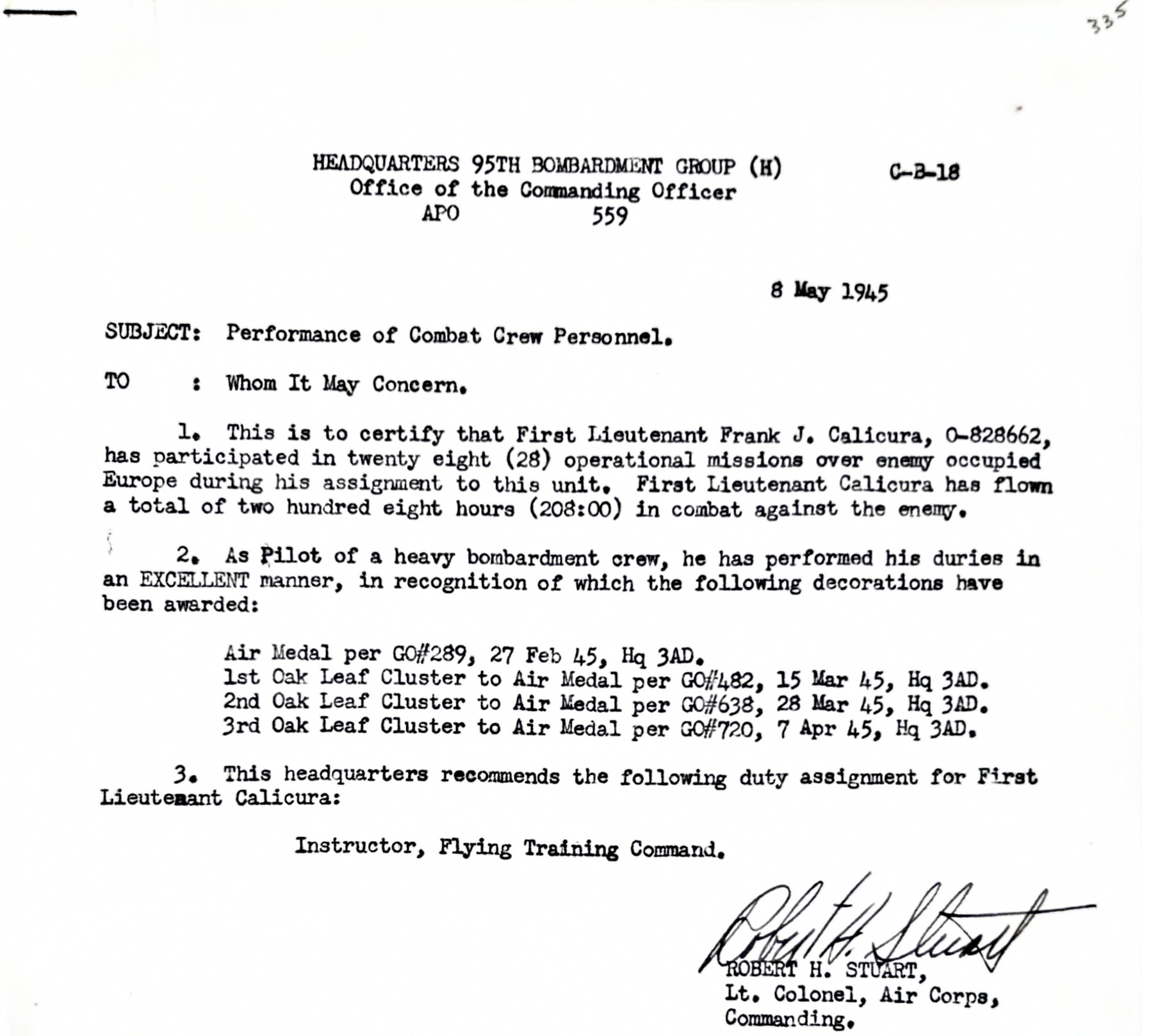

14.2
After Frank Calicura came home, he and Joyce sat down and put the war in order.
She had been collecting all along. Letters reached Martinez on no fixed schedule, and what the family relayed from them reached the Gazette on another; the local papers printed what they printed, when they printed it, and Joyce clipped as it appeared. What she could not do, while it was happening, was sequence it. The delay between a mission and its appearance in print was real and it varied, which meant the pile accumulated across a range of dates rather than in the order the missions were flown.
The ordering came afterward, with Frank in the room. He supplied the dates, the photographs, the identification of which raid was which. She glued the pieces onto black pages and wrote a number in the margin of each one in pencil: Mission #1, Mission #6, Mission #14. The numbering runs from the middle of February 1945 to the third week of April, and it stops at twenty-eight.
Set beside the 95th Bomb Group’s own operational record, the sequence matches mission for mission. The first is the Chemnitz raid of February 14; the second, Cottbus, the day after. Osnabrück is third, the two Nuremberg raids fourth and fifth. The sixth is the Stars and Stripes of Friday, February 23, reporting six thousand aircraft against the whole German rail network — a story that does not name Bamberg. Frank wrote it in the white margin in block capitals. The thirteenth is Swinemünde. The fourteenth names the marshalling yards at Seelze, the fifteenth the war plants at Jena, the seventeenth the airfield at Ahlhorn, the eighteenth the yards at Unna — the same four targets the crew record lists at those same four positions. The twenty-sixth is Munich, the twenty-seventh the attack on the jet airfields in the arc around Berlin — a story naming Burg among the seven fields struck, which is where the crew record puts him on April 10. The twenty-eighth, and last, is a raid on rail yards ringing Berlin whose target list ends with Oranienburg: April 20, 1945, the final combat mission of his war.
See the platePlate 66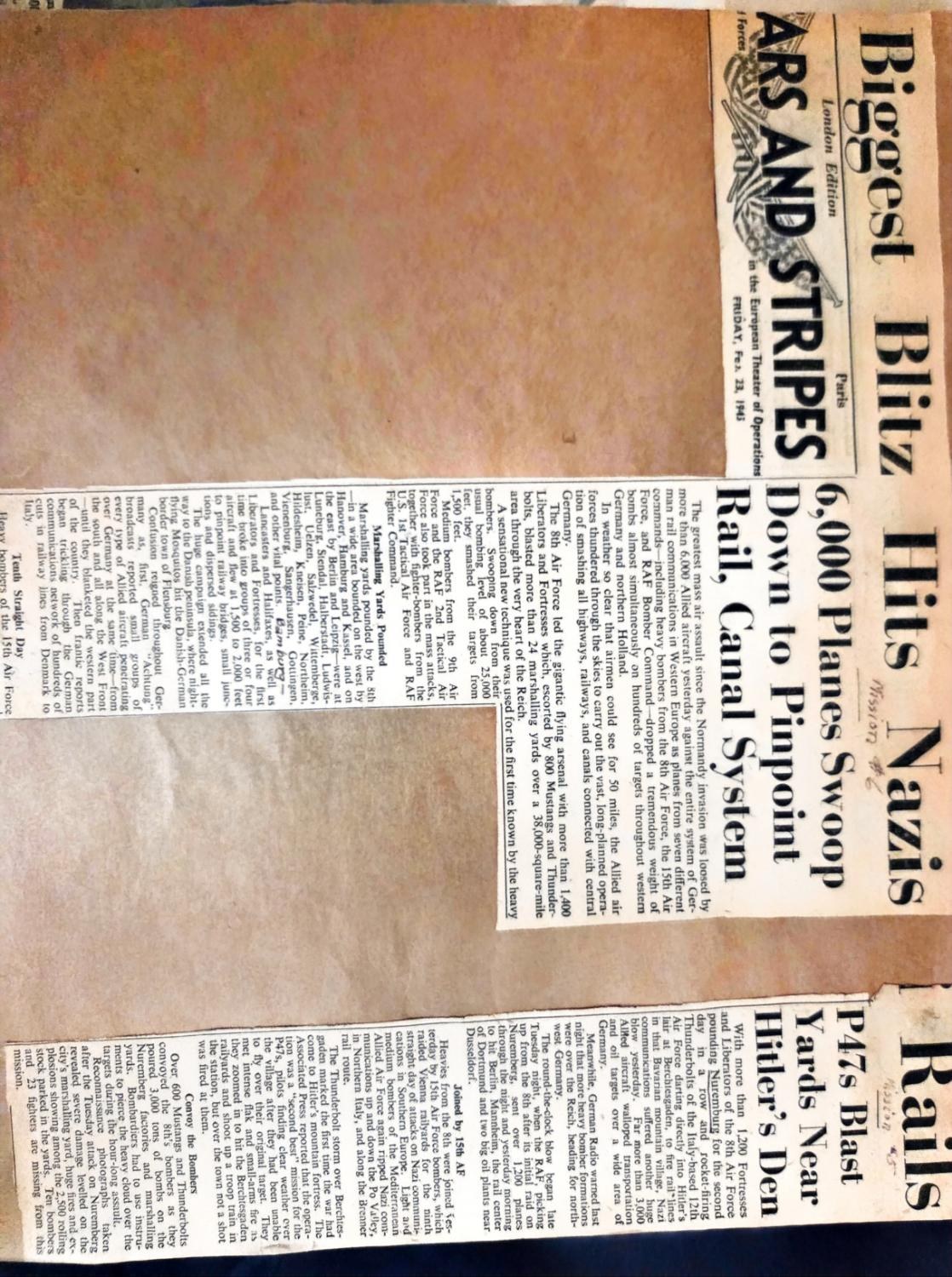

The spread on the black page is that Friday paper, both columns, glued sideways. Mission #6 on the left. The right-hand column is the second Nuremberg, already numbered 5. One map in the same book circles Chemnitz and carries a number that may be 7 or 8. This book numbers Chemnitz first. The pencil is the thesis. It is not required to be tidy.
What the match demonstrates is precise, and it is not corroboration. Lieutenant Colonel Robert H. Stuart certified twenty-eight operational missions at Horham on May 8, 1945, working from squadron paperwork. The scrapbook reaches twenty-eight because Frank Calicura, sitting in a kitchen in Martinez with a shoebox of clippings and his wife beside him, counted to twenty-eight. These are not two tallies that happen to agree. They are the Army’s count and the man’s own count, and the man’s own count is accurate — which is a smaller claim than independent confirmation and a more interesting one. He remembered his war correctly, in order, target by target, months after it ended.
One number in the sequence settles what he thought he was counting. The twenty-fourth is the raid on the ordnance depots in southern Germany, the one whose rail targets included Nuremberg — April 5, 1945, the mission Frank Calicura flew in The Red Fox while the Spirit of Martinez sat at Horham with her cowlings off. It is numbered the same as the rest. This was not a record of an airplane. It was a record of a man, and the airplane he happened to be in that day did not change the count.
What the numbering does not include is equally exact. The three Chowhound drops over Utrecht in May carry no number at all. He did not count them as missions — which is what the Army concluded as well, and which is why twenty-eight and thirty-one are both true statements about the same spring. He was counting the times he was sent somewhere people would shoot at him.
The scrapbook does not settle the jacket. Thirty bomb symbols were painted on the B-15 in the footlocker; the count reaches twenty-eight combat missions, of which two were flown in borrowed aircraft, and three humanitarian drops go unnumbered. No arrangement of those figures produces thirty. That discrepancy stands where it stood.
See the platePlate 96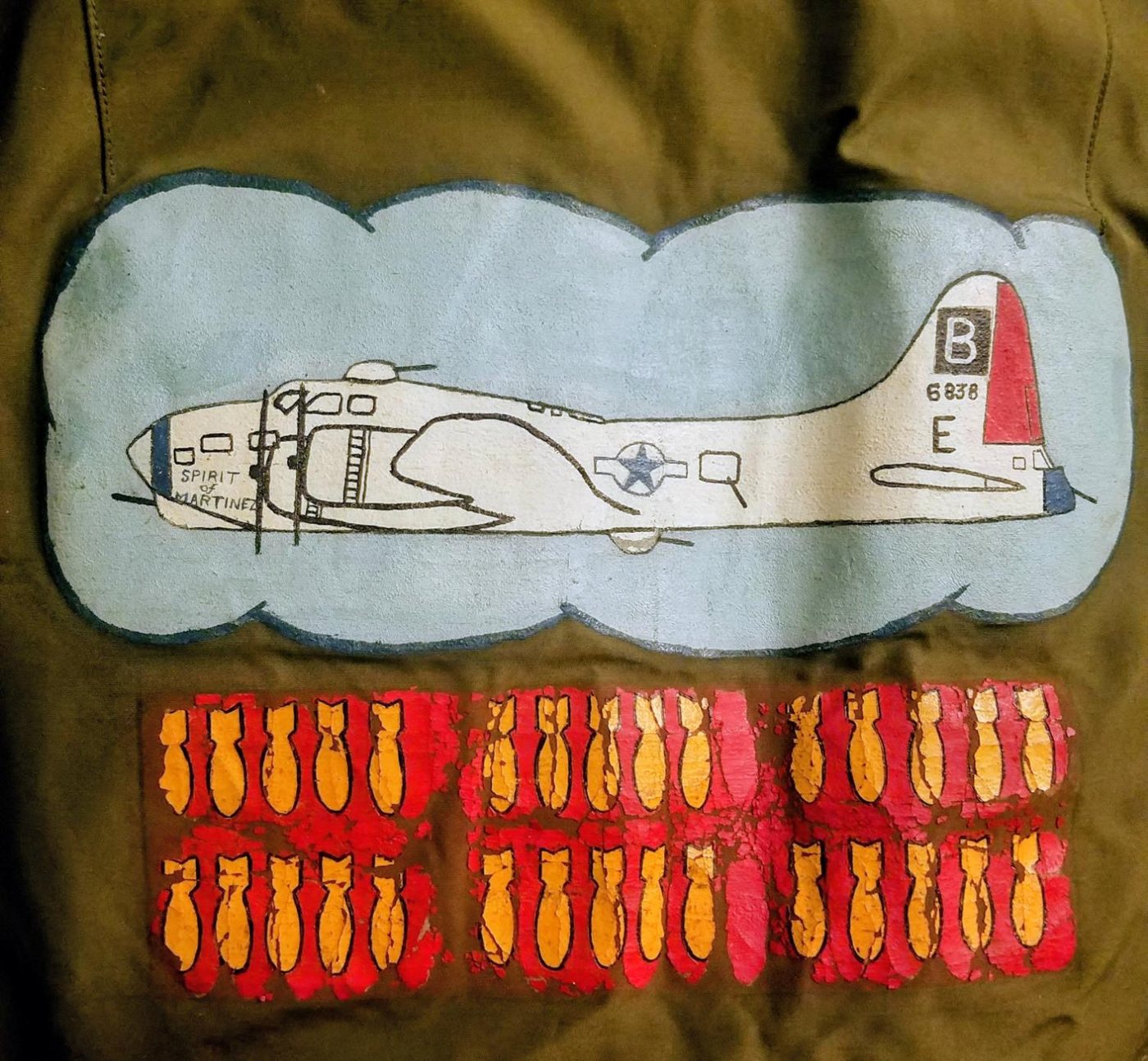

What the scrapbook settles is something the record could not show before. The clippings this book has drawn on for eleven chapters were not a scattering of what happened to survive. They are a series, assembled deliberately, by two people who had the whole thing behind them and decided it should be kept in order.
14.3
The claim file preserves a sworn statement from a man who trained with Frank at Avon Park in the fall of 1944. He recalled, years later and for the record, that Frank had suffered a severe back condition sometime between September and November of that year — before either of them had flown a combat mission — bad enough that he needed help getting into and out of the aircraft.
That is where the injury the Veterans Administration would spend fifteen years adjudicating actually began: not over Germany, but on a training field in Florida, months before the war Frank Calicura is remembered for had started for him at all.
The VA’s decision arrived on October 30, 1959, under claim number C-1,302,621. Compensation was denied. The letter’s own language is more careful than the round number the family has carried forward: the condition was found either not service-connected, or service-connected but rated below the ten-percent threshold required for compensation. Both readings were available in the same sentence. Neither one was a simple no.
Which of the two the examiner meant cannot be known, because the surviving letter does not say, and the ambiguity is better left unresolved than settled by preference. What can be said is narrower and, in its way, harder: a man who could not enter or exit an airplane without help in 1944 was told, fifteen years later, that the government could not establish what had caused it, or that whatever had caused it did not rise to the level the regulations required. The distinction mattered enormously to a claims examiner in Washington. It is not obvious that it mattered at all to the back.
14.4
The service coat survives, and the ribbon bar is still mounted on it. Read left to right, in the order he wore it: a Distinguished Flying Cross in the first position, then the Air Medal carrying three oak leaf clusters, then the European-African-Middle Eastern Campaign Medal with its bronze service stars. Pilot wings above, the winged propeller of the Air Corps on the lapel. The headstone gives the shorter version — Air Medal, three oak leaf clusters. At least one archival summary of the service record, drawn from surviving discharge paperwork, is shorter still: it lists the Air Medal and its clusters, a Good Conduct Medal, the campaign medal, and the WWII Victory Medal, and does not mention a DFC at all.
See the platePlate 98See the platePlate 99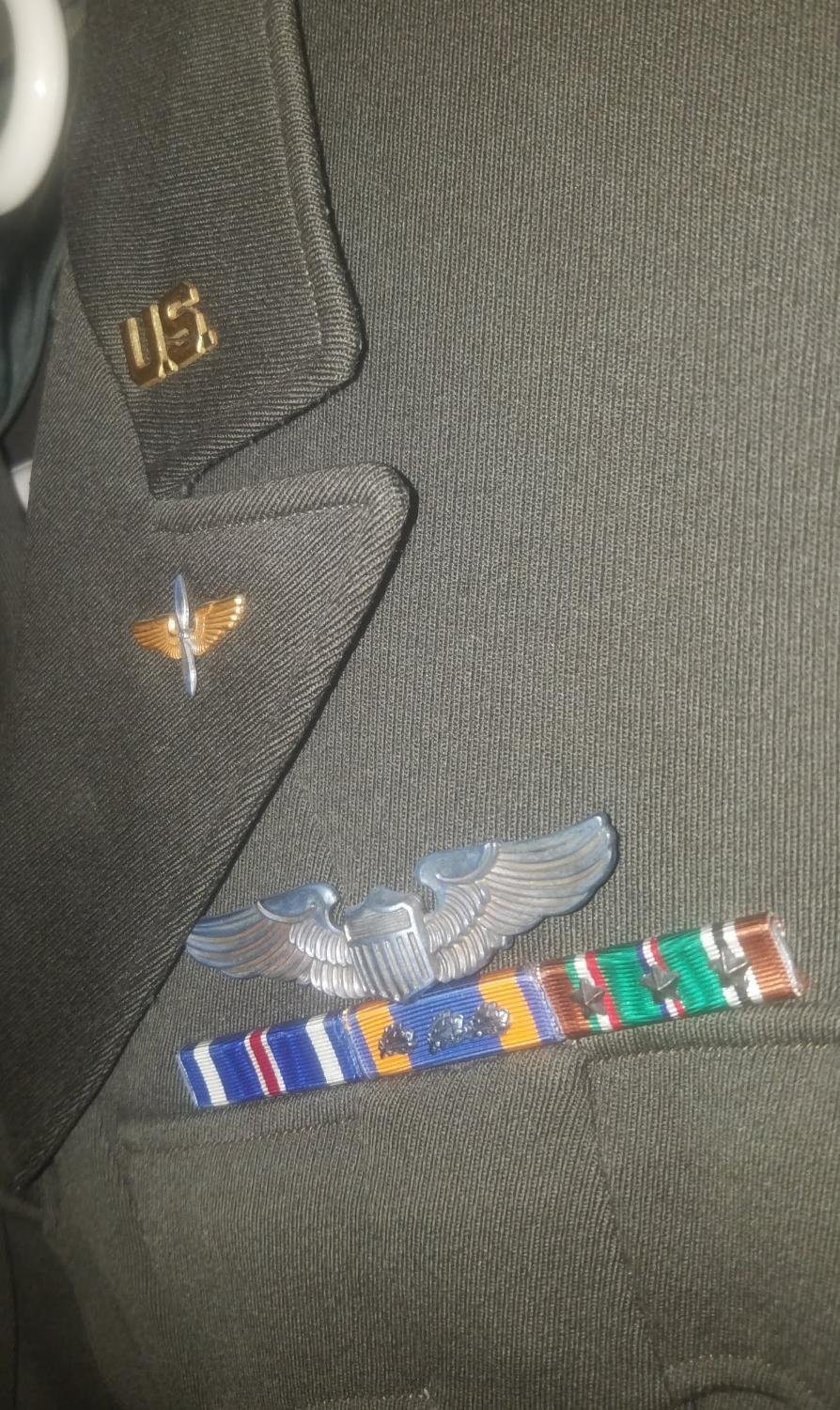
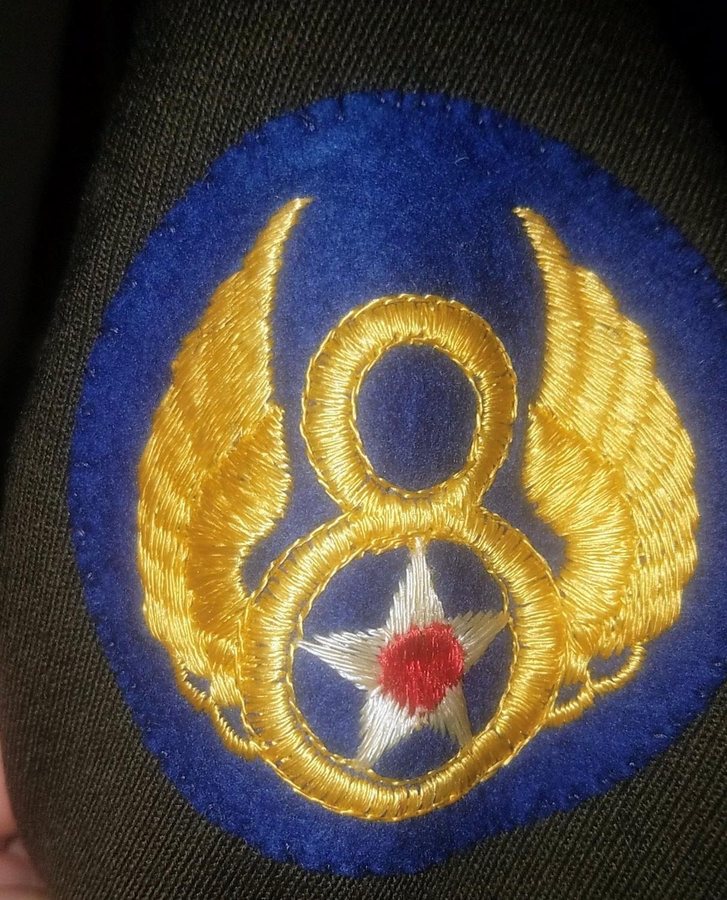

The Eighth Air Force awarded these decorations by a fixed formula, not by individual discretion: an Air Medal for every five qualifying combat sorties, an additional oak leaf cluster for every five beyond that, and — by a policy letter dated November 1942 — a Distinguished Flying Cross awarded in place of the fourth cluster, at the twenty-five-sortie mark. Run against Frank Calicura’s own record, the formula lands exactly where the headstone says it should: one Air Medal, three clusters, and at sortie twenty-five, a cross instead of a fourth ribbon. It is not four separate acts of individual valor. It is a ledger, kept automatically, translated into metal at fixed intervals.
A memorandum in the family's collection, dated 8 May 1945 and signed by Lieutenant Colonel Robert H. Stuart, supplies what the surviving discharge paperwork does not: the citation numbers behind the ribbon itself. It credits First Lieutenant Frank J. Calicura with the Air Medal per General Order 289, 27 February 1945; a first oak leaf cluster per General Order 482, 15 March 1945; a second per General Order 638, 28 March 1945; and a third per General Order 720, 7 April 1945 — all issued by Headquarters, 3rd Air Division. It says nothing about a Distinguished Flying Cross, in either direction.
Three of those four general orders survive in the collection as the orders themselves, not simply as Stuart's later summary of them. General Orders Number 289, Headquarters 3rd Air Division, 27 February 1945, lists Second Lieutenant Frank J. Calicura, serial 0828662, among the 95th Bombardment Group officers and enlisted men awarded the Air Medal — the same citation Stuart's memorandum would repeat ten weeks later. General Orders Number 638, 28 March 1945, and Number 720, 7 April 1945, both award him an Oak Leaf Cluster to that medal, both under the same serial number, both matching Stuart's later citation numbers exactly. Only General Orders Number 482, the first cluster, is not present in the collection; nothing here supplies it.
See the platePlate 102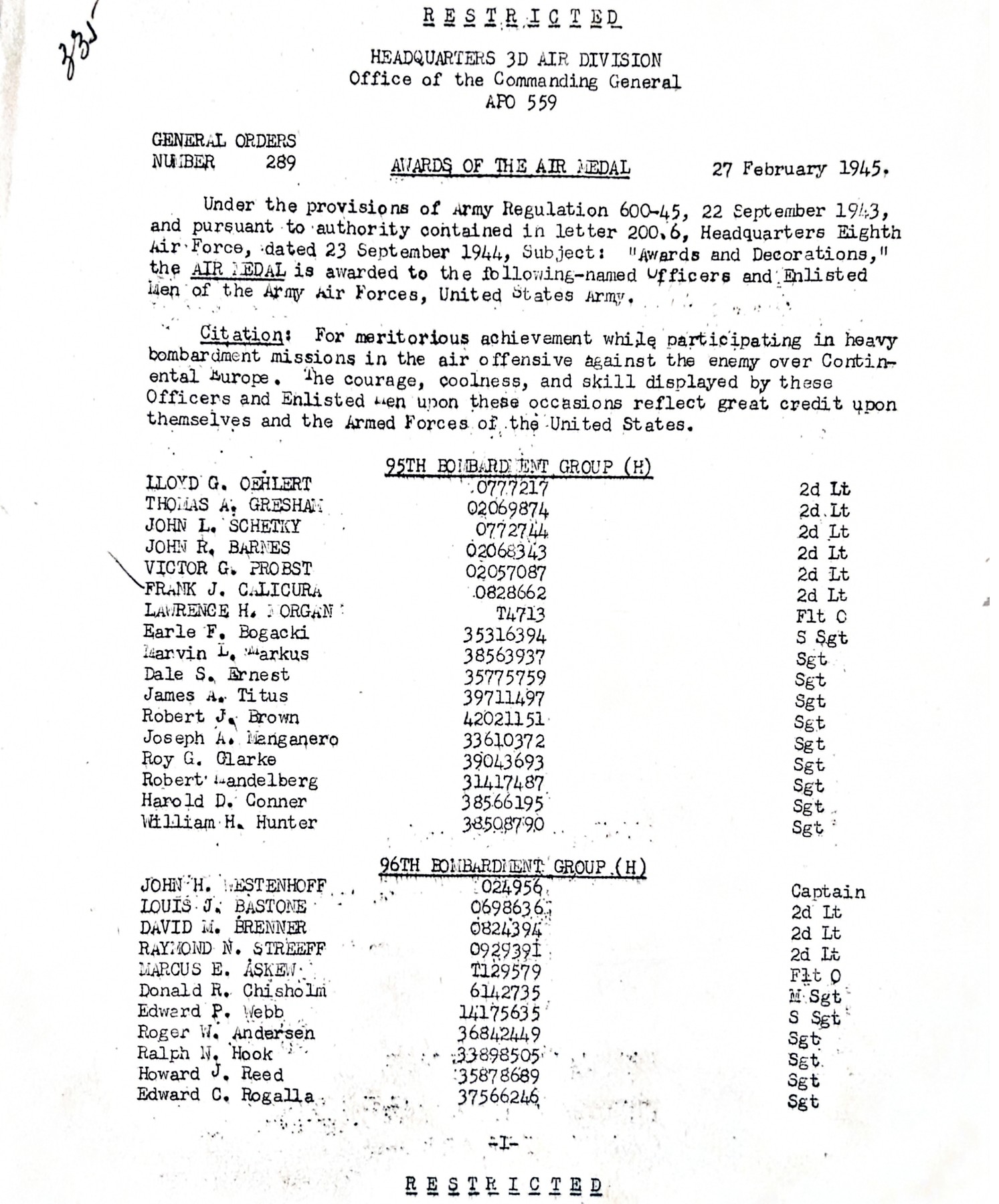

The three surviving orders had already narrowed Frank Calicura's promotion to a six-week window — Second Lieutenant on the February 27 order, First Lieutenant by March 28. A fourth document fixes the date exactly. Special Orders Number 74, Headquarters Eighth Air Force, 15 March 1945, promotes Frank J. Calicura, serial 0828662, from Second to First Lieutenant, Army of the United States, with rank effective that same date — by command of Lieutenant General Doolittle, signed John S. Allard, Brigadier General, Chief of Staff (family collection). A contemporary hand has noted "Lt. Calicura, 335th" at the top of the page, confirming his squadron. The promotion landed almost exactly at the midpoint of the window the general orders had bracketed, nine days after his first Air Medal citation and thirteen days before his second oak leaf cluster — inside the same six-week stretch of his combat tour, and now dated to the day.
The bar on that coat is not a description of an award. It is the award, mounted in precedence order by the man it was issued to, and a pilot does not put a Distinguished Flying Cross at the head of his own ribbon bar by accident. Set against it, the absence of a citation is easily explained without doubting the ribbon. The award required no individual narrative and no separate ceremony — it was a substitution within an existing sequence, processed as paperwork rather than granted as recognition. And a great deal of that paperwork no longer exists at all. In July 1973, a fire at the National Personnel Records Center in St. Louis destroyed roughly eighty percent of Army personnel files for men discharged between 1912 and 1960, with no duplicates and no microfilm backup. For a very large number of World War II veterans, the individual service file simply does not survive to be checked. A missing citation, set against a ribbon still mounted on the coat, is not evidence the award was never made. It is the ordinary condition of a record that burned.
Frank Calicura flew the twenty-five sorties the formula required. The ribbon, wherever its citation went, was earned by arithmetic before it was ever earned by anything the Army thought worth writing down.
14.5
What remains, in a closet in California, is a box.
See the platePlate 00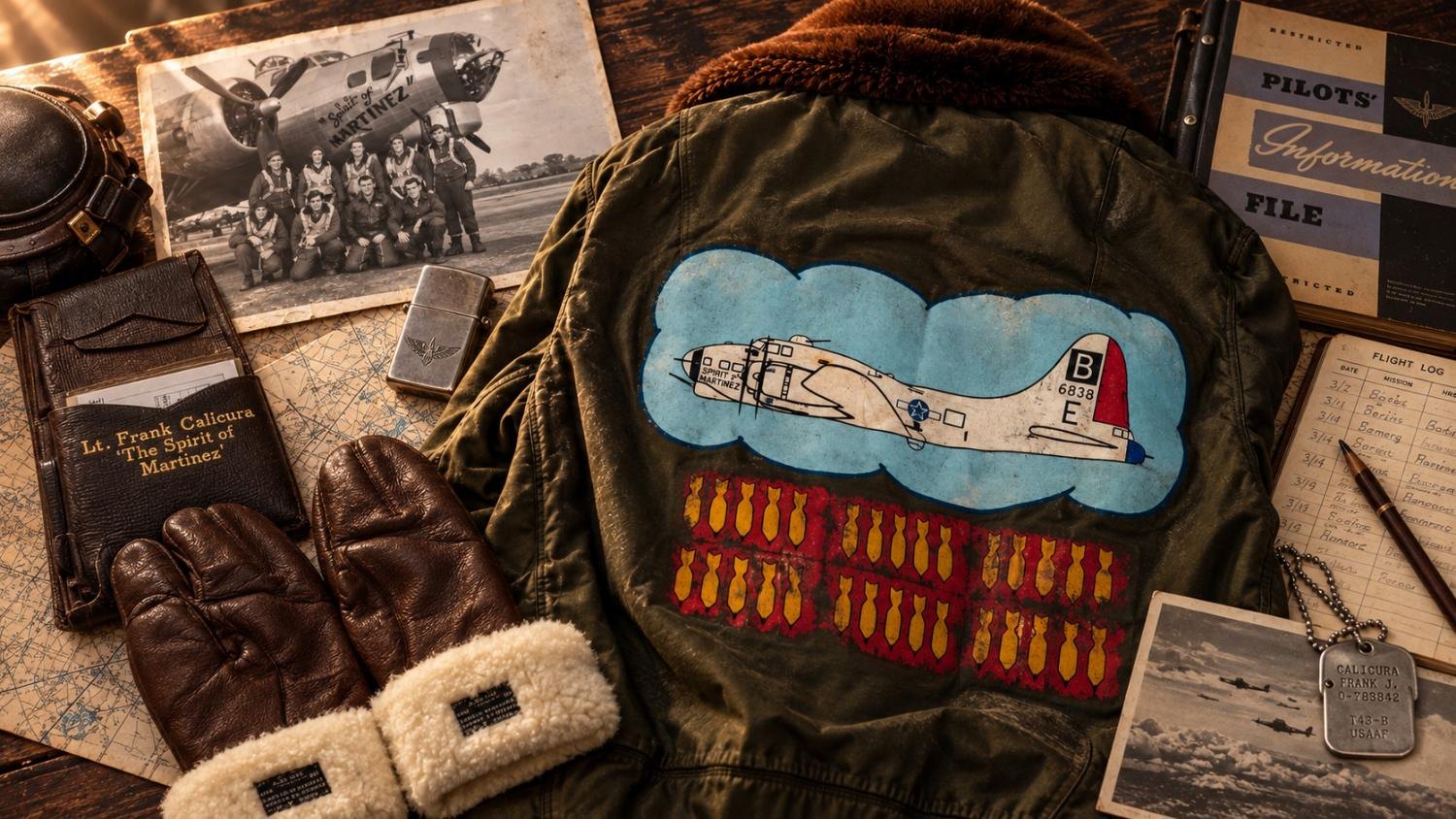

A certificate honoring a Lucky Bastard’s twenty-six missions. A dollar bill signed by nine men and their families in a room nobody wrote an account of. A wallet stamped for a war that ended before it could be used for one. A jacket with thirty bomb symbols on it, some of them likely meant for missions that carried food instead of anything that could kill. A government letter, dated October 30, 1959, that could not quite decide whether a man’s back belonged to the government or not, and denied him either way. A ribbon whose citation may have burned in a fire in Missouri twenty-eight years after the war that earned it ended. And a wooden-covered scrapbook, assembled after he came home, holding the dispatches a wife cut out as they appeared and the two of them numbered together afterward — the only object here that was made rather than kept, and the one a good deal of this book was read out of.
None of these documents agrees with all the others about exactly what happened, or exactly how many times it happened, or exactly what it should be called. Fourteen chapters into trying, this book has not resolved that disagreement either, and has stopped trying to. What it has found instead is a family that kept everything anyway — the correct figures alongside the rounded ones, the ribbon alongside the missing citation, the certain dates alongside the ones that cannot yet be checked — on the working assumption, evidently, that a thing is worth keeping whether or not anyone has yet worked out exactly what it proves.
That is not a flaw in the record. By the end of this book, it looks very much like the record’s whole point.
Cite this
The Spirit of Martinez. The Number, Chapter 14. What a Family Kept.
https://www.spiritofmartinez.com/chapters/the-number
A note on sources