
Chapter 5 · 1944
The Specialist
Hendricks Field, Sebring, Florida — summer 1944
Hendricks Field teaches one thing: how to command a Fortress. A son is born. A mother dies. A twenty-three-year-old signs a will.
A synthetic reading of this chapter is in the bar at the top. It will keep playing while you move through the book. The text below is the transcript. The voice’s place on the page is marked as it reads.
5.1
Frank Calicura went to Hendricks Field to become a specific kind of pilot, and nothing else.
The base had not always worked that way. It opened in January 1942 as a general combat crew school — pilots, copilots, navigators, bombardiers, engineers, radio operators, and gunners trained there together, as complete crews, through most of that first year. But in January 1943, more than a year before Frank arrived, the Army Air Forces reorganized Hendricks into something narrower: a specialized school for four-engine first pilots alone. From that point forward, the rest of a combat crew was assembled elsewhere. A man who came to Hendricks in the summer of 1944 came as a pilot candidate and nothing more — not yet responsible for nine other names, because he did not yet have nine other names to be responsible for.
That distinction is easy to miss and matters. Frank did not meet the men he would eventually fly with at Hendricks. He met an airplane.
5.2
What he met was larger than anything he had flown, heavier in every line, built to survive damage rather than to move quickly.
The transition from twin-engine advanced training to a four-engine heavy bomber was the largest single jump in the entire pipeline. A B-17 had ten stations, four engines that had to be managed as a coordinated system rather than four separate problems, and no autopilot capable of holding formation on its own for the hours a mission actually required. Formation flying at altitude was manual labor as much as it was piloting — continuous small corrections, sustained for as long as the mission demanded, in an unpressurized aircraft at heights that were themselves a physical strain before anyone fired a shot.
A cadet who had soloed a Stearman biplane a little over a year earlier was now expected to command a machine that weighed roughly thirty times as much and answered far less quickly to anything he did with his hands.
5.2a
Hendricks Field, Sebring, Florida — July 25, 1944
Before Frank Calicura ever put a B-17 through its paces, the Army made sure he was dressed for it.
Shipping Officer's Voucher No. 13, prepared in Frank's own hand and dated July 25, 1944, itemizes fifteen pieces of personal flying gear issued to him at Hendricks Field: a flyer's kit bag, summer and winter flying caps sized to his own head, a CO-2 cylinder, flying goggles, winter flying gloves, a winter and a summer flying helmet, a flying jacket, flying shoes, a summer flying suit, winter flying trousers, a flying vest, a life-preserver vest, and a mechanic's sweater. The whole issue was authorized under AAF Regulation 15-121, dated December 27, 1943, and countersigned by M. W. Hiller, Captain, Air Corps.
Hiller's own title on the form reads AAF 95-Supply Officer, Hendricks Field. The number is a coincidence and nothing more — an internal Hendricks Field supply designation, seven months before Frank Calicura would ever hear of the 95th Bomb Group he was eventually assigned to. The two numbers have nothing to do with each other, and this book does not connect them.
What the voucher actually documents is smaller and more concrete: a man being outfitted, piece by piece, sized and signed for, for a kind of flying he had not yet done.
5.2b
Not everything issued to him stayed issued. A Report of Survey filed at Hendricks Field on July 15, 1944 — ten days before the kit voucher above — records that an A-2 flying jacket belonging to Frank Calicura had been taken from a locker in Building 232, the Group I locker room, on or about July 8. The Army’s own accounting fixed its value at $8.12.
The form required Frank to swear to the loss himself, which he did, in his own hand, before Norwyn W. Rees, a second lieutenant serving as recorder for the Property Adjustment Board: “I do solemnly swear... that the articles of public property shown above... were lost, destroyed, damaged, or worn out in the manner stated, while in the public service.” Sworn statement, notarized signature, official seal — all of it marshaled to formally account for one leather jacket, gone from a barracks locker at some point during a week in July 1944.
It is a small theft, and the paperwork it generated outlasted it by decades. The Army’s bureaucracy, confronted with an eight-dollar loss, responded exactly as it would have to the loss of an engine: with a form, a witness, an oath, and a number carried to the cent. Whoever took the jacket left no other trace.
5.3
Hendricks did this at a scale that is easy to state and hard to picture. At peak operation the field kept roughly 120 B-17s in service at once. Over the course of the war it trained more than ten thousand pilots to fly them — a number large enough that the base itself functioned as something closer to an industrial operation than a school, with a base population that at times ran several times the size of the town of Sebring around it.
The field carried the name of a man the training itself had already killed. First Lieutenant Laird Woodruff Hendricks, a Florida native and 1939 West Point graduate, died in a B-17 crash in England on 28 July 1941 — three days after he had reported there to train other pilots, and five months before the United States had even entered the war. The base named for him spent the next three and a half years sending pilots toward the same continent that had killed him before a single American bomb had fallen on it.
Hendricks’ own safety record was, by the standards of wartime flight training, a good one — and it still recorded nine fatal crashes and forty-five deaths before the war ended. Training a man to fly a four-engine bomber was dangerous in ways that had nothing to do with an enemy, and the base’s own numbers do not pretend otherwise.
5.4
Frank Calicura left Hendricks Field in the summer of 1944 rated to fly the airplane. He still could not have named the man who would sit beside him in the right-hand seat, or the six who would work the positions behind him.
That would happen next, at a different field, built for the purpose Hendricks had been narrowed to exclude: putting a trained pilot together with the rest of a crew for the first time. Frank knew, by the time he left Florida that summer, how to hold a B-17 level, how to manage four engines as a single problem instead of four, and how much weight he was now qualified to be responsible for in the air. He did not yet know who, specifically, he would be responsible for. That gap — a man who could fly the airplane, and a crew that did not exist yet — is where the next stage of his training began.
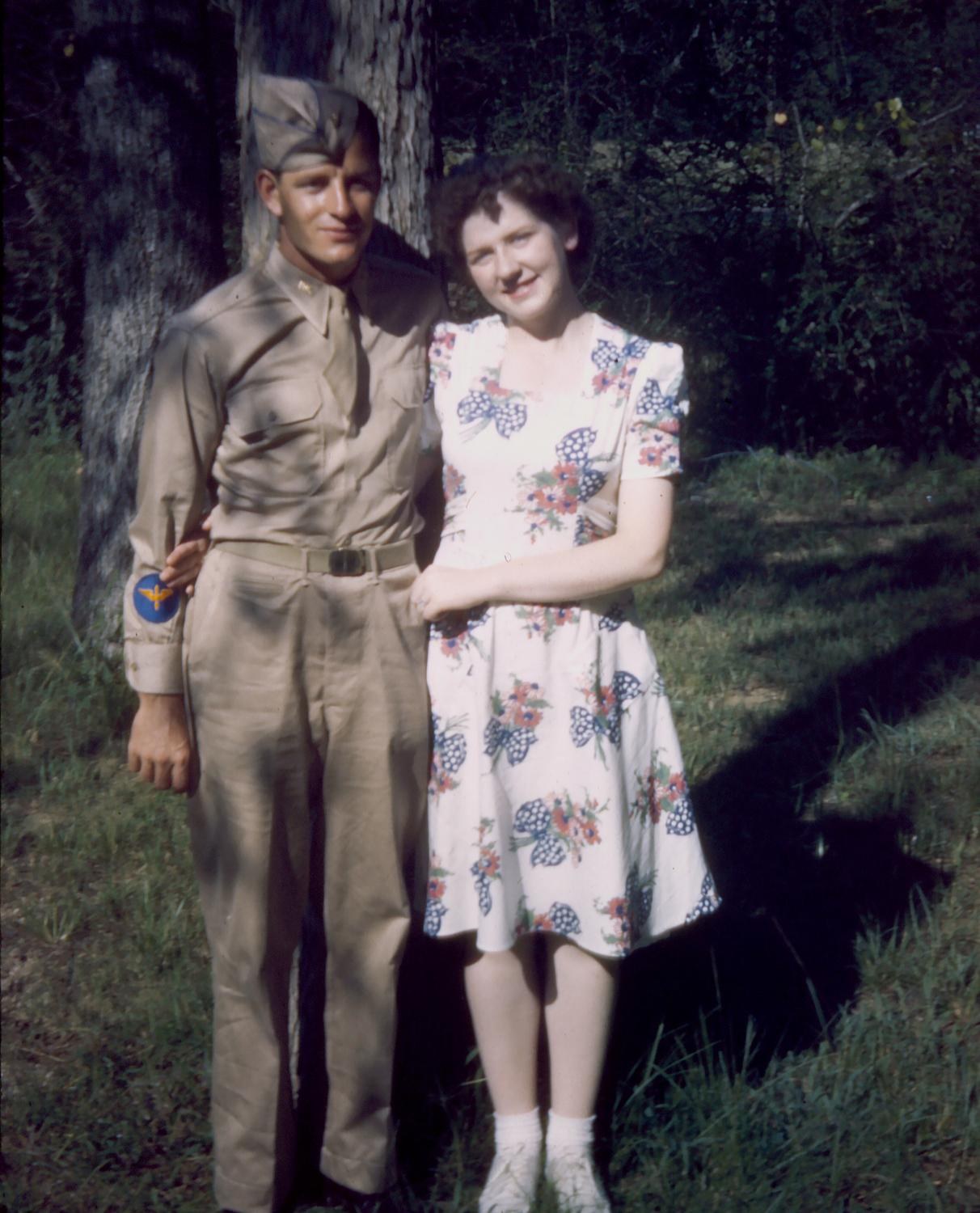
A birth came first. Before the announcement card, a color plate of Joyce: 1943, the front of 731 Mellus Street, already carrying the son the Gazette would name. Another plate, standing, the same suit, another woman the family file names Marie.
See the platePlate 16See the platePlate 15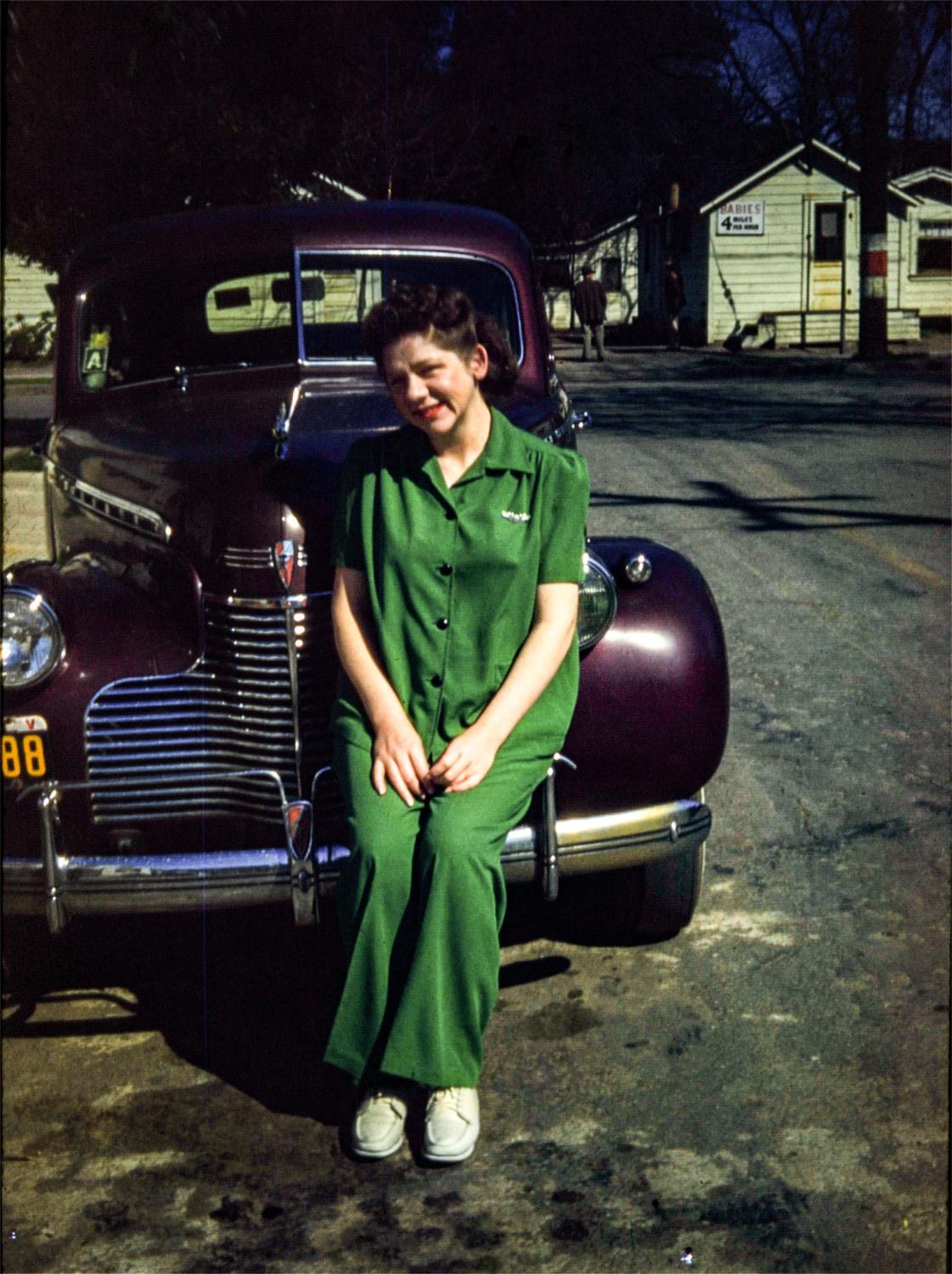


Frank James Calicura Jr. was born June 20, 1944, at 3:15 p.m., at Community Hospital in Martinez — seven pounds seven ounces, named for the father who had not yet seen him. The Gazette ran the news the next day under the headline "New ‘General’ at Lieut. Calicura Home," reporting that Frank, still training in Florida, had a new member of his family he had never seen, and that Joyce was reported "doing nicely" by hospital authorities. A handmade announcement card survives alongside the clipping, addressed in the family's own hand along a drawn clothesline: born 6/20/44, 3:15 P.M., named Frank James Calicura Jr., weighed 7 lbs. 7 oz., signed "Proud Mama and Papa, Joyce & Frank Calicura" (family collection). The envelope carrying the news to Frank is postmarked Martinez, June 21, 1944, addressed to Officer Student's Section, Class 44-D, Hendricks Field, Sebring, Florida (family collection) — reaching him roughly a month before his mother's death, and identifying the infant son shown with him in the undated family photograph cited below as this same child.
See the platePlate 82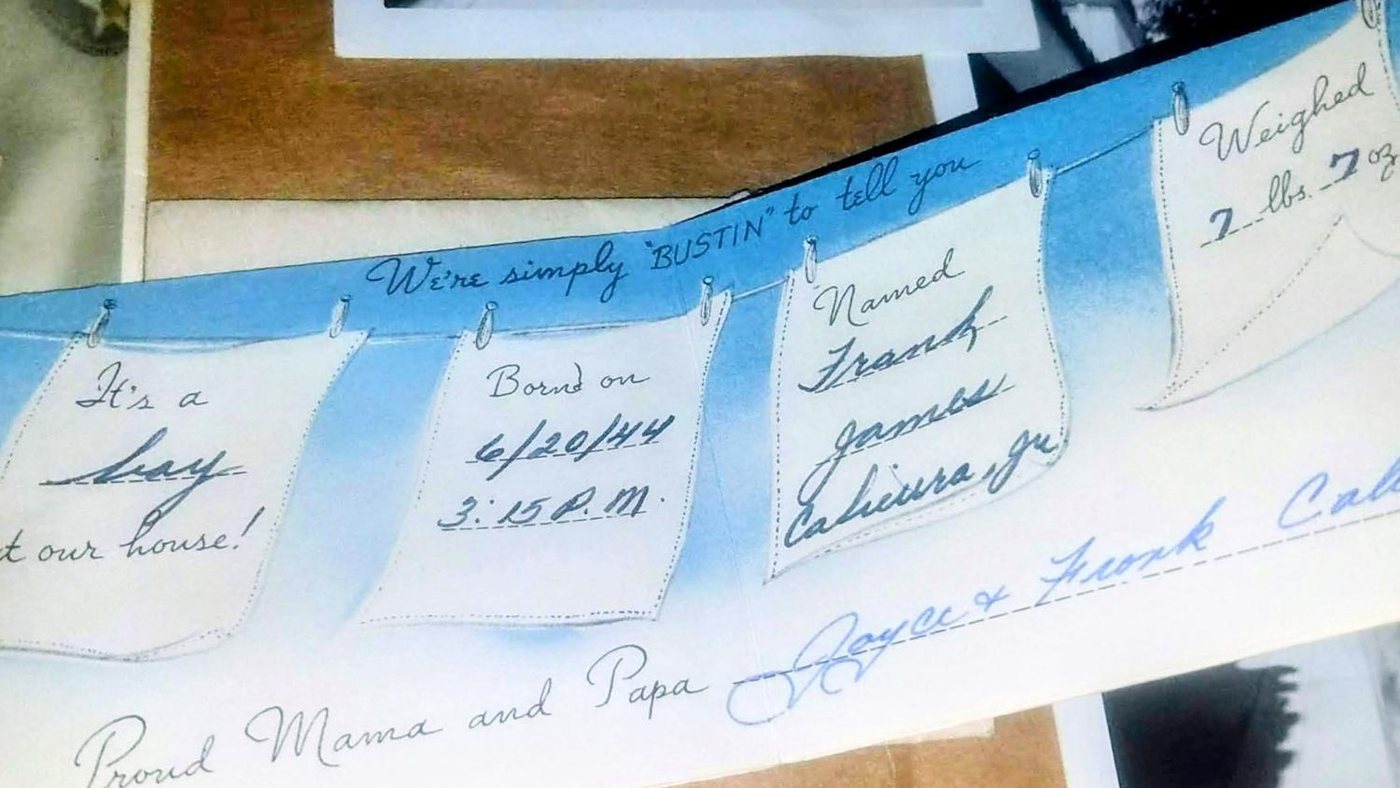

Something else happened in that gap, and the collection records it in a newspaper rather than in any document the Army produced. On the night of Friday, July 21, 1944, after an illness of two days, Angelina Calicura died at Community Hospital in Martinez. She was fifty-eight. She had lived in the town thirty-seven years, kept the house at 515 Mellus Street, and was a native of Italy. The Martinez News-Gazette carried the notice the following morning under the heading Pioneer Mother Dies, and listed what she left behind: her husband Saverio, five sons, eight daughters, seven grandchildren, and two brothers — A. Rodia of Martinez and Sam Rodia of Los Angeles.
Four of the sons were in uniform, and the paper gave their stations: Nick in the Navy, Dominic in Georgia, Corporal William, and Lieutenant Frank Calicura, in North Carolina — a detail that matches nothing else documented about Frank’s service that summer and is noted here without explanation. What can be said with confidence is where he actually was: home in Martinez, on a temporary leave from Hendricks Field, when his mother died. A photograph in the family’s collection shows him on the porch steps in uniform, holding the son he had not yet seen. The family dates it to this leave — the first time he met Jimmy, home for the funeral. His qualification record shows him in continuous B-17 transition training at Hendricks from April 16 to August 17, 1944, but that record does not conflict with the leave — it tracks a man’s official duty station, not his personal time away from it. A soldier on leave remains carried on his unit’s rolls; nothing about two weeks home in California would appear on the paperwork the qualification record was drawn from. Frank was there when the news came. He then went back. The funeral, the notice said, awaited word of the possible arrival of her sons from the south. Whether any of them reached it the collection does not record.
See the platePlate 50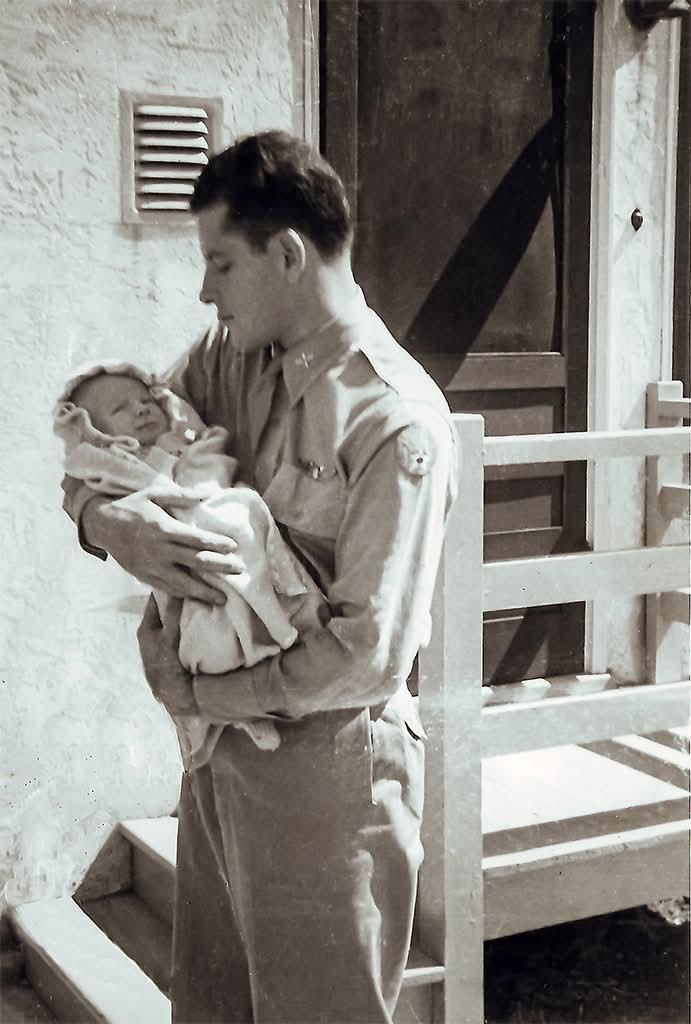

Six weeks later, at Avon Park, Frank Calicura signed a will. It is dated September 7, 1944. He was a second lieutenant, serial number O-828662. He named Joyce B. Calicura of 731 Mellus Street, Martinez, as executrix and left her the entire estate, with his brother Sam of 3120 Ricks Court named to take it if she did not survive him. It is a form filled out by a twenty-three-year-old who had not yet flown a combat mission.
See the platePlate 83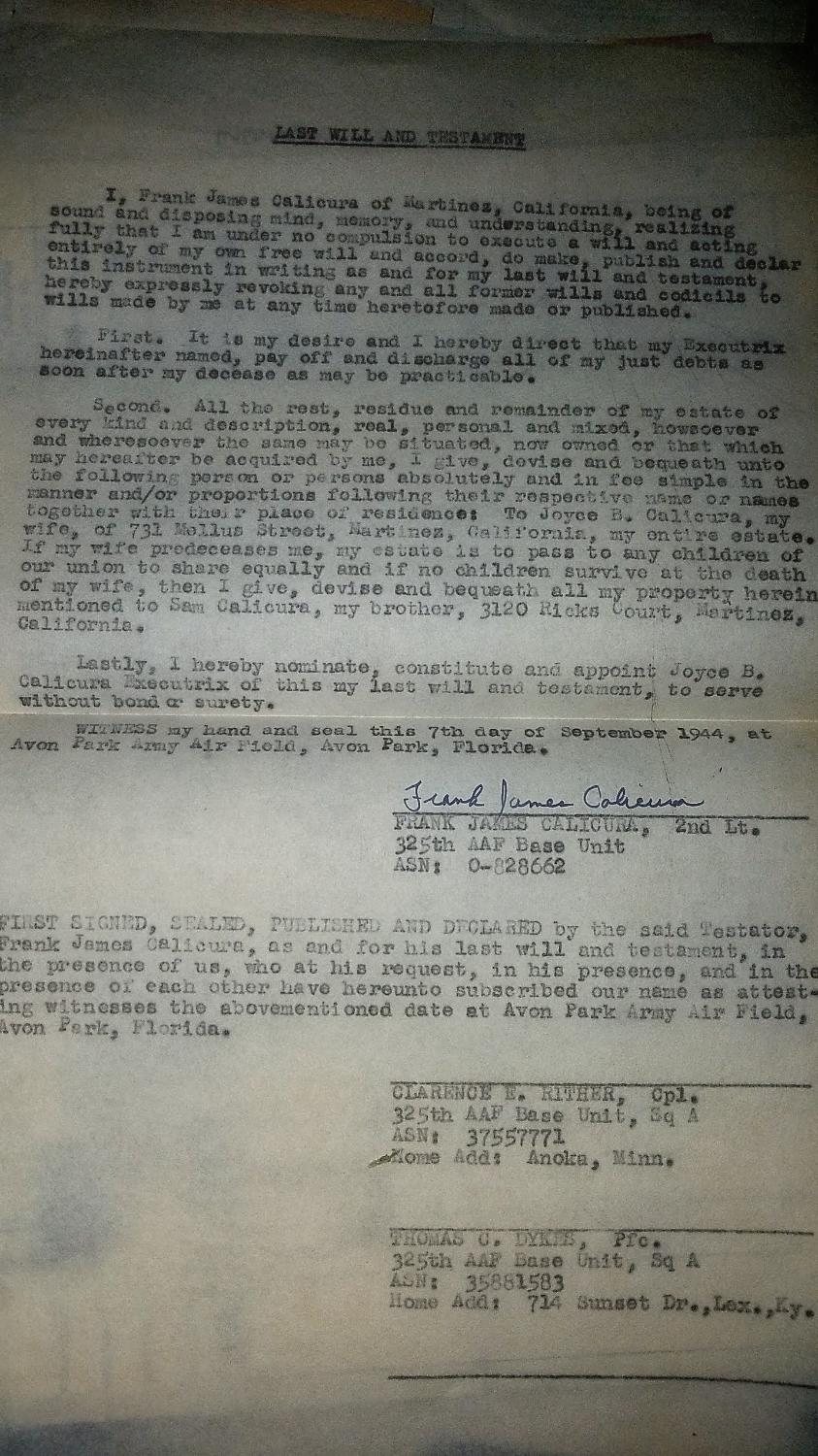

Cite this
The Spirit of Martinez. The Specialist, Chapter 5. What a Family Kept.
https://www.spiritofmartinez.com/chapters/the-specialist
A note on sources