
Chapter 10 · February–March 1945
Ninety-Four Hours
February–March 1945
Nine missions in fourteen days. Munich, Swinemünde, Seelze, Jena. The flight record states the hours. It does not state what a man carried home.
A synthetic reading of this chapter is in the bar at the top. It will keep playing while you move through the book. The text below is the transcript. The voice’s place on the page is marked as it reads.
These mornings also sit on the mission board.
10.1
The individual flight record for February 1945 gives a single number: 94 hours, 35 minutes.
The 95th Bomb Group’s own crew record shows what produced it. After Chemnitz and Cottbus on the fourteenth and fifteenth, the run continued.
Frank Calicura’s crew flew again on the nineteenth to Osnabrück, then the twentieth to Nuremberg, then the twenty-first to Nuremberg again, the twenty-second, Bamberg, the twenty-fourth, Bremen, the twenty-fifth, Munich, the twenty-seventh, Leipzig.
One of these has a clipping of its own beyond those already quoted.
Osnabrück, the third mission, “1,100 Heavies Hit Nazi Rails,” reporting objectives at Osnabrück, Rheine, and Seiger and areas across the Ruhr, escorted by some five hundred Mustangs and Thunderbolts that strafed communication lines below.
See the platePlate 62See the platePlate 63See the platePlate 64See the platePlate 65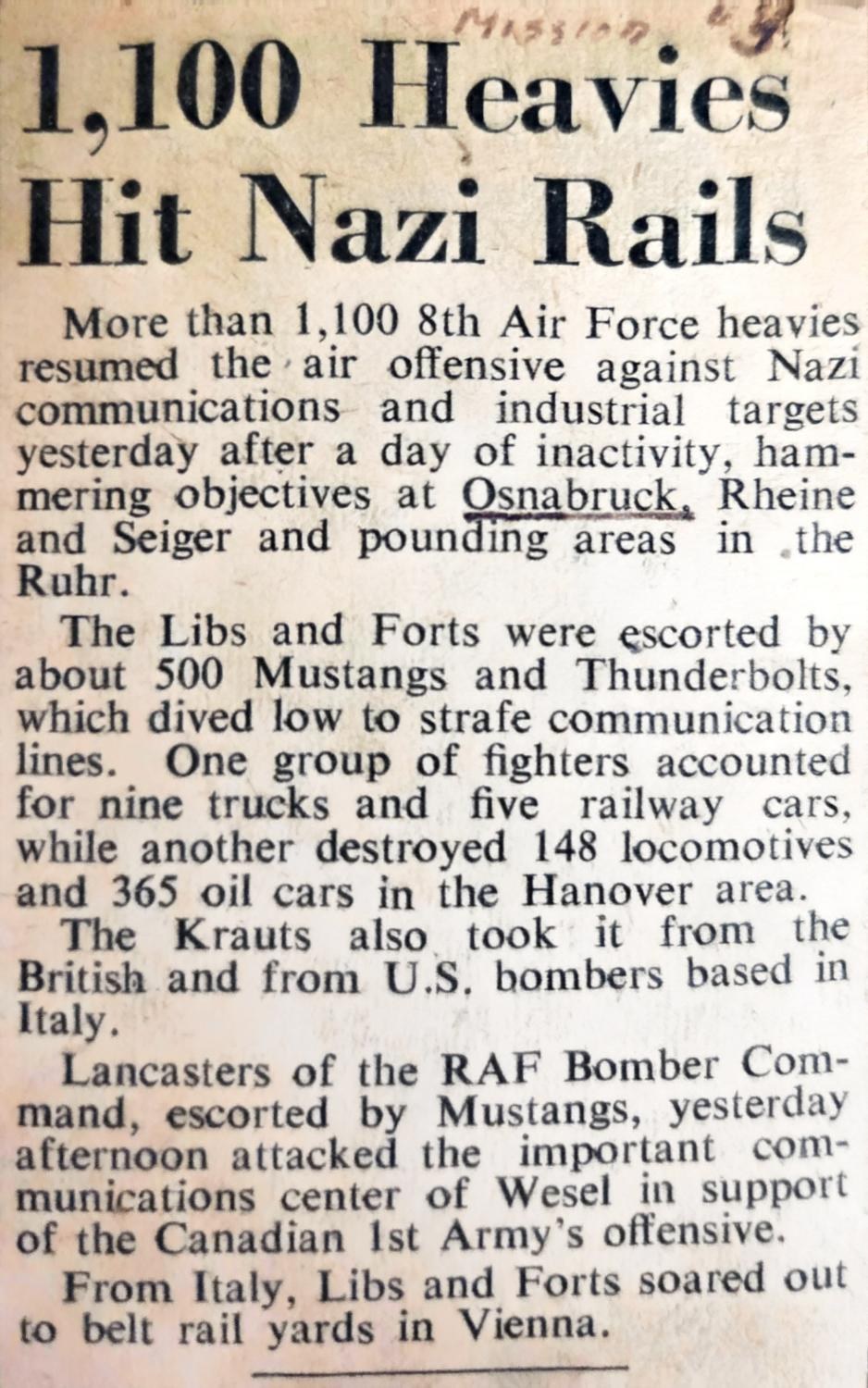
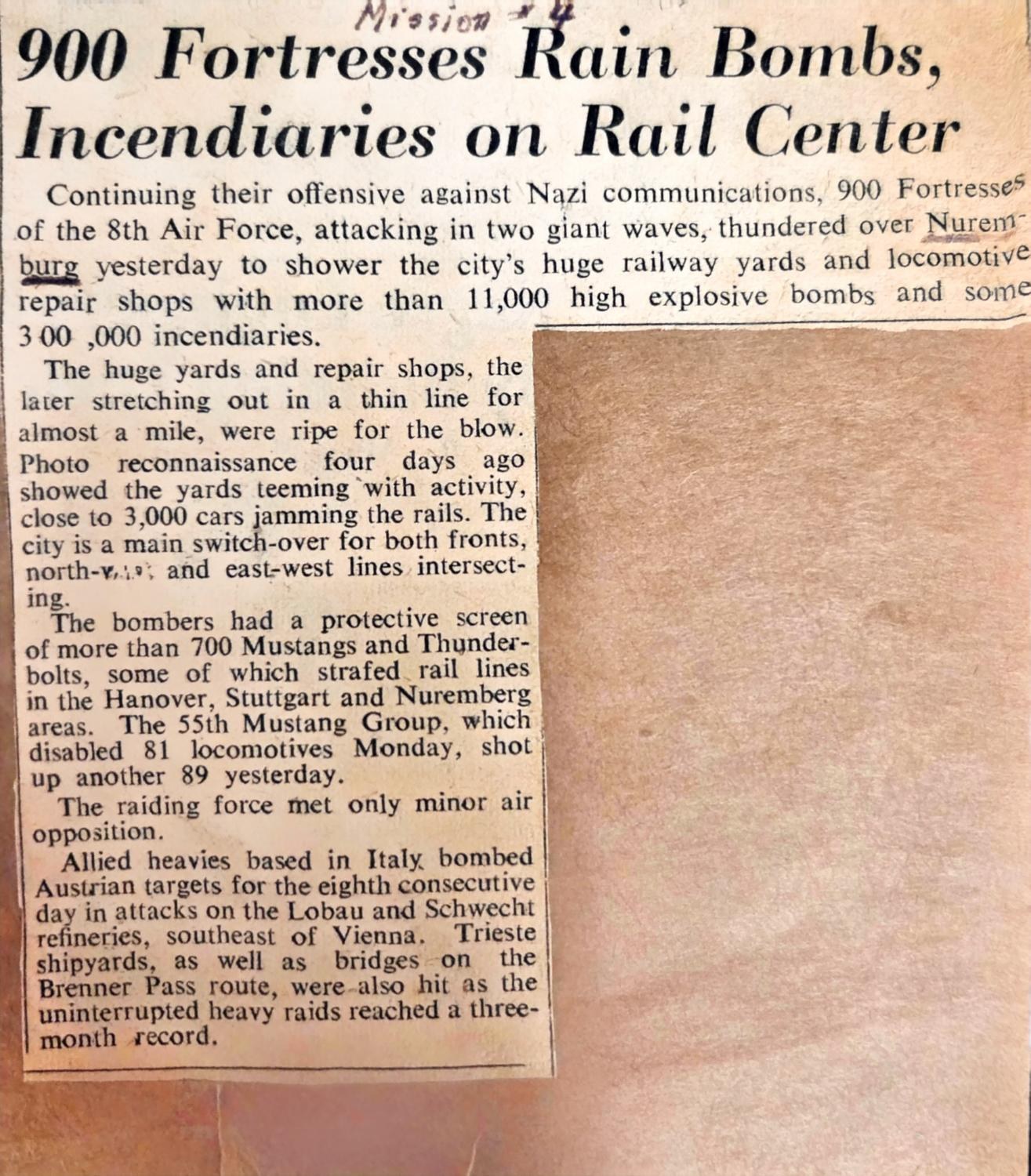
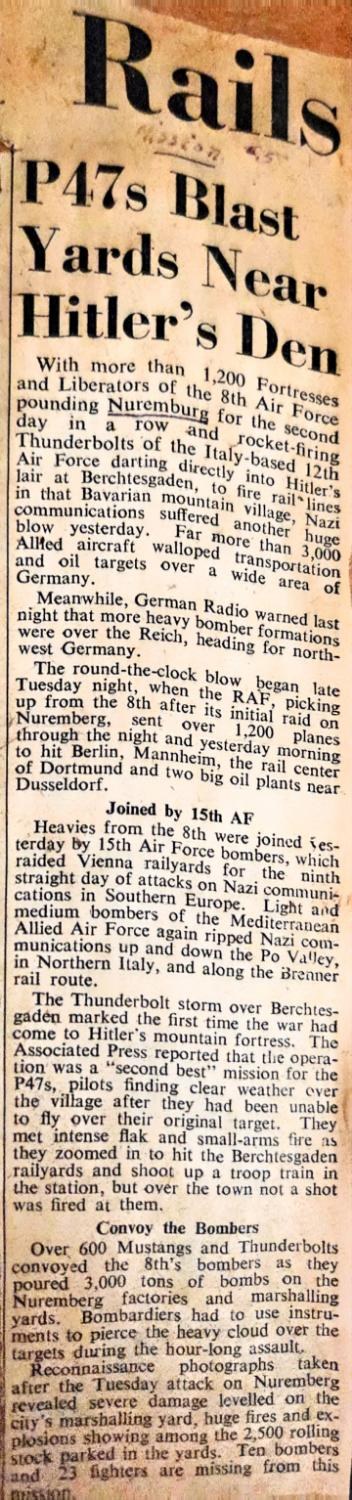
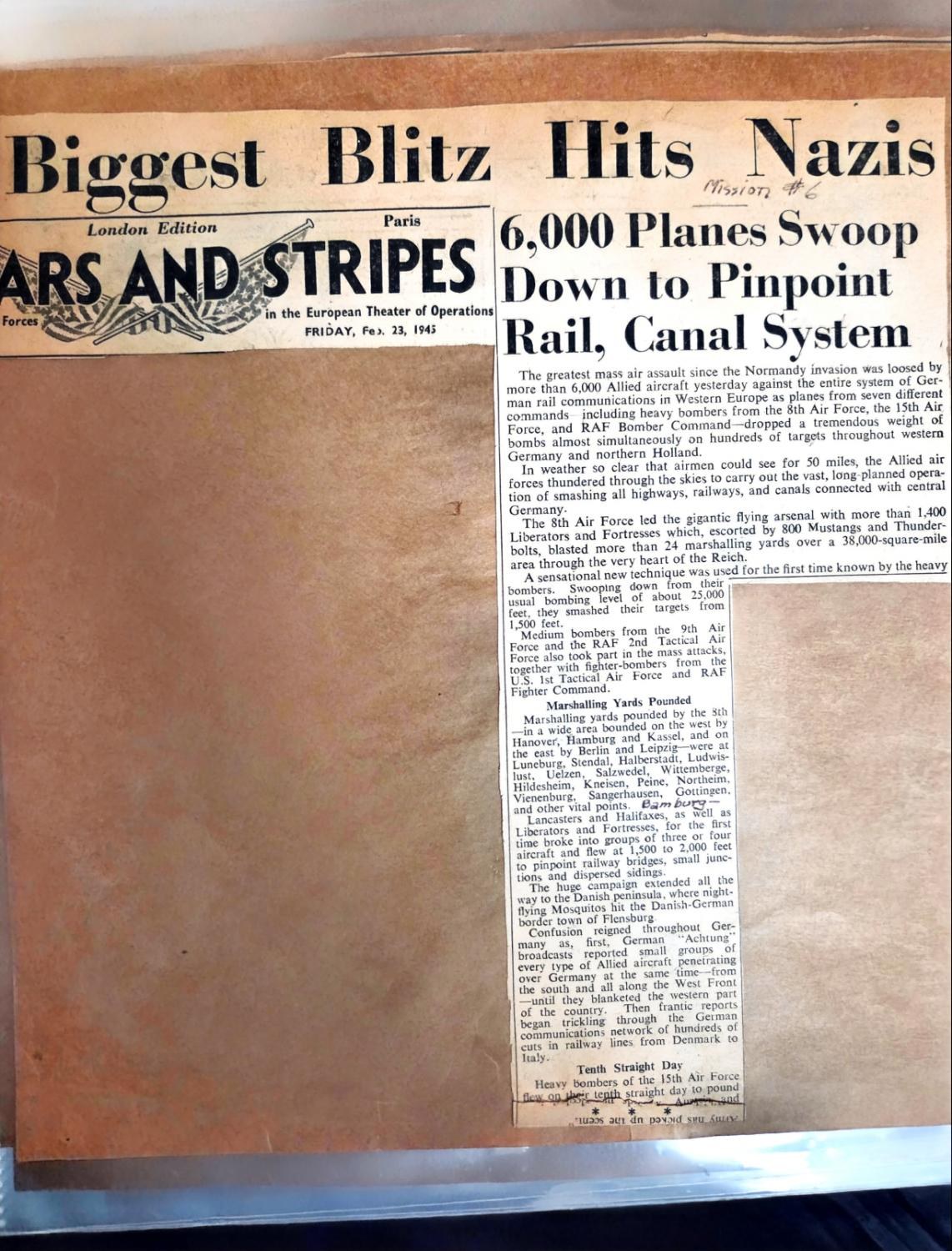

Nine missions in fourteen days, several of them on consecutive or near-consecutive mornings, each one requiring the same sequence — wake before dawn, briefing, the long climb to altitude, hours in an unpressurized aircraft at temperatures that could freeze exposed skin in minutes, the bomb run, the equally long flight home, debrief.
See the platePlate 106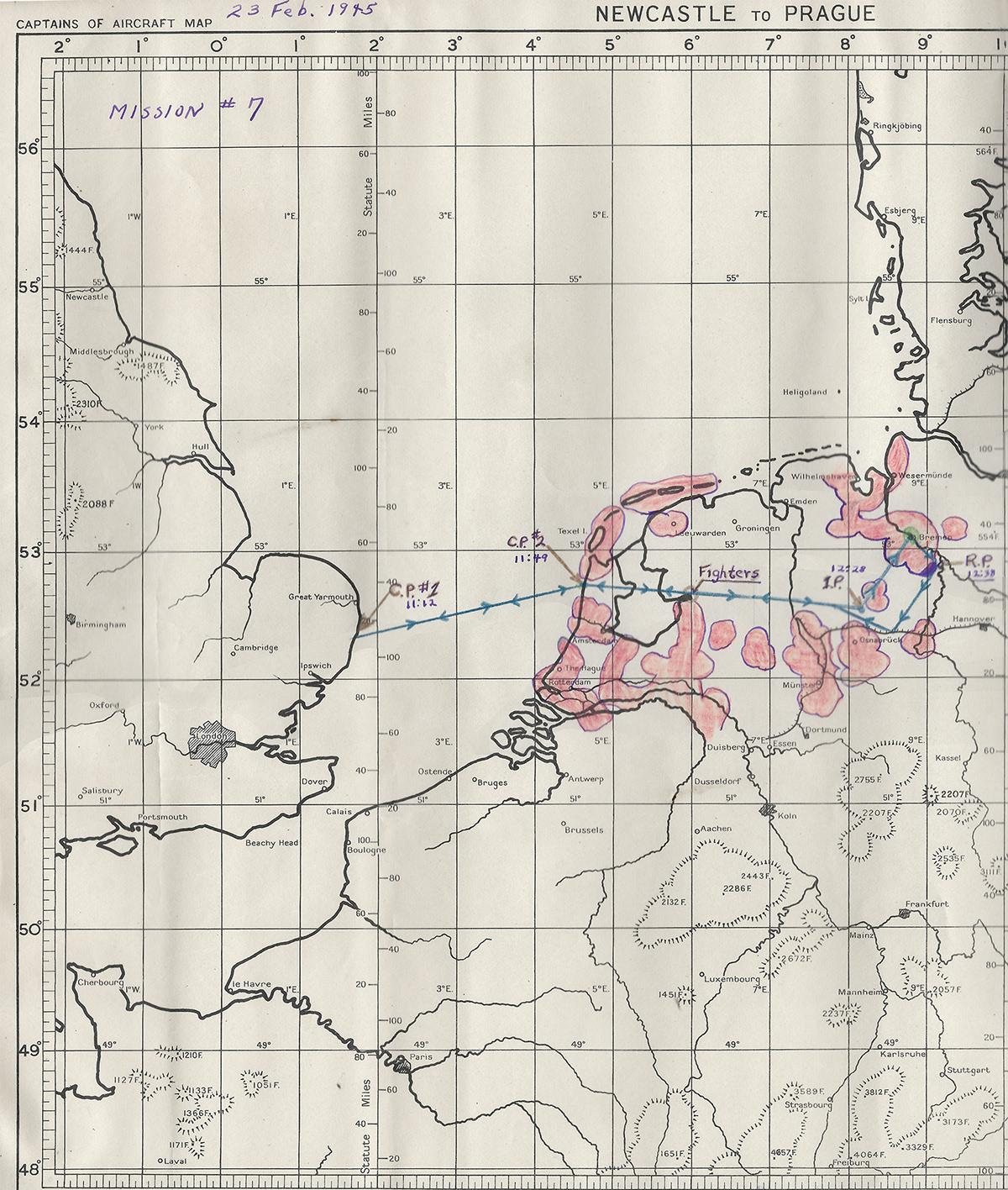

No mission in that run stands alone in the way Chemnitz does, as a first. They accumulate instead, one against the next, in a tempo the flight record reduces to a single figure. The men who flew it would have measured it in a different currency: how many hours of sleep separated one wake-up call from the last.
See the platePlate 100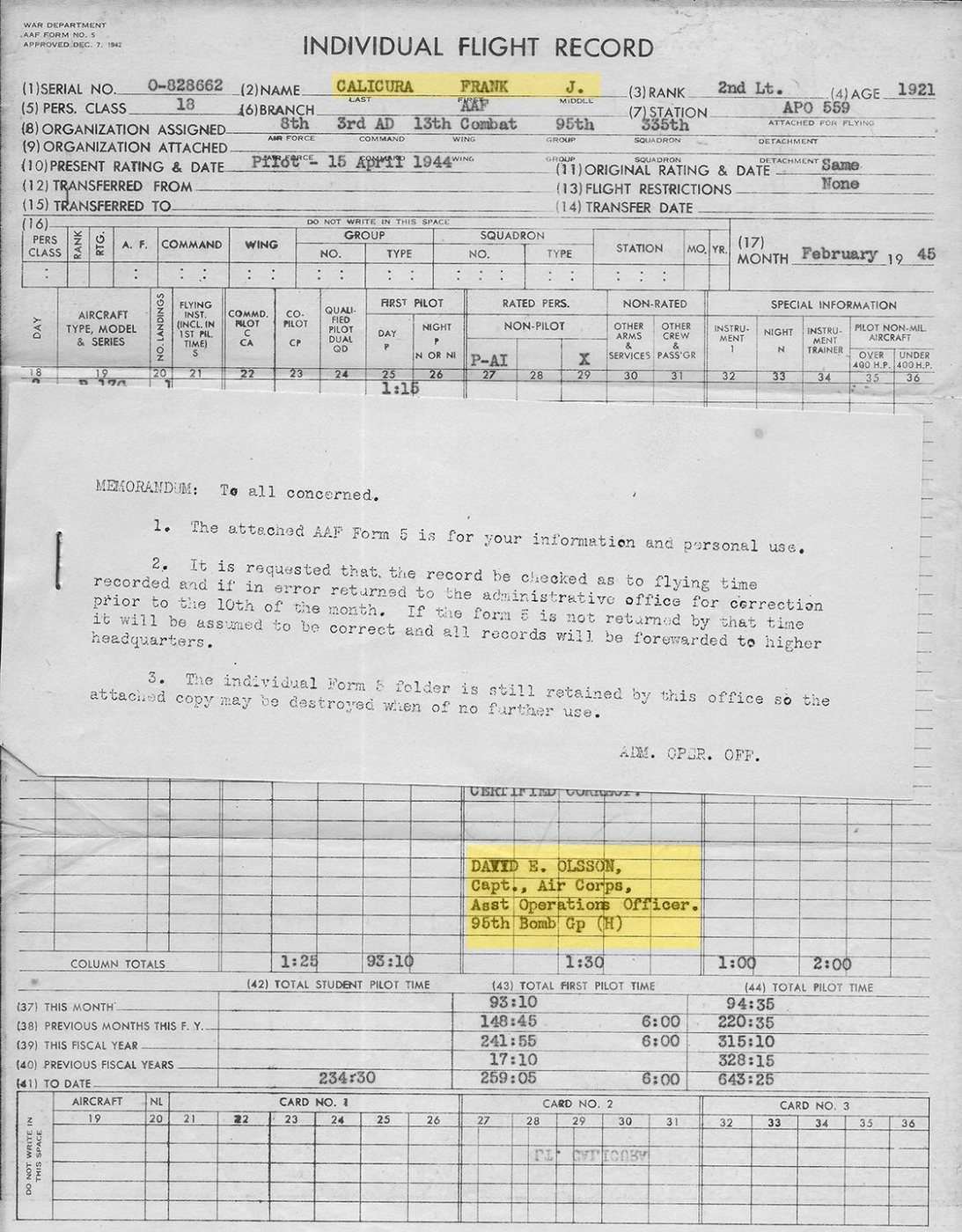

10.2
Mission eight took Frank Calicura’s crew to Munich — a rail target, not an airfield, though two clippings in the collection share that city and a nearly identical headline, and only the 95th Bomb Group’s dated crew record sorts out which belongs to which mission.
The family’s own clipping survives from this one: “Rail-Hitting Heavies Tear Into Munich,” reporting that Fortresses rumbled over the city in two waves to hit the terminal rail station and marshalling yards in its eastern and western districts, the fourth day in a row the Eighth had thrown its weight against German communications and fuel supplies. Other formations that same day struck the yards at Ulm, a tank assembly plant at Aschaffenburg, airfields at Giebelstadt and Schwebisch-Hall, and an oil depot hidden in the woods outside Neuberg. More than seven hundred Mustangs and Thunderbolts escorted the raid, five hundred of them assigned solely to shield the bombers. The clipping is a fair measure of how large and how routine this kind of effort had become by February 1945 — a rail network under sustained, systematic attack, one city at a time, as a matter of course rather than exception.
The ninth morning was Leipzig, February 27. The Air Medal is dated that day. The family kept no clipping of this one of its own.
10.2a
Between Leipzig and Swinemünde, the crew record shows three more missions the family kept clippings for but never a story about. Each of them carries a number in the scrapbook and nothing else — no mark, no note, nothing to distinguish it from the rest of a working week.
March 3 took them to Brunswick, an aircraft-manufacturing center the Eighth Air Force returned to repeatedly that spring — not a single decisive strike but one of several passes at the same industry, the kind of target that required hitting more than once to matter.
See the platePlate 40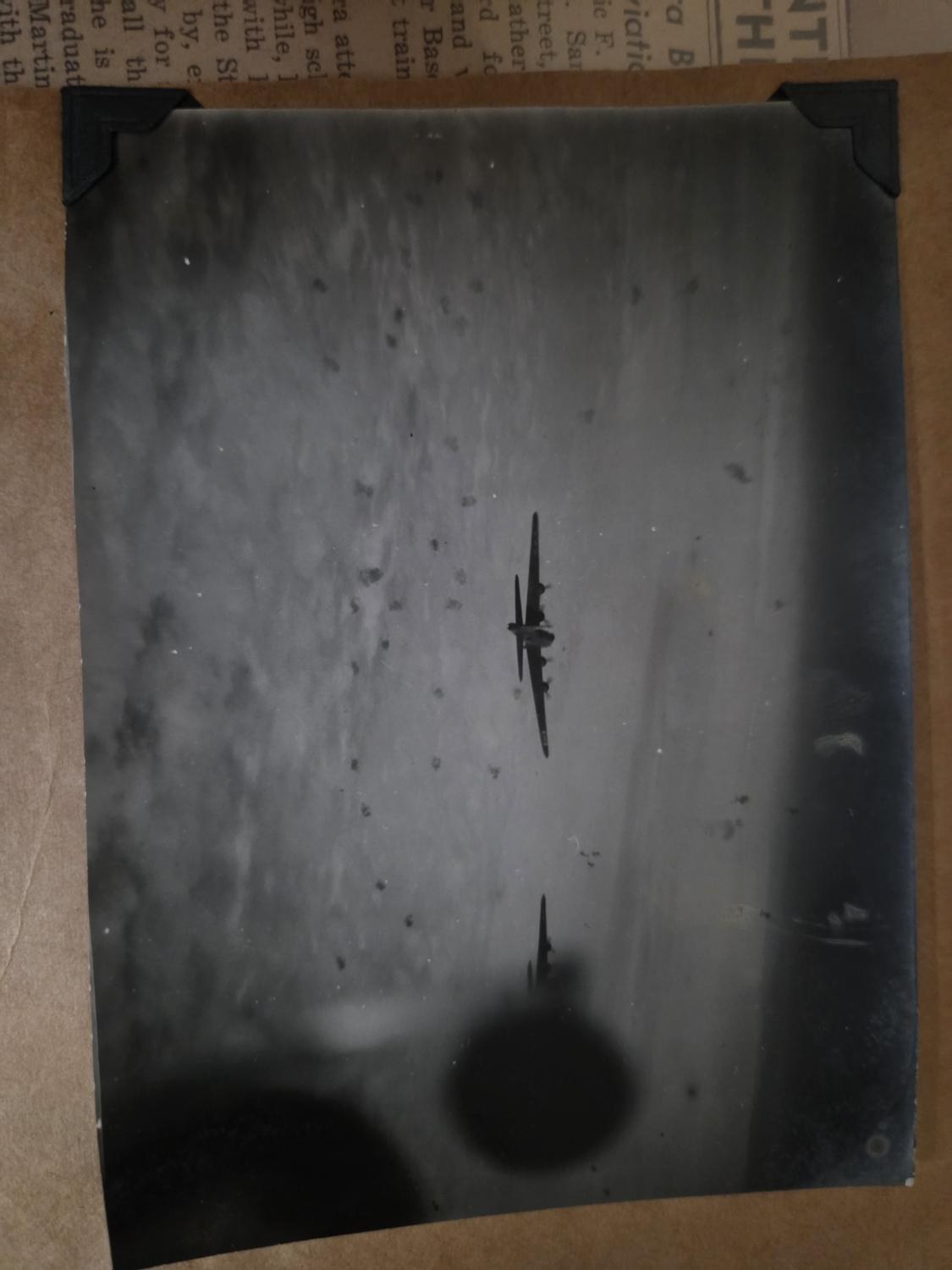

That same mission cost the group something the log entry does not gesture toward. The 95th put up thirty-seven aircraft that morning. The group’s own tally for the day records one damaged and one lost. The one lost was not lost over the target. The Missing Air Crew Report, number 12889, sets out the sequence in the flat register such reports use. At 1024, Stacy J. Tavis’s aircraft — Aunt Callie’s Baby — lost its position and fell behind R. L. Duncan’s Paisano, another 335th Squadron ship, causing Paisano to stall in her propeller wash. Paisano’s tail section then struck Aunt Callie’s Baby’s right wing. Her tail separated at the waist section, she rolled over onto her back, and she crashed at Schönebeck. Nine killed in action.
The report attributes the loss to the collision itself, not to flak or fighters; nothing about that day’s target defenses caused it. It was filed against a mission from which the group lost nothing else at all. Tavis's own combat record shows only two missions total, this one and Ruhland the day before, with nothing recorded after — the database does not say why, and there is nothing to be gained by guessing. What his own family said decades later, at his memorial in Upland, California, was that he brought his own crew home safely that day. Both things happened in the same formation, over the same target, within the same hour: nine men killed in a collision inside their own group, and a pilot who, whatever ended his combat flying two missions later, got his own crew back to England intact.
The next morning, March 4, the target was nominally Ulm, though the day’s own mission record shows Ulm was never the point of the exercise: the primary target was a Messerschmitt components factory at Baumenheim, and Ulm’s marshalling yard was the fallback, used only because cloud cover — ten-tenths undercast — closed out the primary. Crews were woken at 0215 for a 0315 briefing that day, airborne by 0600 in the dark, and the 95th Bomb Group flew it as the second group in its own wing’s formation, the 100th leading despite Horham’s status as the 13th Combat Bombardment Wing’s own headquarters. Being the wing’s home base did not mean flying first.
Six days later, March 10, the crew flew again, to a target the record gives as Dortmunderfeld, in the same industrial corridor the Eighth had been working since Chemnitz.
Ulm and Dortmunderfeld have neither a clipping nor a photograph. Brunswick has a print in the album, two ships in flak, marked in the family’s hand. They exist otherwise as lines in a database that does not explain itself, sitting quietly between a mission the family kept a newspaper page about and one that has already taken several pages here. That asymmetry is not a judgment on which missions mattered. It is a record of which ones a family, sixteen and eighteen and twenty-two years old at the time, happened to be handed a newspaper for — and which print they kept.
10.3
Mission thirteen requires more care than any other in the record.
The target was the German naval base at Swinemünde, on the Baltic, where reconnaissance had identified the pocket battleship Admiral Scheer and other naval vessels at anchor. The raid had been requested specifically by Soviet command, whose forces were closing on the area from the east. The 95th Bomb Group flew it as part of a larger Eighth Air Force effort; the family’s clipping — “Heavies Hit Near Rhine, Along Baltic” — records it from the American side, as one raid among the day’s operations.
What the clipping does not record, and what the historical record surrounding Swinemünde makes unavoidable, is that the city’s population had grown enormously in the weeks before the raid with civilian refugees fleeing the advancing Eastern Front — families, mostly, moving west and north ahead of the Soviet advance, gathered in a port town that was, that week, also a legitimate naval target. Postwar accounts of civilian casualties at Swinemünde vary very widely, from the low thousands into the tens of thousands, and the sourcing behind the highest estimates deserves real skepticism about its framing and its agenda. What can be stated with confidence is this: a naval target, requested by an allied power, struck as ordered, in a city whose civilian population that week was far larger than its military significance alone would suggest, with a human cost that the surviving record does not allow anyone to state precisely.
Frank Calicura’s crew flew the mission and came home. Nothing in the family’s own record indicates what, if anything, he understood about the civilians below him that day.
10.3a
Mission fourteen went to Seelze, west of Hannover, and it was among the roughest days the group had that spring. The 95th dispatched thirty-eight aircraft. Sixteen came back damaged, one was lost, and one more was written off after landing. Frank Calicura flew the Spirit of Martinez, call sign E, and brought her home.
Another 335th Squadron crew did not have that day. G. E. Brumbaugh, flying 44-8438, was hit over the target, lost the number three propeller to a runaway and the number four engine to half power, and fell out of contact with the formation. Flak found the aircraft again near Frankfurt. The crew force-landed in Belgium. The report records eight men returned to duty, one wounded, and the aircraft salvaged.
Sixteen damaged out of thirty-eight is a proportion the flight record does not register in any way. The individual flight record for March gives hours, not odds.
The chart for the day survives in the family collection. It is a printed Newcastle-to-Prague sheet, annotated by hand, numbered fourteen and dated 14 March 1945, with four control points, an initial point and a rally point drawn around a target lettered Seelze.
10.3b
Mission fifteen was Jena, five days later, bombed through cloud along with Plauen. The family’s clipping is “Plane Plants, Airfields Struck By 1,200 Heavies.” What makes it worth more than its position in the sequence is what the escort ran into. Six hundred Mustangs engaged thirty-nine German aircraft that day, five of them jets — and not only the Me 262s that had been appearing since Munich, but Arado 234s, a jet bomber rather than a jet fighter, and a type the crews had not met before. The same raid struck a jet-parts factory at Baumenheim and airfields near Ingolstadt and Ulm believed to be assembling them.
Six weeks earlier the crew had flown their first mission in an aircraft designed in 1935. The war they were finishing in was not the one they had started.
10.4
By the end of the run that had started at Chemnitz and passed through Munich and Swinemünde, Frank Calicura had flown thirteen missions in twenty-seven days.
The flight record states the hours. It does not state what a man carried home from Swinemünde specifically, or from any of the twelve missions around it. That absence is not a failure of the archive. It is the ordinary condition of the record a mission generates — times, targets, tonnage, losses — set against everything a mission actually cost the nine men who flew it, which was never the kind of thing paperwork was built to hold.
Cite this
The Spirit of Martinez. Ninety-Four Hours, Chapter 10. What a Family Kept.
https://www.spiritofmartinez.com/chapters/ninety-four-hours
A note on sources