
Chapter 4 · 1943–1944
Nine Hundred Miles South
Maxwell Field, Montgomery, Alabama & a Florida primary school — spring–summer 1943
Classification, preflight at Maxwell, a cartoon woodpecker for a first solo, gold bars and an instrument rating on the same day’s mail.
A synthetic reading of this chapter is in the bar at the top. It will keep playing while you move through the book. The text below is the transcript. The voice’s place on the page is marked as it reads.
4.1
Location unrecorded — spring 1943
Frank Calicura left Houghton still undesignated.
No collection document records the trip, the orders, the date, or the place. What survives is the outcome, not the address. By the spring of 1943 the Army Air Forces ran classification through three centers nationwide, and a man who had come through a College Training Detachment reported to one of them still unsorted, whatever he believed about himself. Which of the three tested Frank Calicura, the collection does not say, and no attempt is made here to assign him to one on the strength of geography alone.
The battery itself combined a written aptitude examination with a series of psychomotor tests — coordination, reaction time, judgment under a clock — and a physical. The results were converted into a single number, the stanine, on a scale of one to nine. The number, not the man’s preference, decided the track: pilot, navigator, or bombardier.
The reasoning behind concentrating this work at three sites, rather than distributing it more widely, was consistency. A stanine score needed to mean the same thing in Tennessee as it meant in California, and that required identical instruments and identical conditions everywhere the test was given. The Army Air Forces had built, in effect, a single national sorting mechanism and run it through three doors.
Frank’s file by this point carried roughly seventy-five hours already logged in a sixty-five horsepower Piper Cub, flown over a strip his own brother had helped build on the Martinez waterfront. The hours were noted. They did not exempt him from the battery, and nothing in the record suggests the examiners weighted them. When the number came back, it said pilot — on the strength of a battery of tests, not a logbook carried from California.
4.2
Maxwell Field — spring 1943
Preflight followed classification, and for Frank Calicura it happened at Maxwell Field — a preflight school by this point in the war, whatever else it had been earlier.
The course ran roughly ten weeks, and it put no cadet near an aircraft. Half of it was classroom instruction — military law and customs, the theory of flight, the fundamentals of navigation, Morse code, aircraft recognition. The other half was physical: close-order drill, weapons familiarization with sidearm and carbine, conditioning. A cadet left preflight with no additional flight hours and a great deal more discipline than he had arrived with. The airplane itself still lay ahead.
A class yearbook for 44-D survives from this stretch, distinct from the Bainbridge class book cited later in this chapter, and Frank's own hand is on it. Above a photograph of cadets tumbling off a train with their bags, he wrote "Welcome to Maxwell (Nuts)." Above a later photograph of the same men waving from a departing train, he wrote "Farewell to Maxwell (Thank God)." Between the two, the yearbook's own printed text describes the arrival — a haircut captioned "T.S. mister!," a retreat formation, cadets doubling across the parade ground — and the eventual transition to advanced training, where a cadet is treated as a pilot for the first time and the instructors as flight commanders rather than tormentors. The yearbook’s printed text is stock class-book copy. His two captions are not. The cover is dated September 1943: Preflight, Class of 44-D, Maxwell Field, Alabama, Vol. 3 No. 9, Paragon Press, Montgomery.
See the platePlate 14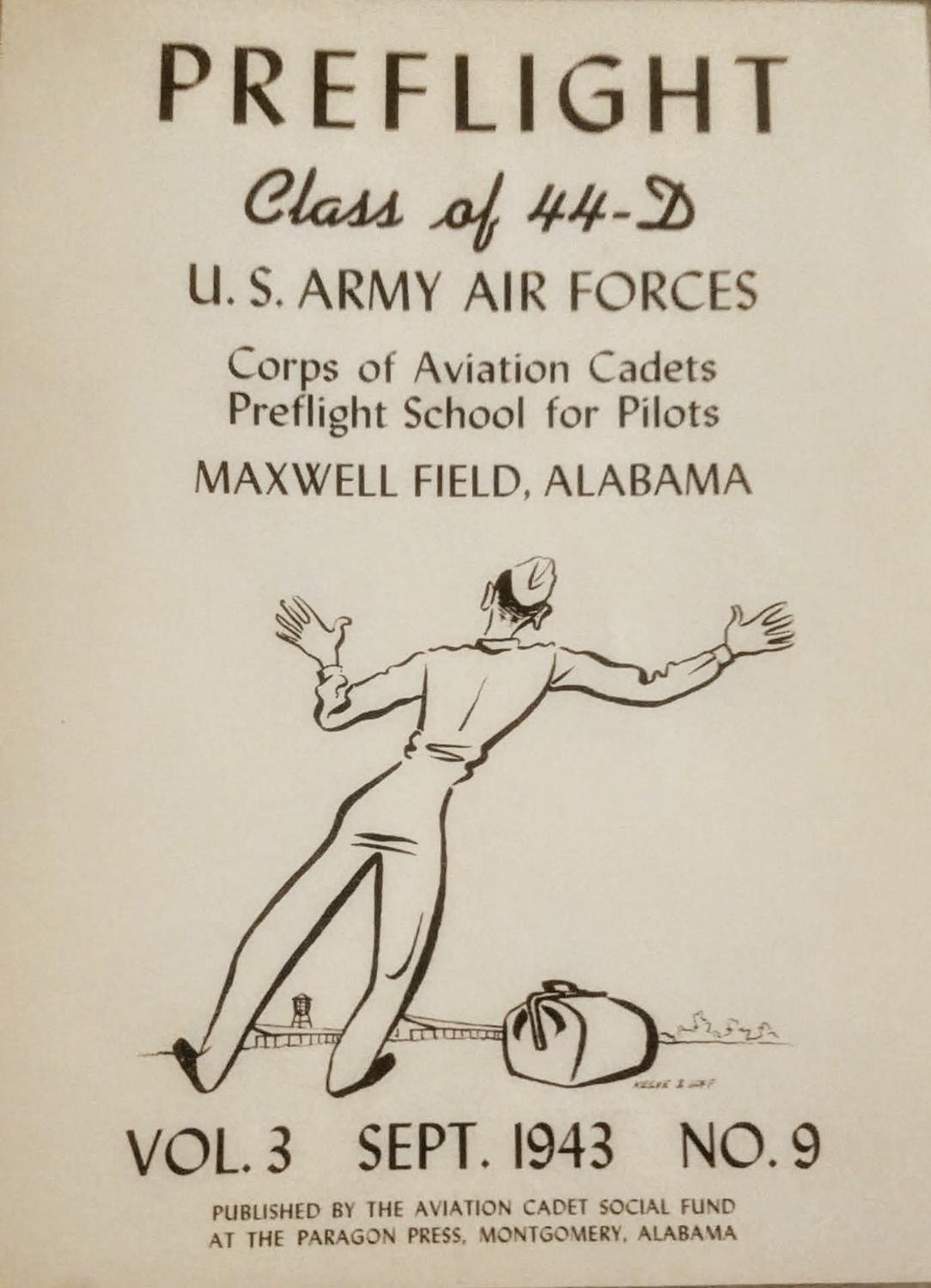

A photograph from the same field survives: four cadets on a gun in front of a columned building. The family keeps it as Frank’s Maxwell. The other three are not named here.
See the platePlate 11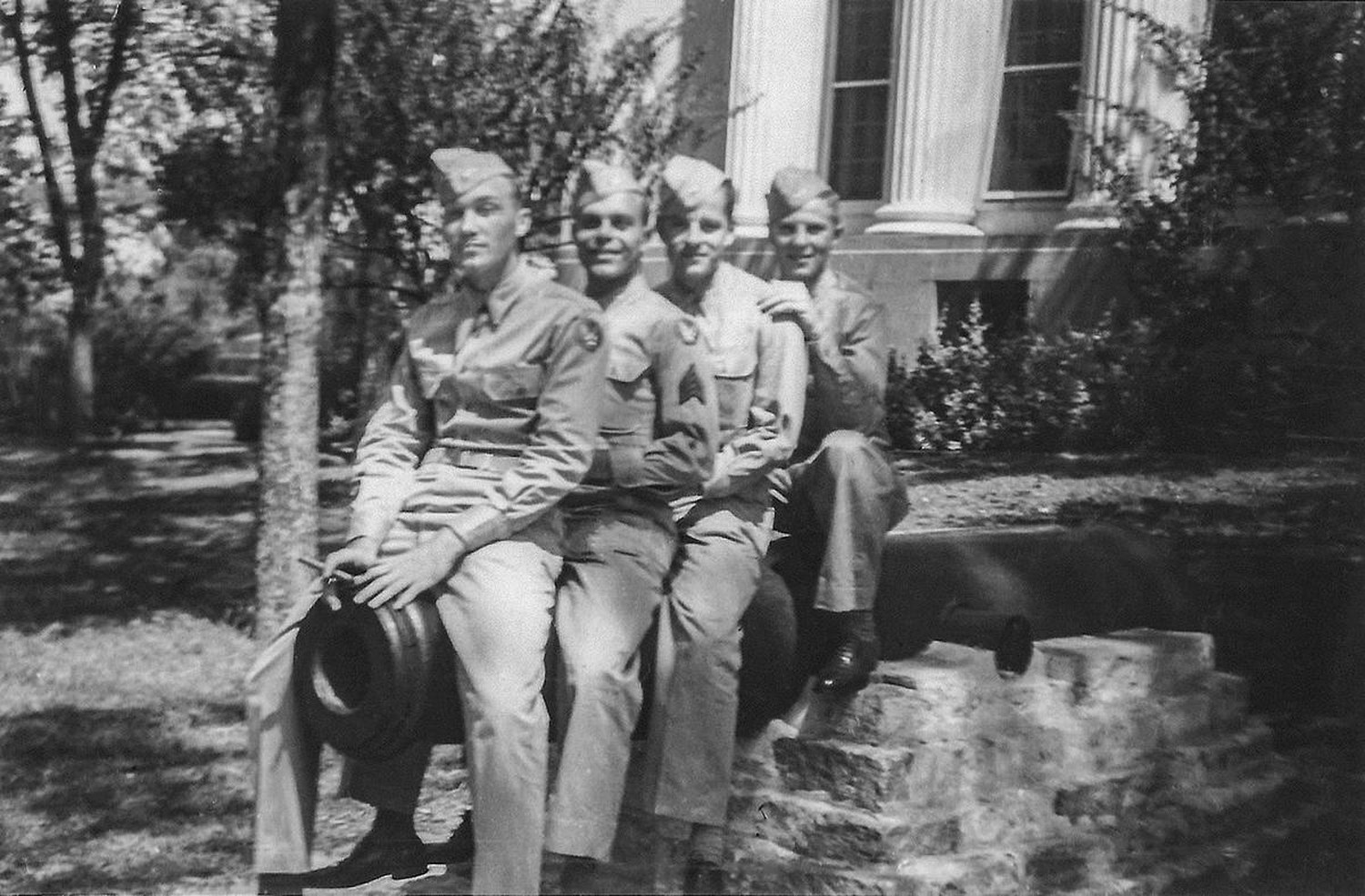

It was at some point in this stretch — the collection dates it only to 1943, Montgomery, Alabama — that Joyce crossed the country to see him. A ten-week course fixed to one post made the visit possible in a way a moving assignment would not have; there was an address to write to and a reasonable chance he would still be at it by the time a train got her there. Wartime rail travel for a civilian visiting a serviceman was not a simple undertaking — connections, cost, and a weekend’s leave on his end were all that could be counted on, and none of it was guaranteed in advance.
A letter survives from the same visit, written in Frank’s own hand on a blank page inside the 44-D yearbook. “Darling,” it begins. “This will remind you of the most wonderful time we had together while you were here. I’m on my way to those wings and nothing can stop me now. My love for you increases each day and I’ll look forward ’till we meet again. All my love, Frankie.” (family collection). It is the first piece of Frank Calicura’s own private voice this book has been able to quote directly.
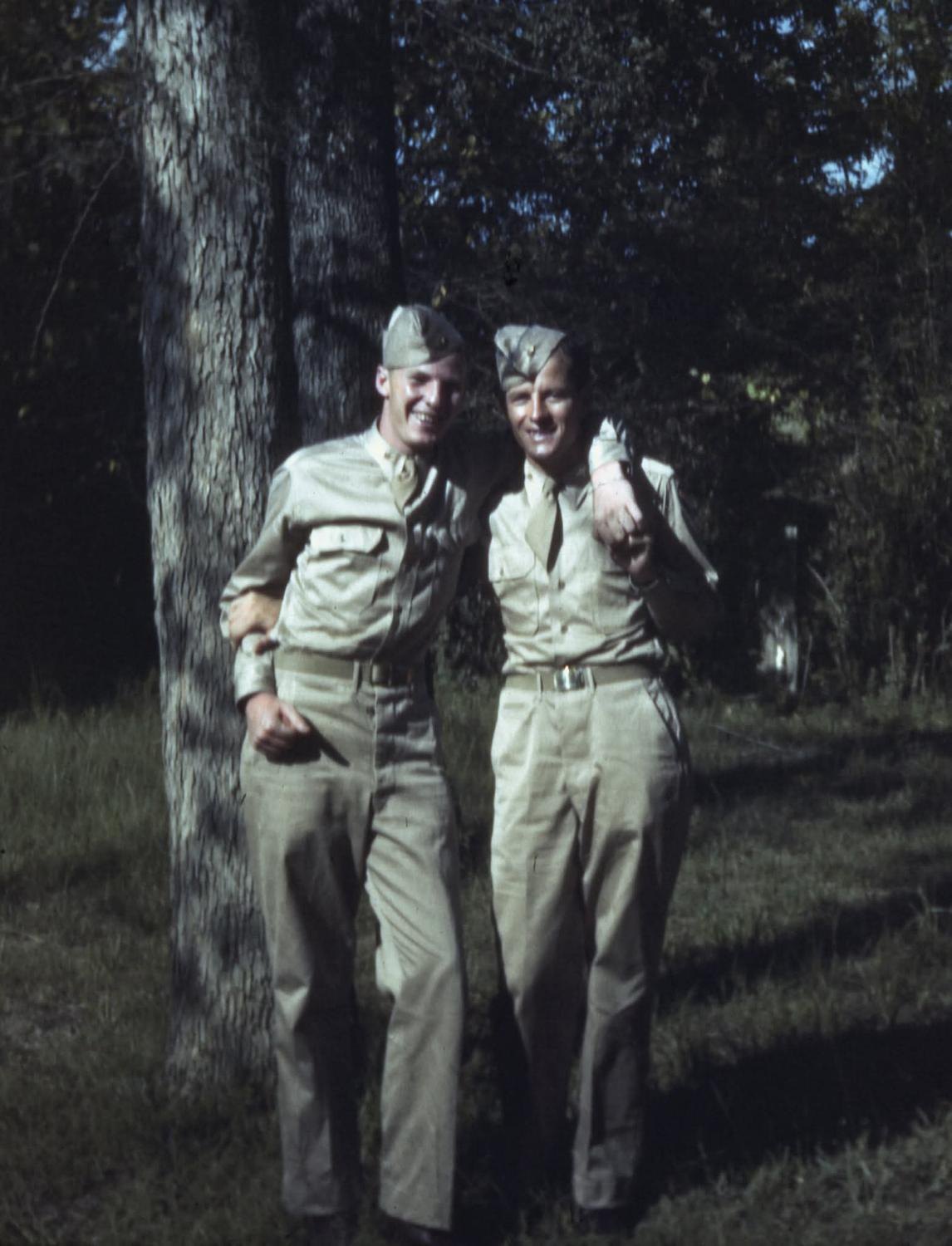
A Kodachrome slide survives from the visit — color film, 1943, a small and by then increasingly rare extravagance. The collection’s own note ties it to what came nine months later: a son. It is worth stating once, plainly, and leaving there. The photograph is already doing what it needs to do. A second Kodachrome from the same trees names the other man Red Carpenter. The book has no other paper on him.
See the platePlate 12See the platePlate 13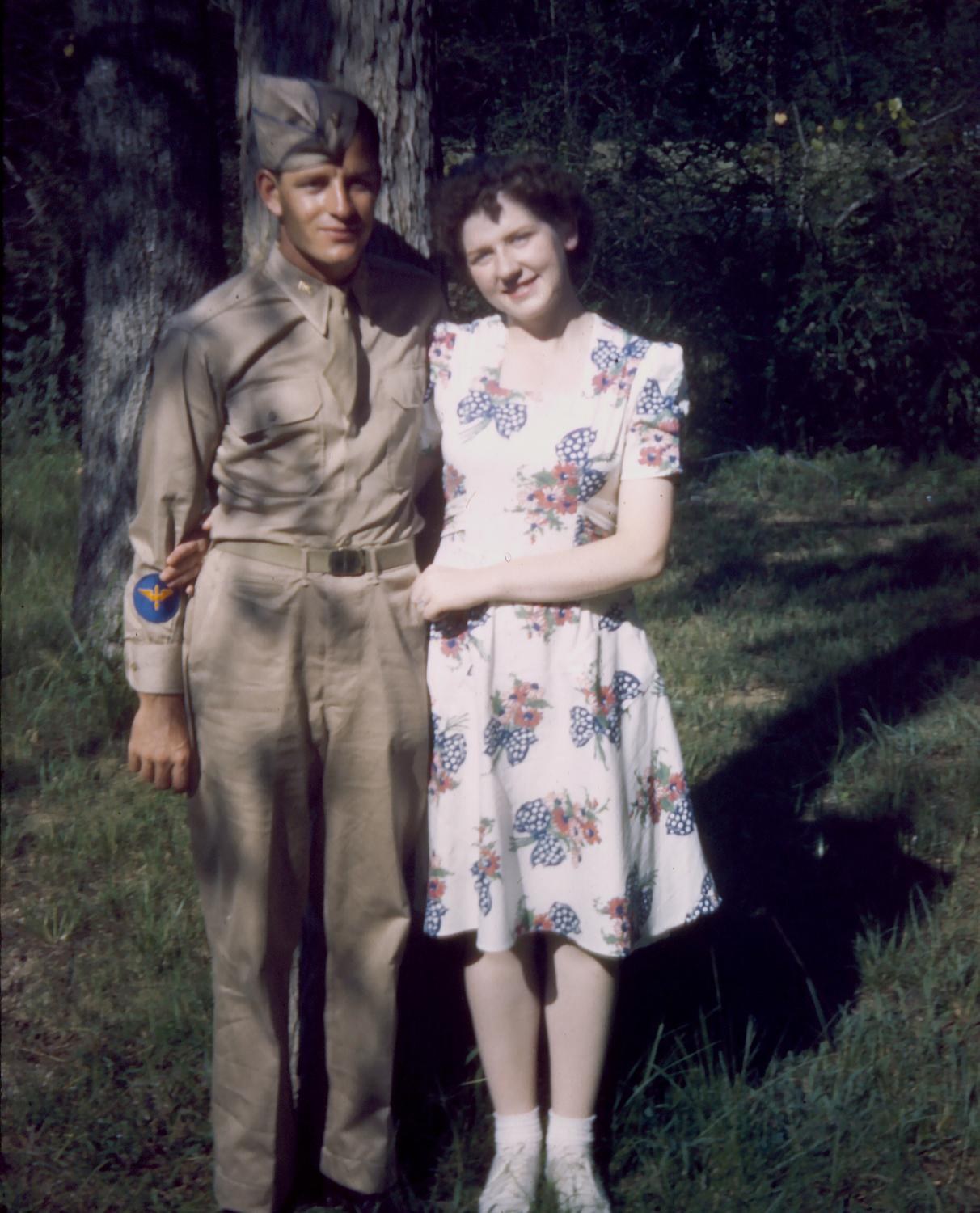


4.3
Greenville Aviation School, Ocala, Florida — summer 1943
From Montgomery, a classified and preflight-trained cadet moved on to primary — the first stage that put him in an aircraft at all.
The certificate itself resolves what earlier research could not. Frank Calicura soloed on October 19, 1943, at Canal Field, Ocala, Florida, signed off by his instructor, Ellis G. Ort. The field had been findable all along under a name the research was not yet using. A separate certificate, issued at Ocala, names the school outright: Greenville Aviation School, a civilian flight contractor to the United States Army Air Forces, certifies that Aviation Cadet Frank James Calicura successfully completed the Primary Training Course conducted by the school under the direction of the Army Air Forces Southeast Training Center — signed by E. G. Cooper, Major, Air Corps, Army Air Forces Supervisor; Frank A. Hanley, General Manager; and A. L. Clemons, Flight Director, Commanding (family collection). It was one node in a regional system that ran the same way at every field in it. The Southeast Training Center ran its primary instruction through civilian contract schools — Carlstrom Field and Dorr Field near Arcadia, others at Lakeland, Albany, Americus, Tuscaloosa, Camden — staffed by civilian instructors under military oversight, and flying almost universally the Boeing-built Stearman PT-17, an open-cockpit biplane that had become the standard primary trainer for cadets passing through Maxwell.
See the platePlate 75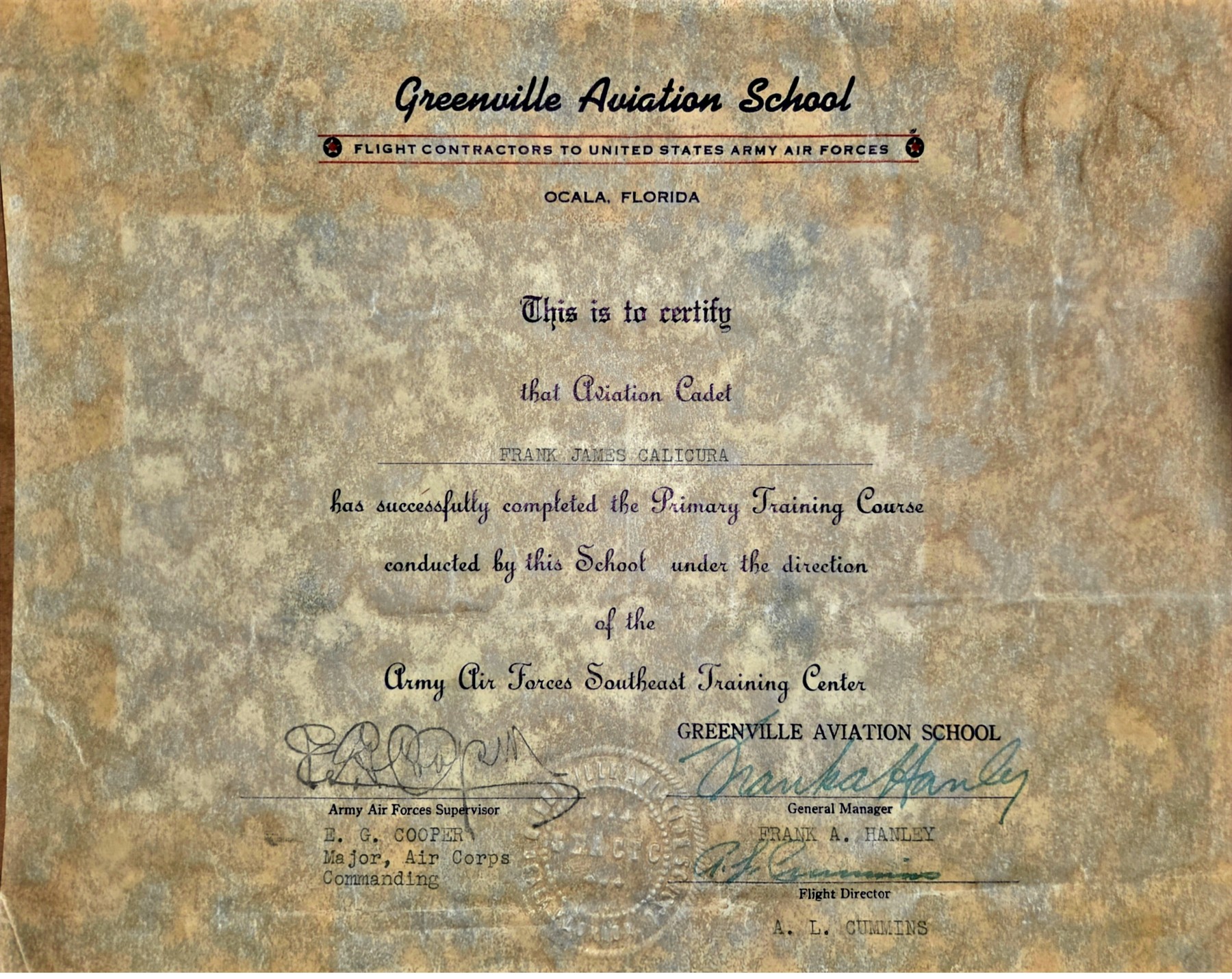

One name on that certificate deserves a direct address, the same way this book handles other coincidental numbers and names it comes across: Greenville Aviation School’s own General Manager signed himself Frank A. Hanley — a different man entirely from Major General Hanley, who would sign Frank Calicura’s commissioning letter at Maxwell Field seven months later. Same surname, two unrelated men, at two different institutions, in two different states.
The course ran roughly nine or ten weeks and about sixty hours, split between dual instruction and solo flying. A cadet’s first solo — the moment an instructor climbed out of the rear cockpit and did not climb back in — was by every surviving account from the period the single most remembered event of primary training, more so than graduation itself.
The certificate marking Frank’s is a cartoon. Woody Woodpecker, not an eagle or a colonel’s signature. The Army let the occasion be what it was: one afternoon, one young man alone in an airplane for the first time, and paperwork that did not pretend to more gravity than the moment actually carried.
See the platePlate 77See the platePlate 76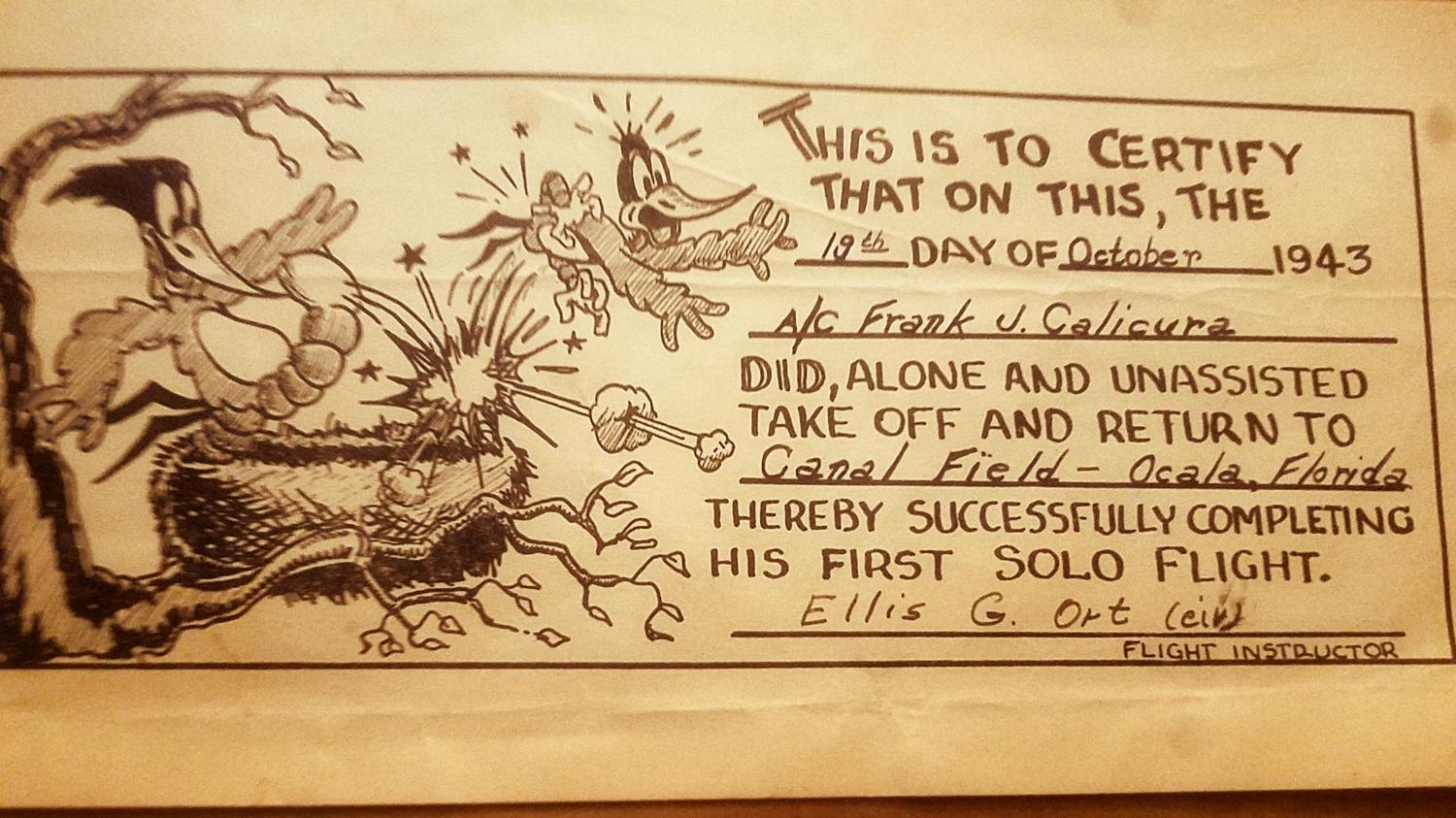
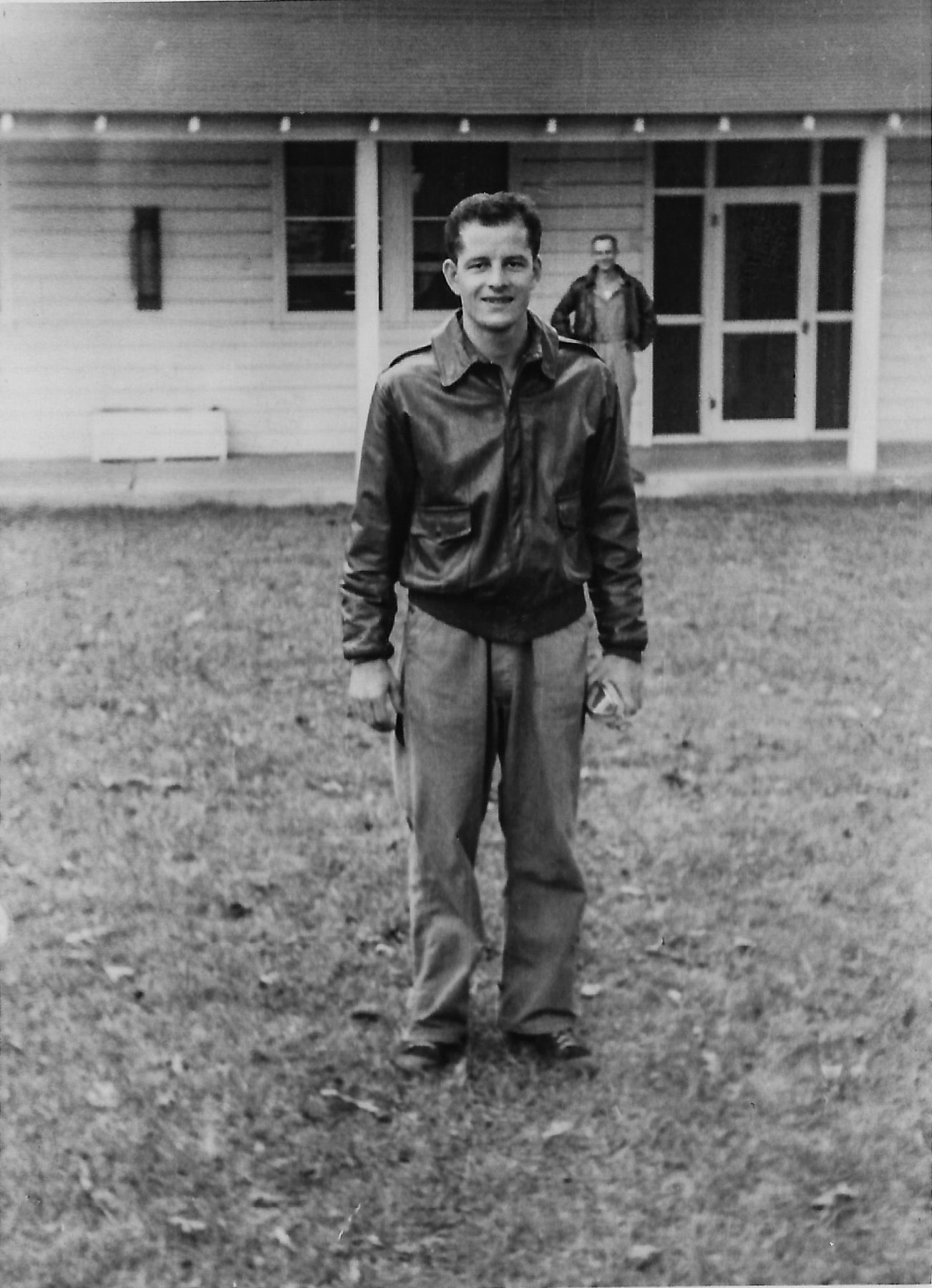


If the aircraft under Ellis Ort’s instruction was a Stearman, as the regional pattern makes likely, it was the same type — a Boeing product, the same basic biplane lineage — that Frank had already flown as a civilian at his brother’s field in Martinez. The Army’s airplane and his brother’s airplane would have differed mainly in paint.
4.4
Florida — summer 1943
Set side by side, the two records make an odd pair.
Seventy-five hours in a Cub at Martinez, flown before the Army had any claim on him, counted toward nothing on his classification file. A stanine score, produced in a testing room in Montgomery over the course of a single sitting, decided that he would fly. The system did not ask what his hands already knew. It asked what a battery of standardized instruments could measure about him in an afternoon, and it built his entire subsequent war on the answer.
Whether the seventy-five hours mattered anyway is not a question the record can settle. Primary training assumed no prior experience and taught as though a cadet had none. But a hand already familiar with a stick and rudder, however the Army chose to score it, is not nothing, whatever the paperwork says about where a man’s competence is supposed to have come from.
By the end of summer 1943, Frank Calicura had been tested at a classification center, drilled at Maxwell, and soloed in Florida. He held a designation the Army had chosen for him in a room he could not have located on a map two years earlier, and a certificate with a cartoon woodpecker on it. He did not yet have an airplane larger than a trainer, a crew, or any indication that most of what followed would happen four thousand miles from either Martinez or Montgomery, over a country he had not yet been told the name of.
4.4a
Ocala, Florida — November–December 1943
Before Bainbridge, there was a smaller command a rung down.
A cadet leadership form from the Army Air Forces Eastern Flying Training Command, issued at Ocala, Florida, appoints Aviation Cadet Frank J. Calicura “2nd Command” of the 57th A.A.F.F.T.D., to rank as such from November 3, 1943, and dated at Ocala December 3, 1943 — signed by Emil Monsour, Captain, Air Corps, Commandant of Aviation Cadets (family collection). The two dates bracket exactly the window a separate service record gives for Frank’s primary training at Ocala: November 3 to December 3, 1943.
What the appointment does not resolve is a date already sitting uneasily in this book’s own record. The solo certificate cited in §4.3 places Frank’s first solo flight, at Canal Field, Ocala, on October 19, 1943 — more than two weeks before this appointment’s own effective date, and before the primary training window a separate service record assigns to Ocala at all. The gap is left as it stands.
4.5
Bainbridge Army Air Field, Georgia — December 1943
From primary, Frank Calicura moved on to basic training at Bainbridge Army Air Field in southwest Georgia, the next rung of the Southeast Training Center's ladder — a heavier, faster aircraft than the Stearman, and the first stage of instruction the Army trusted enough to hand a portion of its own discipline to the cadets themselves. On December 11, 1943, on the recommendation of his tactical officer, Aviation Cadet Frank J. Calicura was appointed Flight Sergeant of the Aviation Cadet Basic Training Group at Bainbridge — put in a limited chain of command over other cadets before he had finished training himself.
It was the second such appointment in eight days. The Ocala paper is dated the third of December; Bainbridge named him Flight Sergeant on the eleventh. Counted from the day the first one took effect — November 3 — the same test ran twice, at two fields, inside five weeks: whether a cadet who could fly could also be trusted to answer for other cadets.
The class book for Class 44-D survives in the collection. On the autograph page he listed himself as Squadron I, Flight “A,” and dated the entry December 16, 1943. The note beneath it is addressed to Joyce: “Darling; It seems like 10 years today I’ve been away from you instead of 10 months. Here’s hoping before long we’ll be able to see each other again. All My Love, Frankie.” (family collection).
4.6
Turner Field, Georgia — April 1944
Between Bainbridge and Hendricks sat one more rung this book had not previously accounted for. Frank's own qualification record lists advanced twin-engine training at Turner Field, Georgia, completed in April 1944 — two months after Bainbridge's single-engine basics, four months before Hendricks put him in a B-17. It was the intermediate step the pipeline required before trusting a cadet with four engines at once: a heavier, faster aircraft than anything in basic, and still nothing like the Fortress waiting at the end of it.
Two documents now fix the stage's final week precisely, arriving at the same date from two different directions.
The first is a certificate: on 15 April 1944, at Turner Field, Georgia, Second Lieutenant Frank J. Calicura passed the Instrument Flight Test prescribed by A.A.F. Regulation 50-3, signed by John B. Patrick, Colonel, Air Corps, commanding, and countersigned by the instrument check pilot, Major Wm. H. Jenkins, A.C. (family collection).
See the platePlate 78See the platePlate 52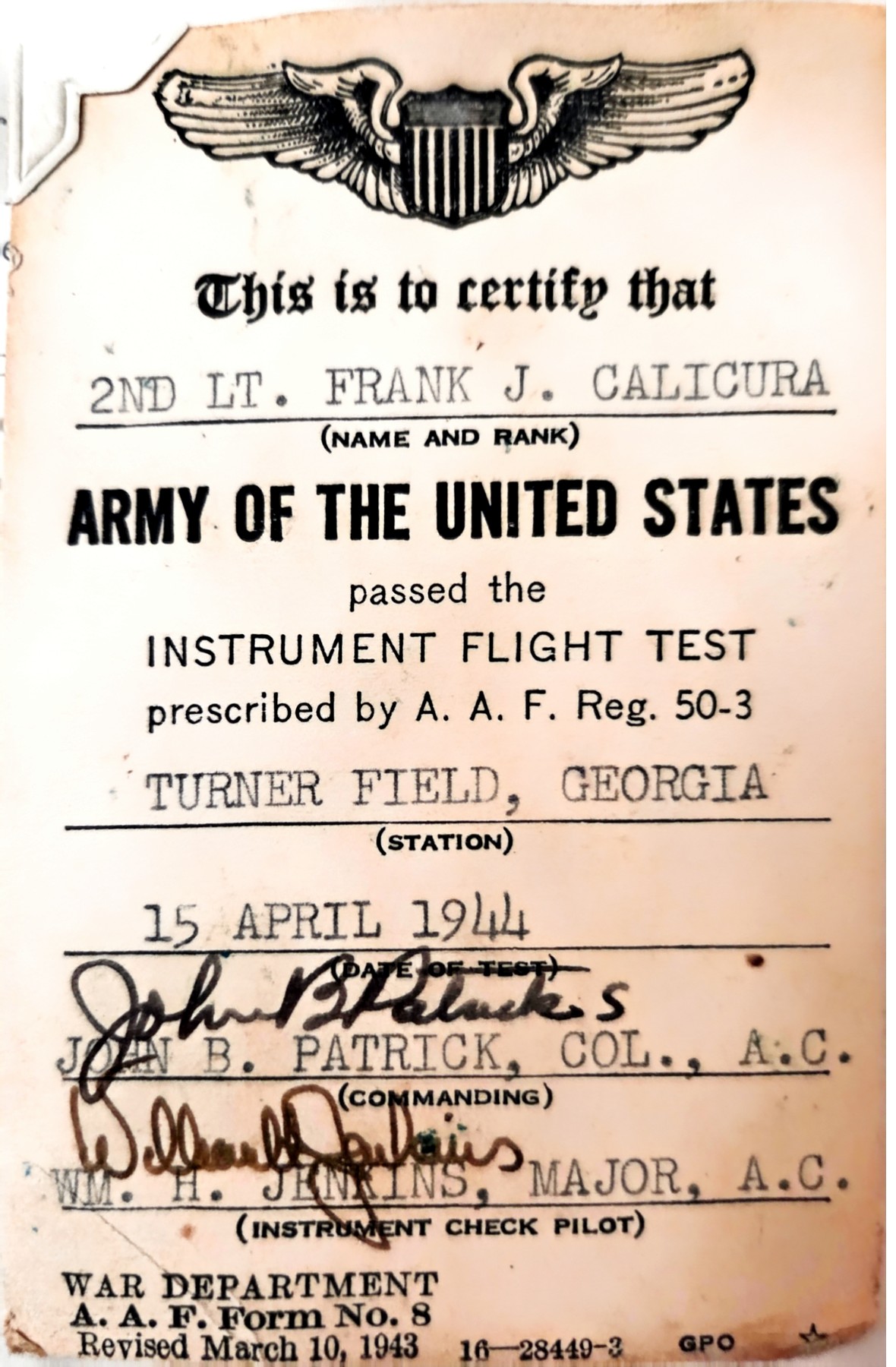
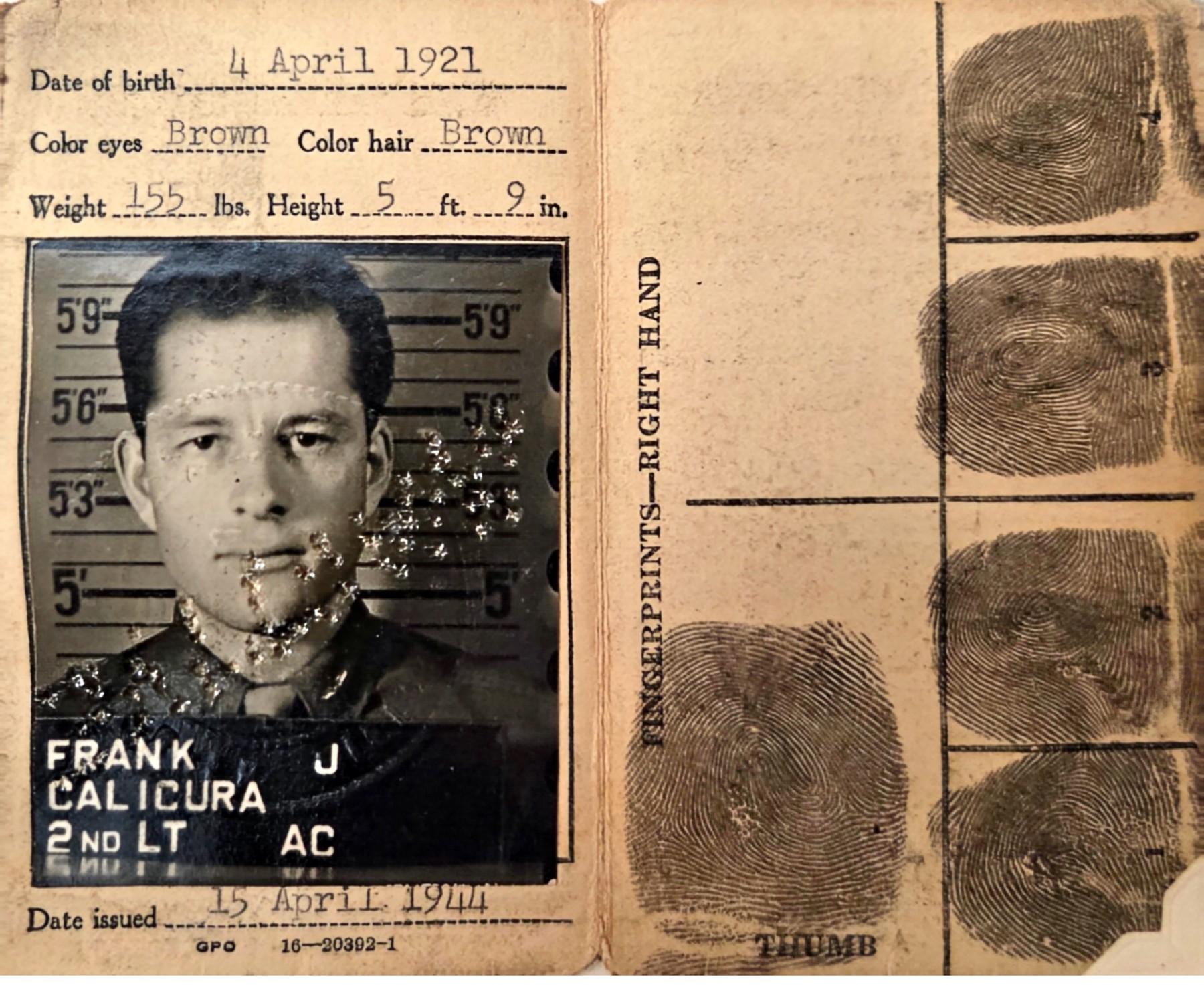


The second is the commission itself. A letter from Headquarters, Army Air Forces Eastern Flying Training Command, Maxwell Field, Alabama, addressed to Second Lieutenant Frank James Calicura at Turner Field, Albany, Georgia, informs him that the Secretary of War has directed that the President has appointed and commissioned him a temporary Second Lieutenant, Army of the United States, effective that same date — 15 April 1944 — under serial number A O-828662, the same number this book has already carried forward from the will signed at Avon Park five months later. The letter is issued by command of Major General Hanley and signed by the Adjutant General, Jamison Porter (family collection).
Read together, the two documents settle what earlier research had only inferred: commission and instrument qualification landed on the same day, certified from two different headquarters — Turner Field signing off the flying, Maxwell Field signing off the rank. Gold bars and instrument rating arrived in the same week’s mail, the way the advanced twin-engine pipeline was built to work.
The Gazette put it in a paragraph headed Martinez Boy Now Lieut. in Air Corps. Aviation Cadet Frank James Calicura, son of Mr. and Mrs. Sam Calicura, Sr., 515 Mellius street — the paper’s spelling — commissioned a second lieutenant at Turner Field, Albany, Georgia, Colonel John B. Patrick announcing it that day. Patrick is the same name on the instrument certificate. The paper uses the parents’ house, and misspells the street. Frank had lived at 731 since 1938.
See the platePlate 79See the platePlate 25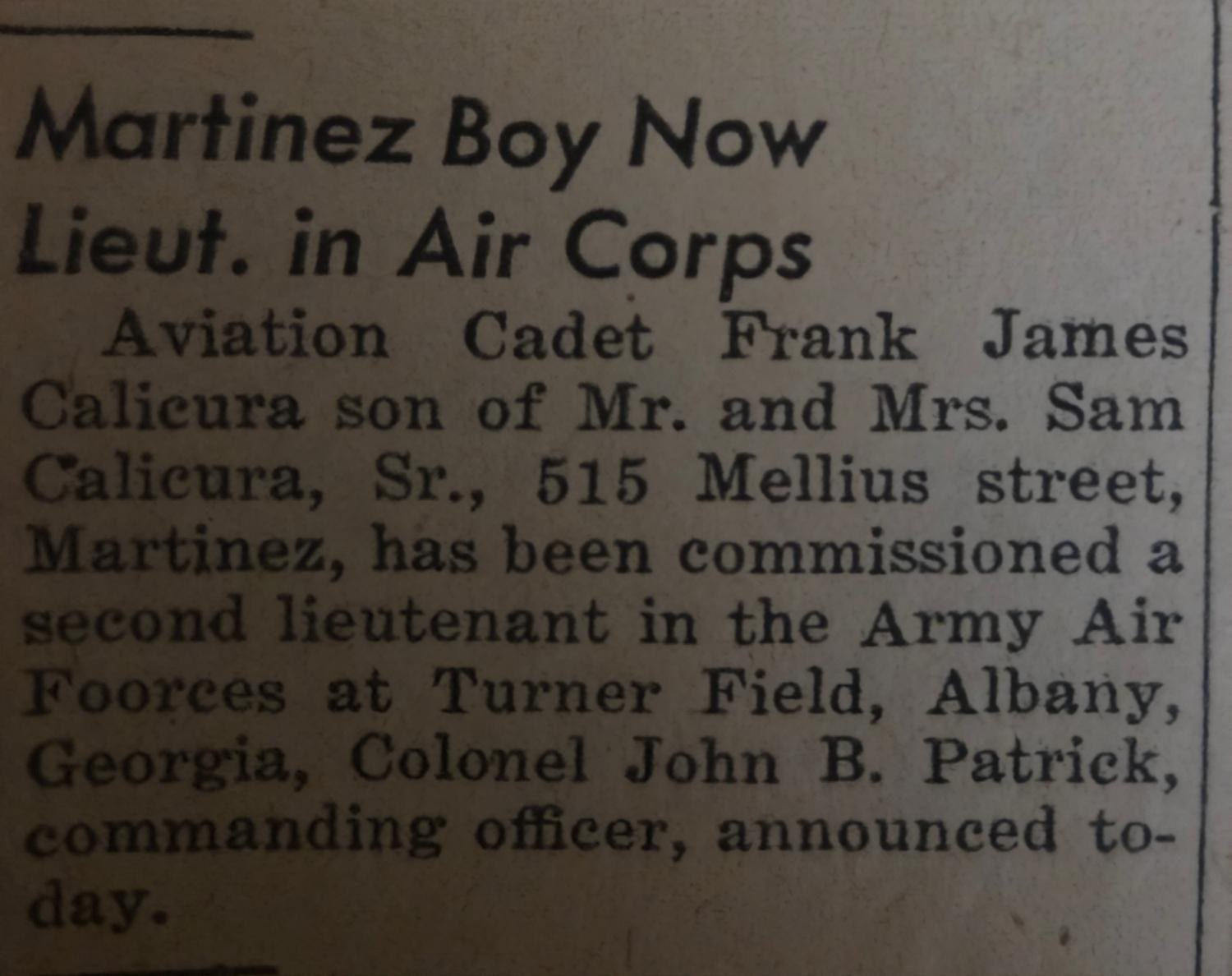
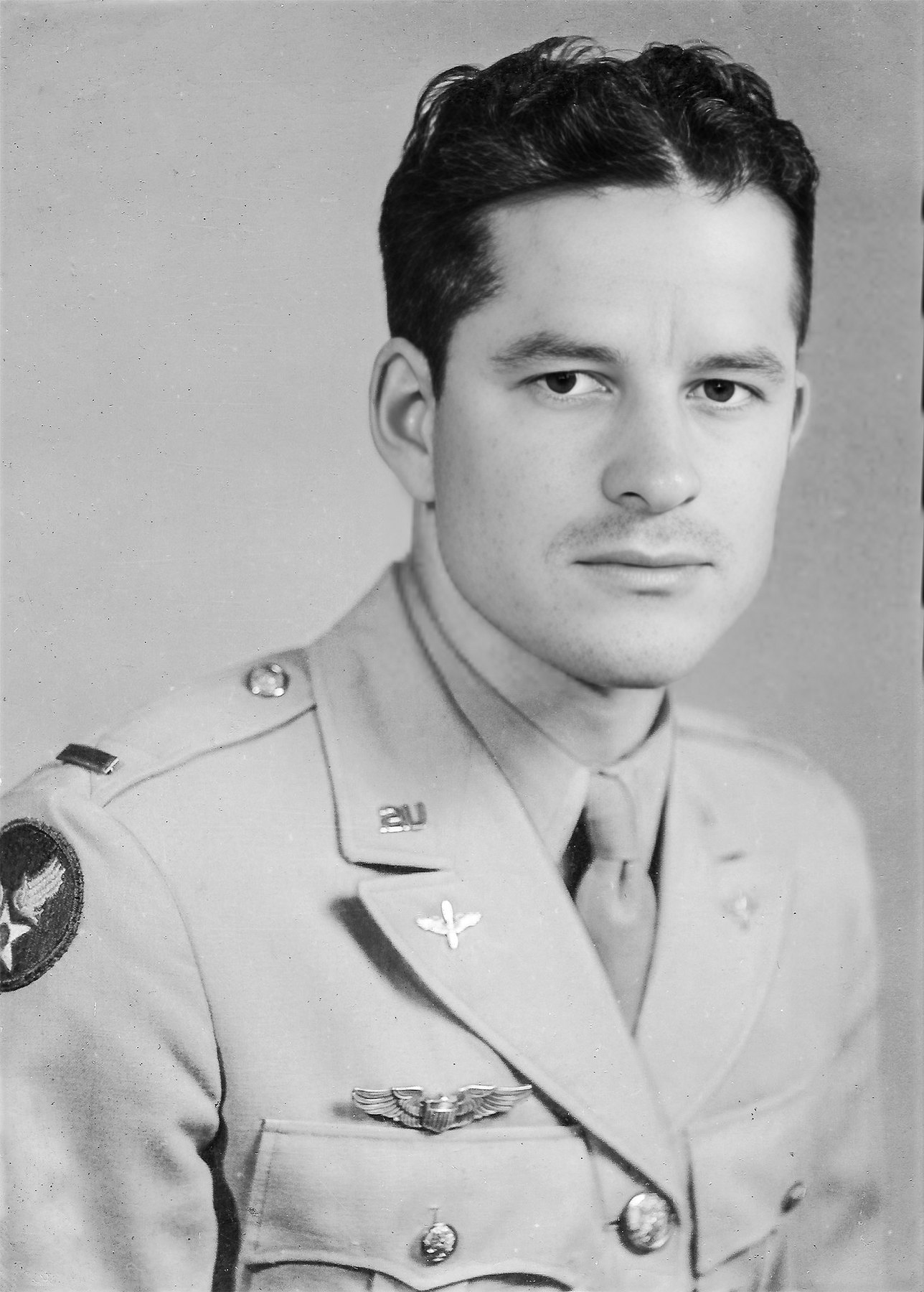


A third document, dated to the same graduation week, rates him for the aeronautical designation itself rather than the commission or the instrument qualification. Personnel Orders Number 15, Headquarters Army Air Forces Eastern Flying Training Command, Maxwell Field, Alabama, 7 April 1944, lists the entire graduating roster of Class 44-D — dozens of names, alphabetically, Calicura's among them — as rated Pilot effective 15 April 1944, Turner Field, Albany, Georgia, under Army Air Forces Regulation 50-7 (family collection). Three separate documents converge on the same date: instrument qualification, officer’s commission, and pilot rating, each issued by a different office, each landing on 15 April 1944.
A fourth item survives from the same week, and it belongs to a different category. Where the commission, the instrument certificate, and the pilot rating are administrative — records the Army kept because it had to — this one is a keepsake. A formal graduation announcement from the Army Air Forces Eastern Flying Training Command announces the graduation of Class 44-D, Turner Field, Albany, Georgia, on Saturday, April 15, 1944, personalized on its inside flap: Frank J. Calicura, Lieutenant, Air Forces, Army of the United States (family collection). Nothing about it was required. It was kept because a graduation is the kind of thing a family wants a card for, even one issued by the Army.
One more object survives from Turner Field, and it is the only thing in this stretch of the record made to be worn. It is a ring: a dark stone in an oval bezel, the lettering around the bezel worn most of the way down to illegible, and on the shoulder an eagle with its wings spread over a shield. Beneath the shield is a banner with one word on it. PILOT.
See the platePlate 97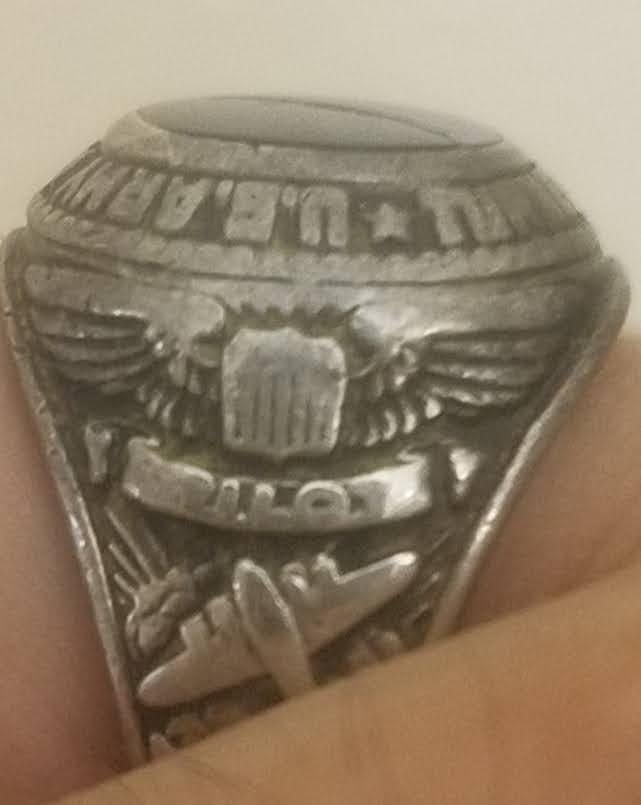

The paper from that April is all addressed to somebody — the Adjutant General, the Commanding General, whoever filed the qualification record. The ring is not addressed to anyone. It states what he was, in one word, to whoever happened to be looking at his hand.
The night of the graduation itself is documented too, and not the way anyone at the ceremony would have chosen. A Gazette clipping headlined "Calicura Learns Hard Way How to Land in Tornado" reports that at midnight the Saturday of his commissioning, a tornado grounded every aircraft at Turner Field, a few hours before Frank was due to fly home on furlough — word reaching Joyce, at 731 Mellus Street, by telegram. He was expected within a few days if the furlough could still be arranged (family collection). The same clipping places the rest of the family on that same date: Dominic, commissioned a fighter pilot at Spence Field, Moultrie, Georgia; Nick, a Chief Petty Officer awaiting sailing orders at Alameda Naval Base; and Bill, stationed at Nashville, Tennessee, in the Army's antiaircraft artillery — the first documented record in this book of Bill's own wartime service, previously known only from his postwar partnership in the family's meat market.
A second Gazette item from the same commissioning week names the transfer and the other three. Lt. Frank Calicura, Newly Commissioned, Soon to Get Transfer — Florida next. One of four brothers in the service. Corporal William Calicura in the anti-aircraft forces at Camp Davis, North Carolina; Nick a machinist’s mate in the Navy at Alameda; Dominic in the Army Air Corps at Moultrie, Georgia. The tornado clipping from the Saturday of that week puts Bill in Nashville and Nick a chief petty officer awaiting sailing orders. Two papers, two ranks, two stations. They are left standing.
See the platePlate 80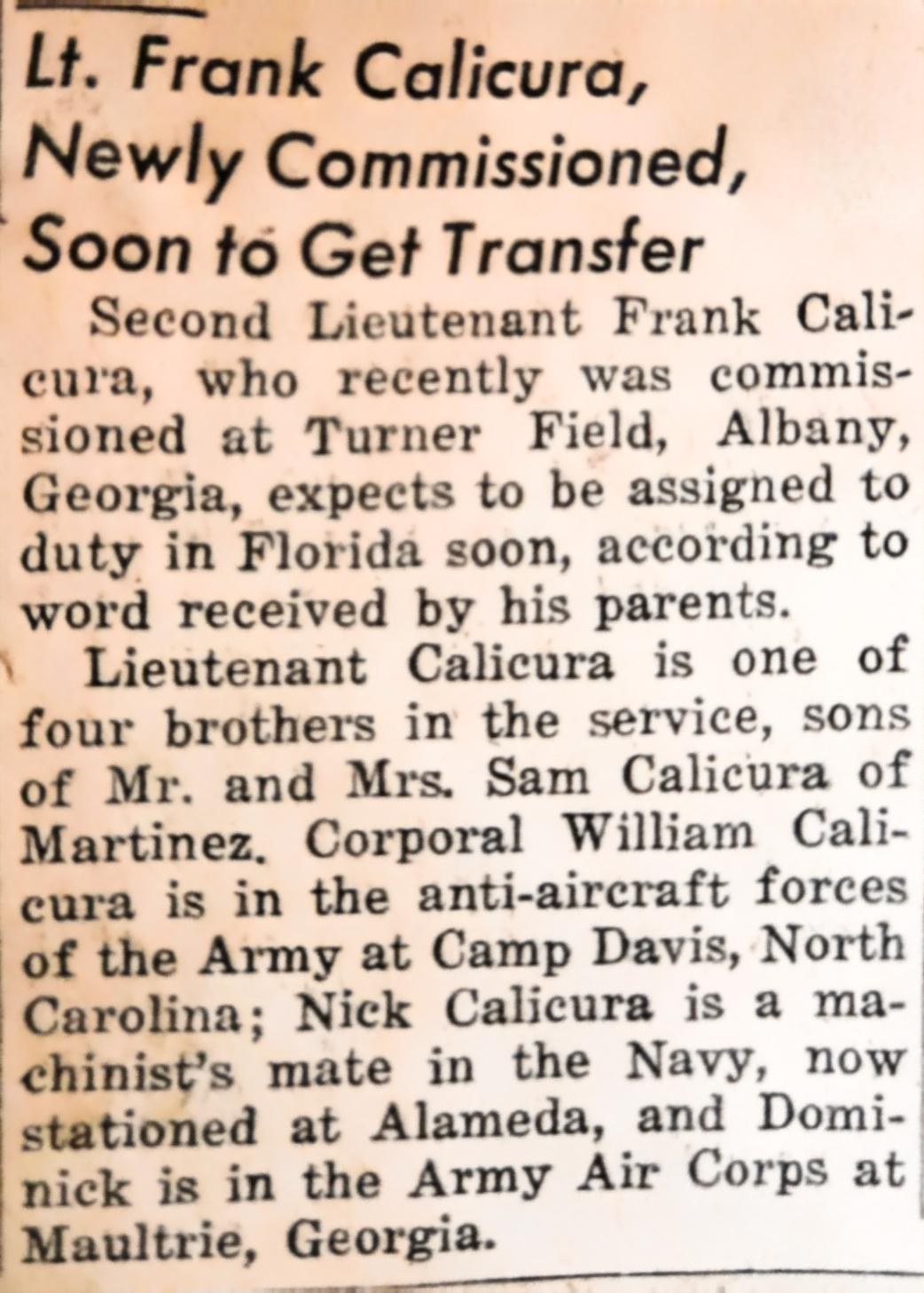

An earlier draft of this section stated that nothing in the family’s collection documented this stage beyond the bare entry on the qualification record. That statement no longer holds.
Cite this
The Spirit of Martinez. Nine Hundred Miles South, Chapter 4. What a Family Kept.
https://www.spiritofmartinez.com/chapters/nine-hundred-miles-south
A note on sources