
Chapter 15 · 1954–1959
Uncle Sam
Martinez, California — 1954–1959
The builder of the Watts Towers stands in an apron in his sister’s hometown, between two of her nephews, in the month the shop moves to 700 Main Street.
A synthetic reading of this chapter is in the bar at the top. It will keep playing while you move through the book. The text below is the transcript. The voice’s place on the page is marked as it reads.
15.1
Sabato Rodia is not otherwise a figure in this book. His name appears once, in passing, in Angelina Calicura’s own obituary from July 1944 — “two brothers, A. Rodia of Martinez and Sam Rodia of Los Angeles” — and then not again for a decade.
The public record of his life picks the thread back up on its own, independent of anything the family kept. In the summer of 1954, after thirty-three years spent building what the world would eventually call the Watts Towers, Rodia suffered a stroke. He deeded the property to a neighbor, boarded a bus, and by most published accounts never returned to Los Angeles again. Multiple independent sources — museum archives, historic-preservation records, an academic study of his life — agree on the shape of what followed: he left Watts for good in 1954, and he settled in Martinez, California, where he lived until his death in 1965.
Several of those same sources state that he moved to Martinez “to be with his sister.” That detail does not survive contact with this book’s own record. Angelina had been dead ten years by 1954. The brother named in her own obituary — A. Rodia of Martinez — is the far more plausible anchor. A fact repeated across several public sources about this family is very likely a simplification, or a decade-old assumption never corrected, rather than an independently verified detail. The Calicuras had a Rodia already living in Martinez before Sabato ever arrived. That is a documented fact this book can supply that the public record of Rodia’s own life apparently could not.
15.2
What the family’s own collection adds to this is a photograph, and the photograph carries its own date. A wall calendar hangs on the shop wall, open to August 1955 — the same month, by coincidence or not, that Calicura Bros. Meats had just finished moving into its new quarters at 700 Main Street.
The photograph shows the shop mid-workday. Frank stands at the display case on the left, restocking it. Billy works the BIRO bandsaw on the right, a hanging carcass visible in the open cooler behind him. And in the background, behind Billy, half in shadow, stands a third man — older, watching or waiting rather than working — who the family identifies as Sabato Rodia.
See the platePlate 70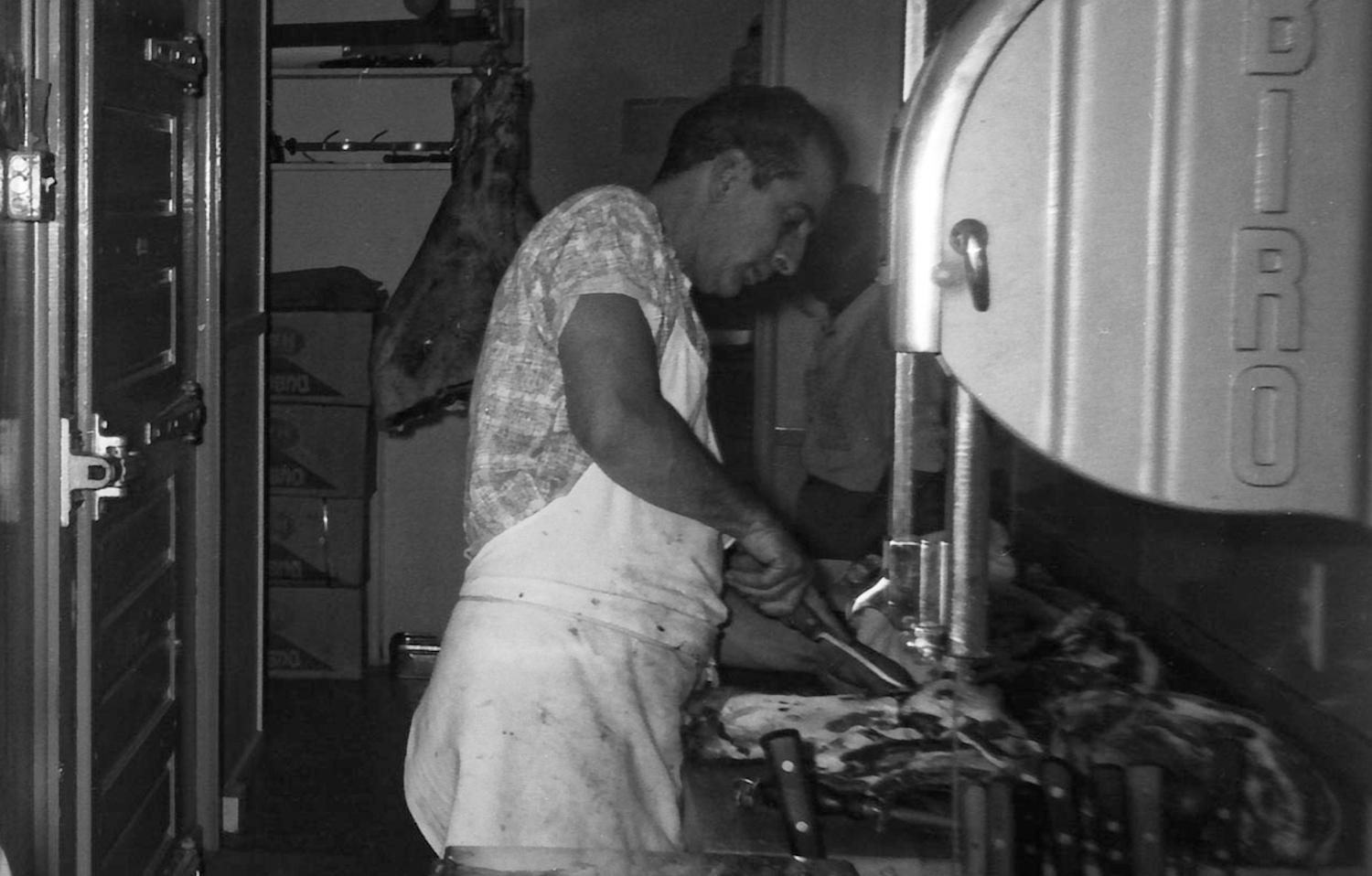

A second photograph, posed rather than caught mid-task, puts all three men together deliberately: Frank and Billy flanking Rodia, who stands at the center, visibly older than either of his nephews — the same man, seventy-six that year, who had spent three decades laying tile and glass into concrete a few hundred miles south, now standing in his sister’s hometown, in an apron, between two of her nephews.
A third plate the family keeps of the same three is not independently the shop. Frank, his uncle, and Bill, at a table. The family names them left to right.
See the platePlate 71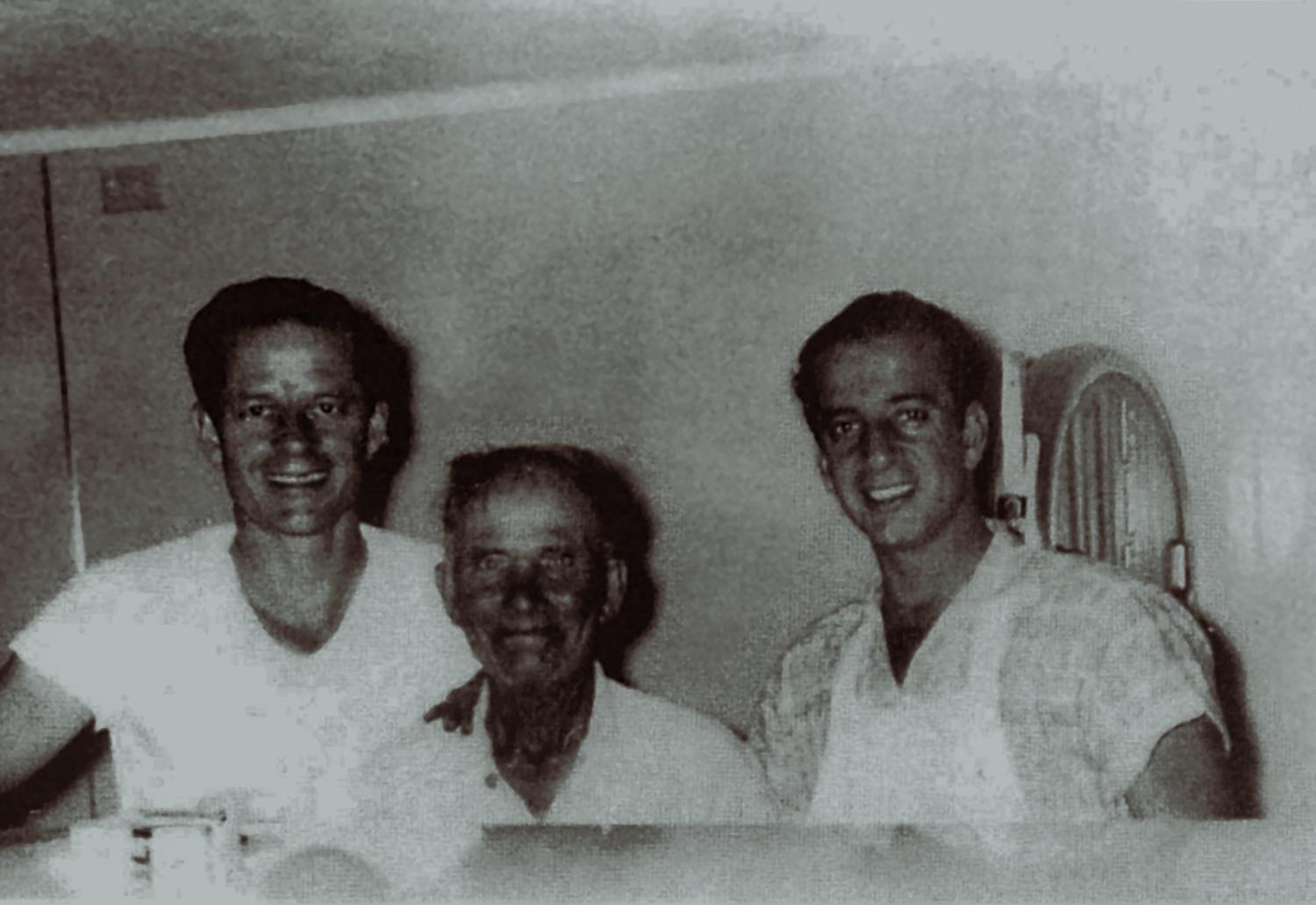

Nothing in the family’s collection or the public record explains how often he came, what he did there, or whether “in the shop” meant working or simply present. Samuel Calicura’s own memory — that his great-uncle Sabato was a fixture at his father’s shop — is family testimony, corroborated by two photographs. What they confirm is narrower than the memory: in August 1955, Rodia was in Martinez, and Rodia was, at least once, standing in that shop with both of his nephews.
15.3
What the photographs suggest, a newspaper interview confirms directly. A Martinez News-Gazette feature on a documentary being made about Rodia — undated in the collection, but referencing a film “currently being produced” and a Watts Towers preservation campaign already some years old — quotes two of his nephews and nieces by name, on the record, describing what this chapter has otherwise pieced together from photographs and family memory.
Nick Calicura, Rodia’s nephew, told the paper plainly: “When my brothers Frank and Bill had the butcher shop, he would hang around there.” Virginia Calicura Sullivan, his niece, added texture rather than correction: “He was quite a colorful character. He was wonderful. He was warm. He loved our children.” Neither quote is new information exactly — both confirm what the August 1955 photographs already show — but both convert it from something this book infers to something two people who were there said aloud, in print, decades before this chapter existed to ask them.
The article adds detail this book did not otherwise have. Rodia’s house in Watts burned in 1957, and the property sat untended and “slightly vandalized” from 1954 to 1958, before William Cartwright and Nicholas King purchased it in 1959 and began the preservation campaign that eventually saved it. Nick Calicura is quoted giving his uncle’s birth year as 1875, in the province of Avellino — a year the article itself calls disputed, and one that conflicts with the 1879 birth year given by the public sources already cited in this chapter. Consistent with how this book treats every other such conflict, neither figure is adopted over the other.
The article also reports that Rodia “finished his project in the late 1940s,” which sits awkwardly beside the public record already cited here — that he worked on the towers until the stroke that ended his time in Watts altogether in 1954. Both may be true in different senses: a structure substantially complete by the late 1940s, still being maintained, tiled, and added to for years afterward.
15.4
Two threads in this book cross in 1959, and here, for once, a contemporaneous record supplies the name.
Frank Calicura’s disability claim was decided by the Veterans Administration on October 30, 1959, built on a sworn statement from an unnamed man who had served with him on an aircrew at Avon Park during September and November 1944. The same year, Jimmy Calicura’s own slide index — filled in by hand at the time, not reconstructed later — logs an entry in Section C: “Dale Ernest + Dau, ’59.” Ernest is otherwise documented in this book only through his postwar career; this is the only point where he appears inside the family’s own record, dated by the collector himself to the same year the VA closed Frank’s case.
Ernest is the only member of the crew whose presence at Avon Park during the exact months the VA statement covers is independently confirmed elsewhere in this book. That he also held a Naval Ordnance Laboratory patent dated January 1959, and left for Kelsey-Hayes in Detroit that December, places a cross-country visit comfortably inside a year already documented as one of transition for him.
None of this proves Ernest is the unnamed man in Frank’s claim file. What can be said is narrower, and it no longer rests on an unnamed photograph: a member of Frank’s own crew, present with him at exactly the right moment in 1944 to have witnessed what the claim describes, was also, by the family’s own contemporaneous record, in Martinez in 1959 — the same year the claim was decided. The connection is offered as likely, not documented, and stated exactly that plainly.
15.5
Every other connection this book has drawn between the Calicura family and Sabato Rodia runs one way — Rodia coming north, into Martinez, into the family’s own shop and street. One photograph in the collection runs the other direction.
See the platePlate 58See the platePlate 59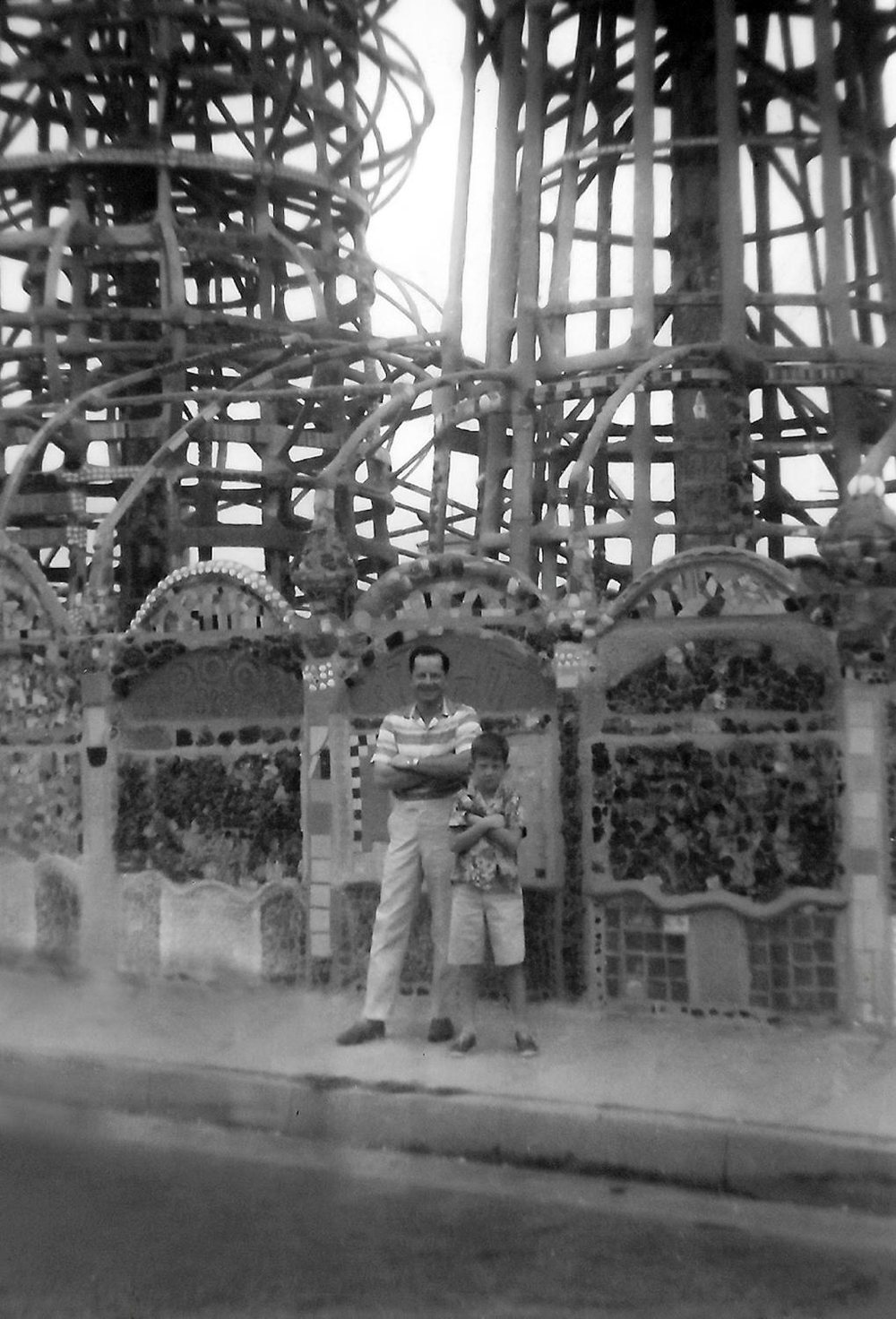

It shows Frank Calicura and his son Samuel standing on the sidewalk outside the Watts Towers themselves, the mosaic walls and looping tower framework filling the frame behind them. Frank stands with his arms folded; Samuel, younger, stands the same way beside him. The family places the stop during a trip south to Disneyland. Samuel, born in 1952, would have been about six that year — consistent with 1958, the working date used here, a year ahead of both the Ernest visit and the VA’s decision on Frank’s claim, though nothing fixes the trip’s date itself independently of family memory; only Samuel’s birth year is separately confirmed.
The towers were a detour on the way to or from a vacation remembered for something else entirely. Nothing in the record says what Frank told his son standing there, or whether he told him anything at all.
Cite this
The Spirit of Martinez. Uncle Sam, Chapter 15. What a Family Kept.
https://www.spiritofmartinez.com/chapters/uncle-sam
A note on sources