
Chapter 1 · 1938–1941
The Weight of Small Machines
Martinez, California — 1938–1941
A butcher’s son from a refinery town is judged competent at a small problem in moving water, on an island built to be an airport that was never built.
A synthetic reading of this chapter is in the bar at the top. It will keep playing while you move through the book. The text below is the transcript. The voice’s place on the page is marked as it reads.
1.1
Treasure Island, San Francisco Bay — 1939*
The certificate says Award of Merit. It gives the year, 1939, and the recipient’s name, and it names the event: a Gas Model Hydroplane Meet, held in connection with the Golden Gate International Exposition on Treasure Island. The printed formula around the blanks calls him an outstanding junior citizen. It carries two signatures, one of them Leland W. Cutler’s, president of the exposition.
See the platePlate 73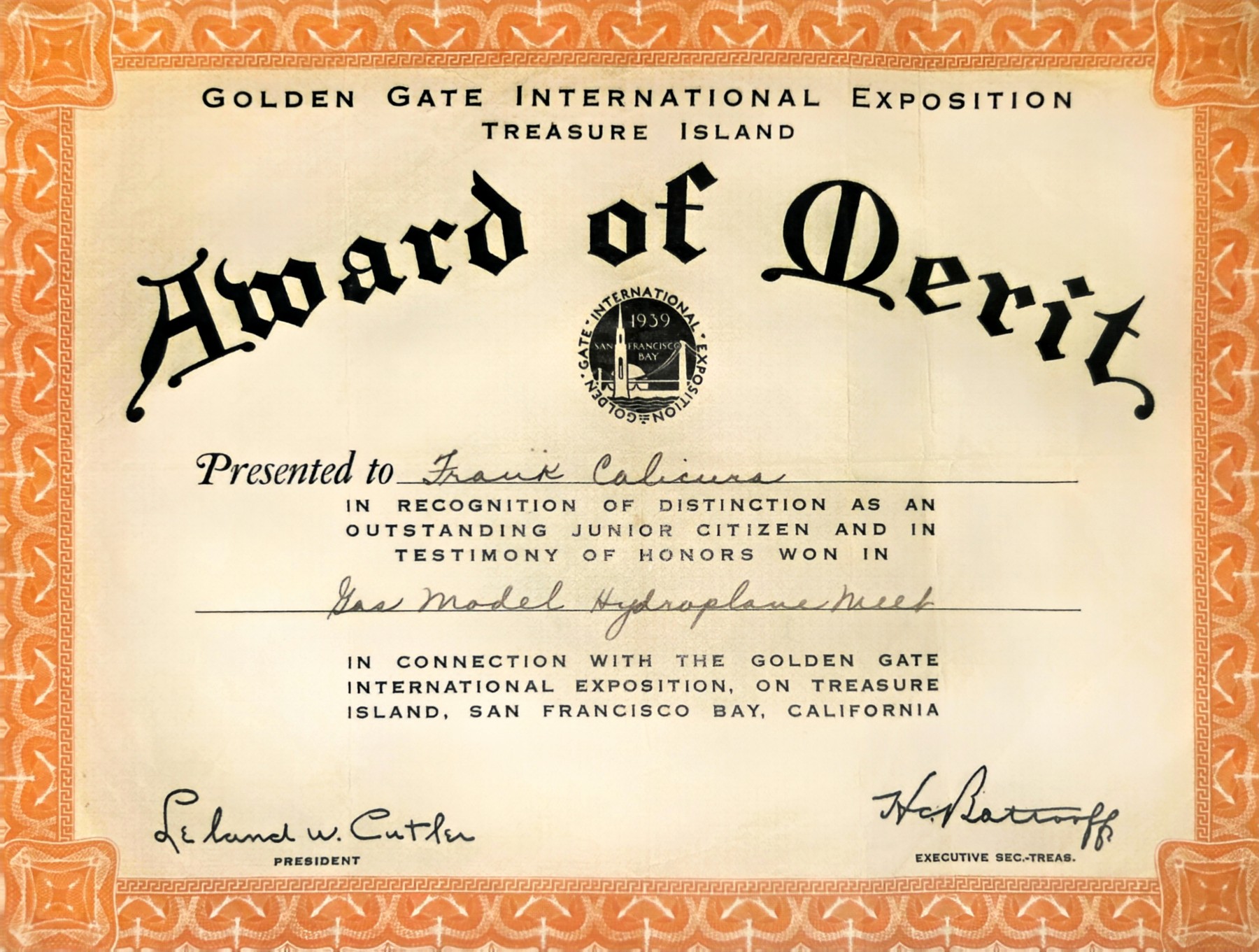

That is the whole of the document. It is the earliest object in the collection that has anything to do with the way things move.
Frank Calicura turned eighteen six weeks after the fair opened. He was the son of an Italian mule skinner and blacksmith, one of seventeen children in a house on Mellus Street in Martinez, thirty miles northeast across the water, and he cut meat for a living in his older brother’s shop. What he had built was a boat designed not to displace water but to escape it — a hydroplane rides on top of the surface once it is moving fast enough to break the grip of it. Adults judged it and found it worth a certificate.
The ground he stood on to collect it had not existed four years earlier.
In February 1936 the Army Corps of Engineers began dumping rock and sand onto the shoals north of Yerba Buena Island. More than nineteen million cubic yards came off the bottom of the bay, topped with barged-in soil, until there were four hundred flat acres in the middle of San Francisco Bay where there had been open water. They called it Treasure Island, after the gold that might be in the fill.
The fair was the interim use. The island had been built to be an airport.
Federal money paid for the dredging and for three permanent structures — a terminal building and two hangars along the south shore — intended to serve San Francisco’s municipal airport once the exposition closed. The north end, where the runways were to go, was paved for the time being as parking for twelve thousand cars.
Pan American Airways moved its flying-boat operation over from Alameda on January 23, 1939, three weeks before the gates opened. The Clippers came down in the cove alongside the fairground. Pan Am was itself an exhibit: one of the hangars was fitted with a spectators’ gallery so that fairgoers could stand and watch mechanics overhaul transpacific aircraft.
Ten million people came in 1939, and five million more the following summer. The fair celebrated two finished bridges and the ascendancy of California in the Pacific.
The airport was never built. The Navy took the island in 1941 and held it for fifty-six years. The Clippers were out of regular service by the end of the war, and San Francisco built its airport south of the city instead, on the tidal flats at Mills Field.
So the certificate records a butcher’s son from a refinery town, judged competent at a small problem in moving water, on an artificial island built to be an airfield, at a fair about the Pacific Ocean, twenty-eight months before the Navy took the ground and the ocean became something else entirely.
It does not say he wanted to fly. Nothing in the record says that yet.
1.2
Martinez, California — 1938–1941
The house at 515 Mellus Street belonged to Sam and Angelina Calicura, and it held seventeen children.
The number is the first fact of Frank Calicura’s life, and it is an economic fact before it is a sentimental one. A household that size in an immigrant town during the Depression is a labor pool with a rotation of wages coming into it — the older ones working, the middle ones minding the younger ones, everything pooled against one roof. It also means that a boy born in 1921 grows up under several men who function as his fathers.
Seventeen is the family’s own number, and this book keeps it. The paper supports sixteen. The Gazette counted a sixteenth birth in August 1928, and no birth after it is documented anywhere in the collection. The seventeenth is carried here on the family’s authority alone, and remains unaccounted for.
Seventeen is also the first in a long series. Almost everything that can be established about Frank Calicura now arrives as a figure someone had a reason to write down — hours logged, a score on a scale of one to nine, the size of a crew, the count of missions flown. The family kept the objects. The institutions kept the numbers. Both are in the record, and they do not always agree.
The eldest had been born in Italy in 1906, fifteen years ahead of Frank. The father had come over as Saverio Colacurcio, and the eldest son carried the same first name — a second Saverio, differing from his father only in the middle — and there were two Sams in the house, because Americans called them both that.
The surname did not survive the school system. A name-change document in the family’s collection records the family becoming Calicura, and the account attached to it gives the reason: around 1914 the eldest son was failing at school, and the Martinez school district suggested a spelling that teachers and clerks could manage. He was eight. Saverio Colacurcio had carried the name he was born with through Ellis Island in 1902, through the Pennsylvania coal towns, and across the country to a refinery on the Carquinez Strait. It came off in a classroom.
In print afterward the father is Sam Calicura and the son Sam Calicura Jr., though the two men did not share a middle name and so were never strictly Senior and Junior; the papers were solving the same problem the household had, in the same rough way. The change also dates the record. A Colacurcio in a Martinez newspaper belongs to the years before 1914. A Calicura belongs to the years after.
The name was worth managing. A notice in the collection runs under the heading TO MY FRIENDS and is signed by the eldest son, his name set in capitals at the foot. It was bought and paid for in the Martinez News-Gazette, where it ran on page 2 on Wednesday, May 29, 1940. Word had reached him that someone named Calicura had been arrested, and people had been asking whether it was him. He had never been arrested for anything, he wrote, and he had gone through the records of the city and the county himself and found no one of that name who had been. The collection does not identify the other Calicura, or explain what prompted the rumor.
See the platePlate 74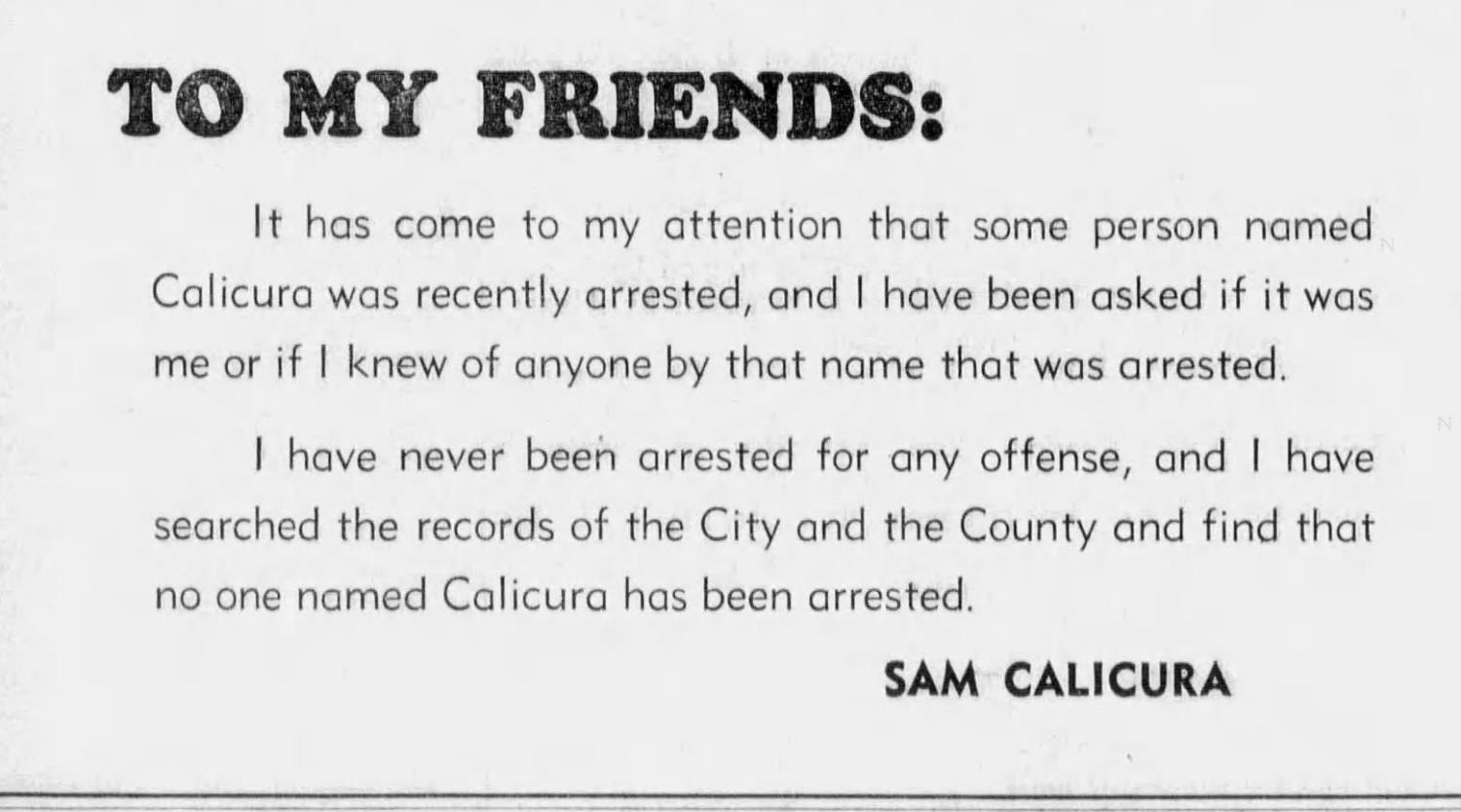

The date is worth holding onto. In the spring of 1940 the name was twenty-six years old — no longer new, but not old either, and by then attached to a butcher shop, a union local, and, before the year was out, a hangar going up on the waterfront fill. The man who paid for the notice was thirty-four and in the middle of building his town an airport. What it shows is someone who understood that in a place this size a surname in print was a business asset, and that a name his family had taken at a school district’s suggestion could still be damaged by a stranger who happened to carry it.
Martinez had been the seat of Contra Costa County since 1850, on the south shore of the Carquinez Strait where the rivers come down to meet the bay. Portuguese and Italian fishermen had worked that water since the 1870s, productively enough that by 1882 two of the twelve fishing canneries on the Pacific Coast were operating there, shipping salmon to Europe, the eastern states, Australia, New Zealand, and Hawaii. Commercial fishing supported families in the town until the bay was closed to it in 1957. Italians settled the place heavily in the last quarter of the century and started a wine industry that later moved to the Napa Valley. Joe DiMaggio was born there in 1914, to a fishing family, and the town has never once stopped mentioning it.
Then the oil came, because the harbor was deep and the railroad already ran along the waterfront. Shell built its refinery on the Martinez shore in 1915. Associated Oil put another three miles away a few years after. By the time Frank was old enough to work, the town ran on two economies at once — the old one that came out of the water, and the new one that came off the hill in a smell you could navigate by.
Frank finished at Alhambra High in 1938 and went to cut meat for his brother at the Star Meat Market on Main Street. The family had been in the meat business since about 1925.
See the platePlate 81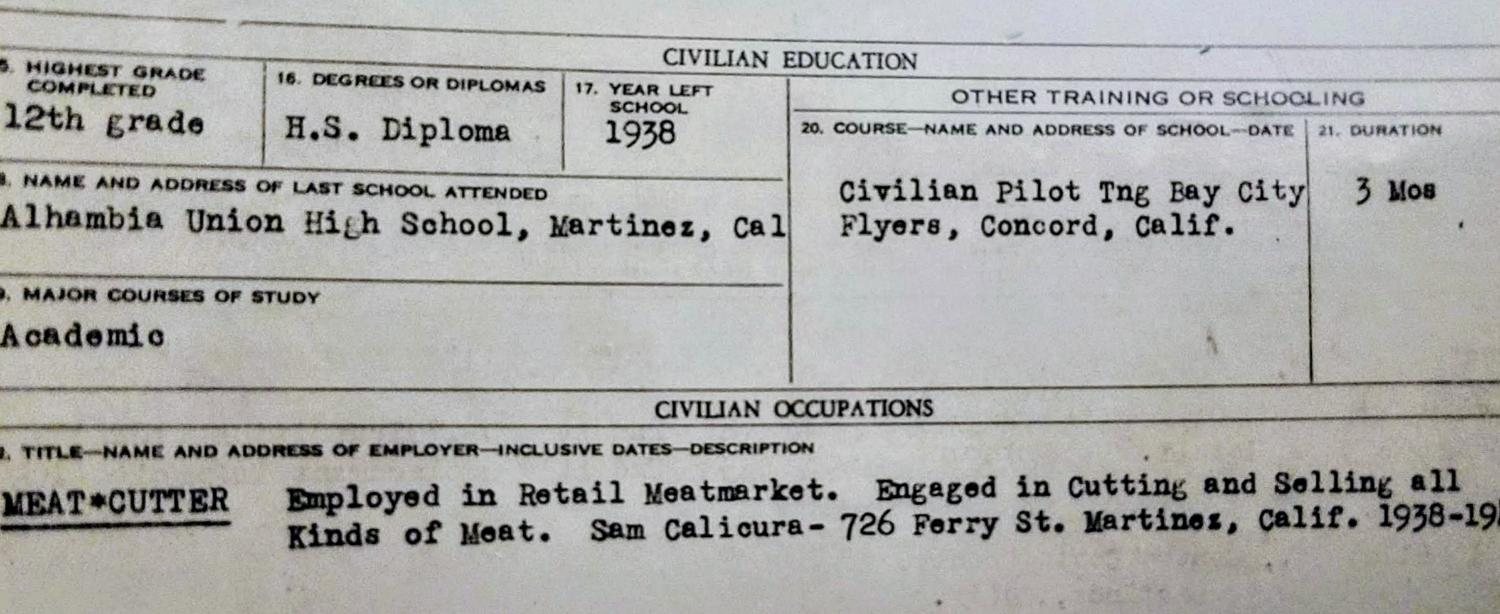

He also left the house that year. From 1938 his address is 731 Mellus Street, a few blocks from the one he was raised in — the address that would appear on his enlistment papers, on the envelope carrying news of his son’s birth to Florida in 1944, and on his medical certificate as a civil airman four years after the war. He was seventeen. The house of seventeen children is the house he grew up in, not the one he lived in as an adult; he was gone from it before he was old enough to enlist.
His 1938 Alhambra High yearbook entry survives in the collection, and it is the earliest piece of Frank Calicura's own world on record — not a document about him, but his classmates' shorthand for who he already was. It notes him “seen delivering for his brother,” his ambition given as wanting “to swing a bat,” and his likely destiny, in the yearbook's own joke, as “swinging hash.” The prophecy was not far off. He stayed in the meat trade, on and off, for the rest of his working life.
See the platePlate 72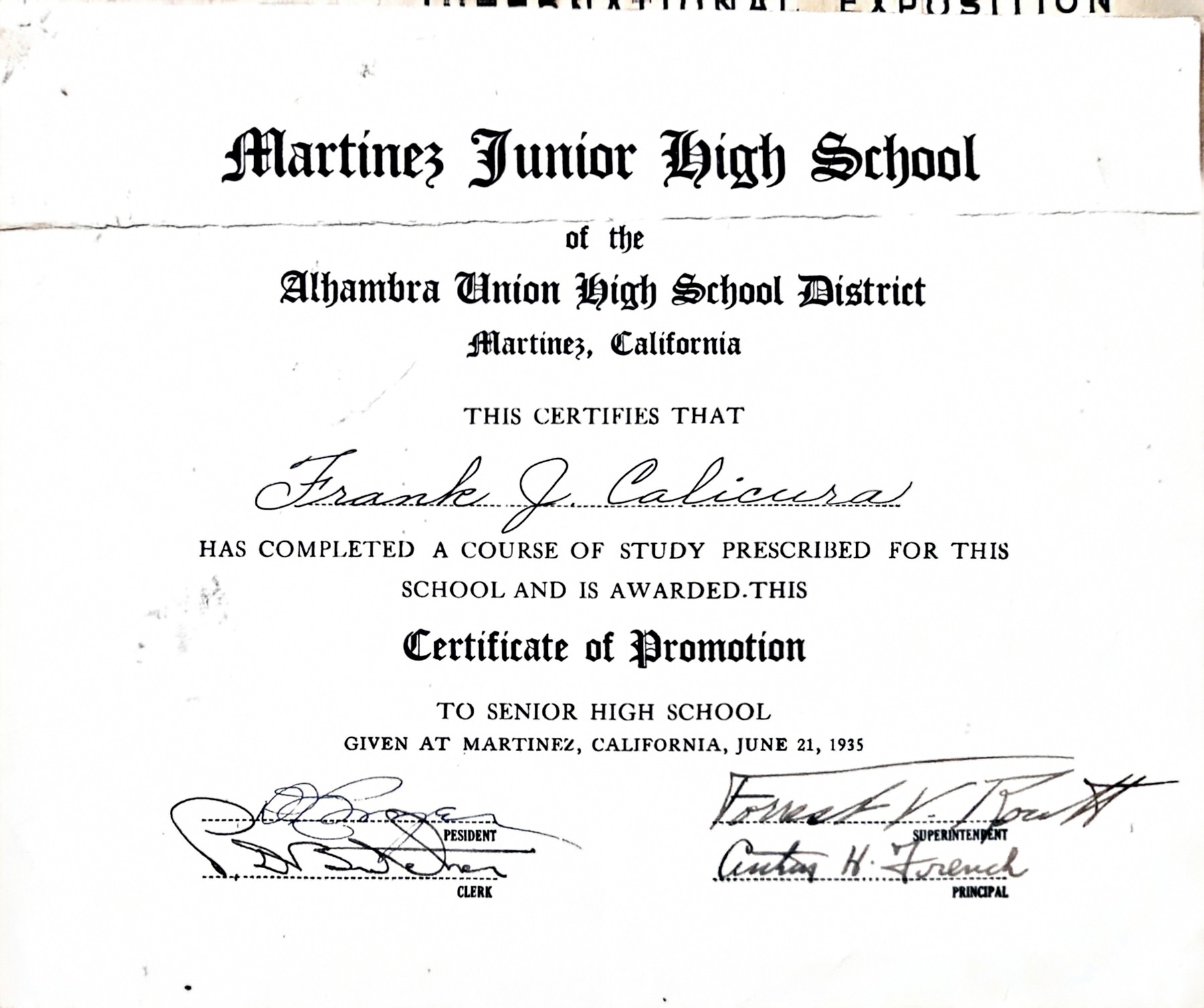

Butchering in 1938 was a trade, not a job. It carried an apprenticeship, a union card, and a body of knowledge that took years to get into the hands: where a joint will part on its own, what a bone tells you through a blade, how to hold a knife so the work lasts a full day. Men were paid for knowing it and they defended what they were paid.
That is what he did from 1938 until the Army finally sent for him: cutting meat on Main Street for his brother, in a town of seven thousand people that smelled of oil and salt water.
Cite this
The Spirit of Martinez. The Weight of Small Machines, Chapter 1. What a Family Kept.
https://www.spiritofmartinez.com/chapters/weight-of-small-machines
A note on sources